



El mercado de las tecnologías de la información (IT) en España ha experimentado una notable evolución en los últimos cinco años, impulsado por la creciente digitalización y la adopción de tecnologías emergentes. Este artículo examina los sectores tecnológicos que más están creciendo, las tecnologías más demandadas y aquellas que se perfilan como las más prometedoras para el futuro.
Sectores Tecnológicos en Crecimiento
1. Inteligencia Artificial (IA) y Machine Learning (ML):
La IA y el ML se han consolidado como pilares fundamentales en la transformación digital de las empresas españolas. Estos sectores no solo están creando nuevas oportunidades de negocio, sino que también están mejorando la eficiencia operativa y la toma de decisiones en tiempo real. Aplicaciones como chatbots, análisis predictivo y automatización de procesos son cada vez más comunes en empresas de diversos tamaños y sectores.
2. Ciberseguridad:
Con el aumento de los ciberataques y las crecientes amenazas a la seguridad de los datos, la demanda de soluciones de ciberseguridad ha aumentado significativamente. Las empresas están invirtiendo en tecnologías avanzadas para proteger sus activos digitales y garantizar la privacidad de la información de sus clientes.
3. Servicios en la Nube:
La adopción de servicios en la nube ha crecido exponencialmente, impulsada por la necesidad de flexibilidad, escalabilidad y reducción de costos. Las soluciones de infraestructura como servicio (IaaS), plataforma como servicio (PaaS) y software como servicio (SaaS) están siendo ampliamente adoptadas en diversos sectores.
Tecnologías Más Demandadas
Big Data y Analítica:
La capacidad de analizar grandes volúmenes de datos para obtener insights accionables es crucial para las empresas modernas. La demanda de profesionales capacitados en análisis de datos, científicos de datos y herramientas de big data ha crecido considerablemente.
Desarrollo de Software:
El desarrollo de aplicaciones móviles y web sigue siendo una de las áreas con mayor demanda. Lenguajes de programación como Python, Java, JavaScript y frameworks como React y Angular están entre los más solicitados.
Internet de las Cosas (IoT):
La interconexión de dispositivos a través de internet está transformando sectores como la industria, la agricultura, la salud y el hogar inteligente. La implementación de soluciones IoT está en auge, con una creciente demanda de ingenieros y desarrolladores especializados en esta tecnología.

España: Un Hub Tecnológico de Referencia en Europa
España se ha consolidado como uno de los hubs tecnológicos más importantes de Europa, impulsado en gran medida por la actividad en dos de sus ciudades más grandes: Madrid y Barcelona. Estas urbes no solo destacan por su vibrante ecosistema tecnológico, sino también por la cantidad de empresas que han decidido establecerse en ellas, convirtiéndolas en epicentros de innovación y desarrollo.
Madrid: Un Ecosistema en Expansión
Madrid se ha posicionado como un referente en el sector tecnológico gracias a la presencia de varios centros de innovación y emprendimiento. Entre los más destacados se encuentran Campus Madrid, Impact Hub, Silicon Alley y The Cube. Estos espacios no solo facilitan el crecimiento de startups y empresas tecnológicas, sino que también fomentan la colaboración y el intercambio de ideas, fortaleciendo así el tejido empresarial de la ciudad.
Barcelona: El Distrito Tecnológico por Excelencia
Por su parte, Barcelona no se queda atrás y brilla con su propio distrito tecnológico, conocido como 22@. Este área, dedicada a la innovación y el desarrollo empresarial, alberga iniciativas como Tech Barcelona, Disseny Hub y un Impact Hub, que funcionan como motores de crecimiento para la industria tecnológica. La ciudad se ha convertido en un punto de referencia para empresas y emprendedores que buscan un entorno dinámico y creativo para desarrollar sus proyectos.
El Auge de Nuevas Ciudades Tecnológicas
Además de Madrid y Barcelona, otras ciudades españolas están emergiendo como importantes núcleos tecnológicos. Málaga, Valencia y diversas localidades en Galicia están experimentando un notable crecimiento en este sector. Asimismo, Bilbao y Sevilla se están posicionando como destinos atractivos para empresas tecnológicas, gracias a sus esfuerzos por fomentar la innovación y la inversión en tecnología.
En conjunto, estas ciudades contribuyen a que España se mantenga a la vanguardia tecnológica en Europa, ofreciendo un entorno propicio para el desarrollo empresarial y la innovación continua.
Algunas conclusiones
En los últimos cinco años, el mercado IT español ha experimentado una transformación notable. La digitalización ha pasado de ser una opción a una necesidad imperativa para la supervivencia empresarial. La pandemia de COVID-19 aceleró la adopción de tecnologías digitales, con un aumento significativo del teletrabajo y las soluciones de colaboración en línea.
Además, el apoyo del gobierno y la disponibilidad de fondos europeos para la digitalización y la innovación tecnológica han jugado un papel crucial en el crecimiento del sector IT en España. Programas como el Plan España Digital 2025 buscan impulsar la conectividad, la ciberseguridad y el desarrollo de competencias digitales.
Las empresas tecnológicas españolas también han visto un aumento en la inversión y la financiación, con un creciente número de startups emergentes que están atrayendo la atención internacional. Esto ha contribuido a la creación de un ecosistema vibrante y dinámico, donde la innovación es una constante.
En conclusión, el mercado IT en España está en plena expansión, con sectores como la inteligencia artificial, la ciberseguridad y la nube liderando el crecimiento. Las tecnologías emergentes como el blockchain, la realidad aumentada y la computación cuántica prometen transformar aún más el panorama en los próximos años. La evolución de los últimos cinco años demuestra un compromiso claro hacia la digitalización y la innovación, posicionando a España como un actor clave en el ámbito tecnológico global.
Si te interesa saber más sobre esto, hacer algún apunte sobre el tema, o si te interesa trabajar con nosotros, no dudes en contactar a los autores de este artículo:
Alejandro Pino (Team Lead Recruiter – alejandro.pino@e-frontiers.ie)
Ana Martín (Technical Recruiter – ana.martin.romero@e-frontiers.ie)

You’ve secured a big job interview: what’s next?
Nowadays, securing a position in the IT industry requires more than just technical skills. It demands a comprehensive approach to preparing for job interviews that showcases your expertise, personality, and cultural fit.
Whether you’re a seasoned professional or a fresh graduate entering the workforce, mastering the job interview process is essential for landing your dream role in Ireland’s thriving IT sector. Interview preparation is key.
It is a huge advantage to have the help of a recruiter from E-Frontiers throughout the hiring process. Not only can we help with your CV and give you visibility with different companies, but we can also support you throughout the hiring process, providing coaching for interview preparation, giving you a heads up on information about the type of interviews planned, and vitally, following up with the Hiring Manager on your behalf.
So, how do you prepare for an IT job interview? The following are points to consider in your interview preparation:
Be Interested
This may seem obvious, but it is crucial to be pleasant and to look, sound, and act interested in the position you are applying for. If you give a vibe that you would rather be somewhere else, then you can probably assume you won’t be getting a call back. It can be quite a challenge for interviewers when they encounter disinterested candidates, so don’t set yourself up for failure before you’ve even begun.
Research the Company and Role
Before stepping into the interview room/virtual room, take the time to research the company thoroughly. Understand its mission, values, products, and services. Familiarise yourself with their recent news, industry trends, and the company’s position within the market. And don’t just limit this research to a quick Google search, be more thorough.
- Look at their latest annual report, check out their latest advertising, and chat to people you may know within the industry about the company -this will give you a feel for what the company is about and how they are perceived within your industry.
- Additionally, delve into the specifics of the role you’re applying for, including specific job responsibilities, the required skills, and qualifications. This knowledge will enable you to tailor your responses during the interview and demonstrate your genuine interest in the company and the position.
- Try to find out in advance who is on the job interview panel so that you may be able to connect with them on a personal level. Check their LinkedIn profiles for mutual connections, and common experiences through education, location, or sport.
Demonstrate your Technical Proficiency
In the IT industry, technical expertise is paramount. Ensure that your skills are up-to-date and aligned with the job requirements.
Job Spec:
Review core concepts, programming languages, software tools, and methodologies and mention certifications, courses, and training you have that are relevant to the role.
Is upskilling necessary?
Consider refreshing your knowledge through online courses, tutorials, or hands-on projects to make your experience more relevant.
List Your Achievements:
Before the job interview, make a list of your key tech projects and accomplishments. For each item on your list, write down the specific role you played, the IT skills you used, the challenges you faced, and the outcomes.
Practical examples:
How have you applied your technical skills to solve problems or improve processes? This could involve software you developed, systems you implemented, or complex data you analysed.
Do you have a Portfolio?
Do you have a github account or portfolio with your personal projects? Make sure they have access to that.
Technical proficiency coupled with practical examples will instill confidence in your abilities and set you apart from other candidates.
Display Your Soft Skills
While technical competence is crucial, don’t overlook the significance of soft skills in the IT sector.
Effective communication, problem-solving, teamwork, agility in project management and the ability to work effectively in remote teams are highly valued attributes in today’s workplace. Be prepared to share examples of how you’ve effectively handled challenges, resolved conflicts, or contributed positively to team dynamics in previous roles.
Showing strong interpersonal skills will demonstrate your ability to thrive in diverse work environments and foster positive relationships with colleagues and clients.
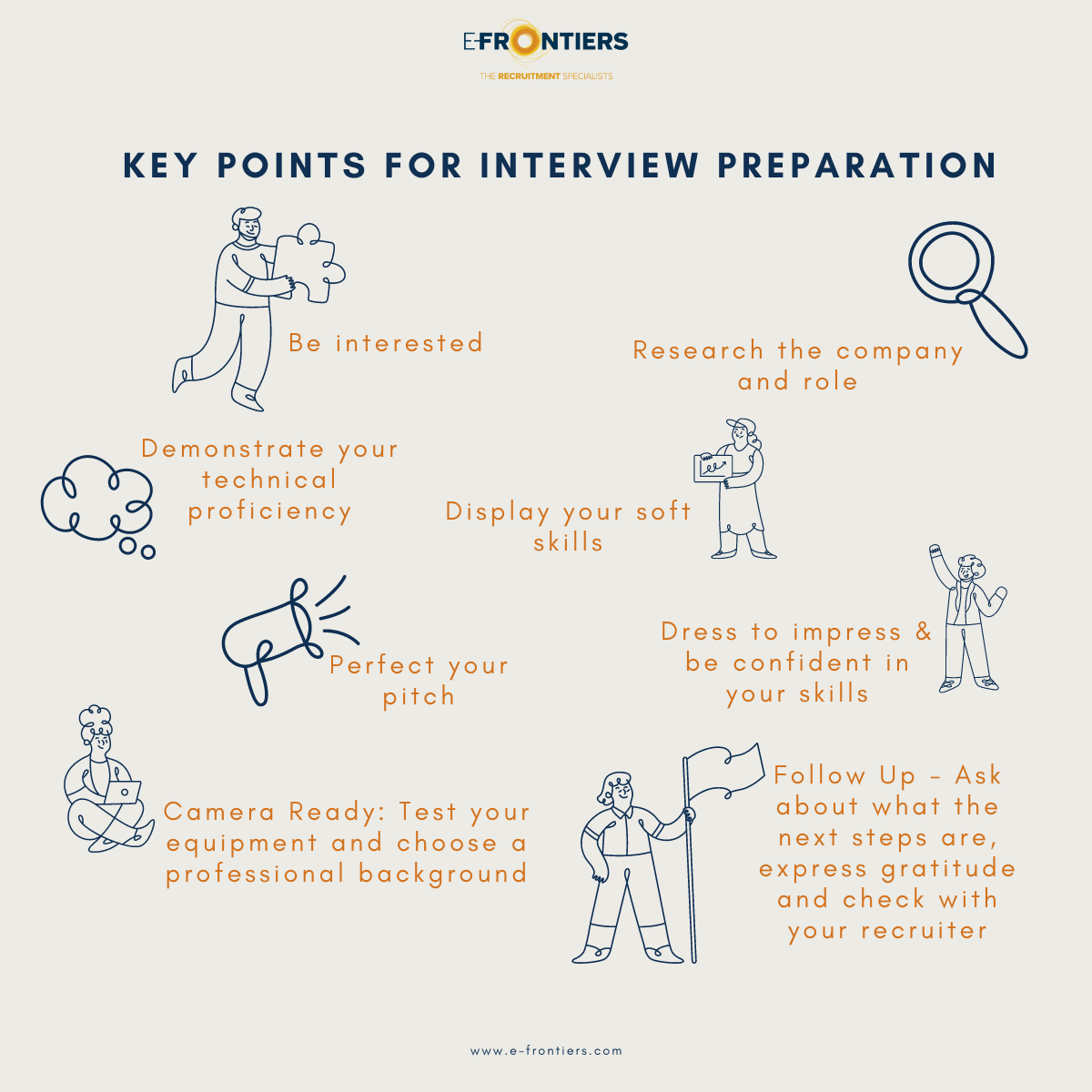
Perfect your Pitch
Use the STAR Method:
Structure your responses using the Situation, Task, Action, Result (STAR) format. This method helps organise your thoughts and present your experiences clearly, concisely, and engagingly to the interview panel.
Mock Interview:
Practice articulating your ideas confidently and clearly. Practice describing your strengths, experiences, and STAR examples. Be prepared with specific examples that demonstrate your problem-solving abilities, leadership potential, and ability to be agile and quickly adapt to change. Practice your responses out loud, preferably with a friend or mentor who can provide feedback. This will help you refine your delivery and ensure that your examples are communicated effectively.
Prepare Thoughtful Responses:
Anticipate the common interview questions and formulate responses that showcase your qualifications and suitability for the role. And make sure to link your skills back to the job description.
Skills Alignment:
Tailor your responses to highlight how your skills and accomplishments align with the company’s objectives and how you could contribute to its success.
– Ask Questions:
Finally, prepare a couple of questions to ask the interviewer or hiring panel that demonstrate your interest in the role, the company culture, and opportunities for your professional growth within the company.
Dress and Act Professionally
Dress to impress! Choose attire that is appropriate for the company culture and industry standards, this can vary hugely by industry. Your recruiter can give you a hint on the dress code. The same rules apply if you are doing a video interview.
Small but Serious: Some very important considerations are things like being punctual, having a firm handshake or a calm smile if the job interview is online, maintaining eye contact, listening attentively, and demonstrating a keen interest in the opportunity and company are KEY. This advice is especially important for video interviews. Aim to look at the camera when speaking, not the screen. This creates the illusion of direct eye contact with the interviewer, making the conversation feel more personal and engaging.
Perception: Be confident in your abilities while remaining humble and approachable. Pay attention to nonverbal cues such as posture, gestures, and facial expressions, as they can influence the interviewer’s perception of you.
Camera Ready: Mastering the Art of Video Interviews
Video interviews have become a staple in the recruitment process, especially for IT jobs. Here are some specific tips to help you excel in a virtual interview –
Test Your Equipment: It’s most important to do a run-through to ensure everything is working. As a tech professional, it’s not a good look if you cannot get your camera or sound to work. Ensure your camera, microphone, and speakers/headset are all working properly. Check your internet connection for stability and consider using a wired connection to avoid any potential disruptions.
Choose a Professional Background: Opt for a neutral background or a tidy room. Avoid busy or distracting backgrounds that can divert attention away from your conversation.
Lighting: Position yourself so that your face is well-lit, ideally with natural light facing you or a lamp that illuminates your face without creating shadows.
Familiarise Yourself with the Platform: Whether it’s Zoom, Microsoft Teams, Skype, or another platform, understand how it works. Know how to mute/unmute, turn the video on/off, and share your screen, as you might need to demonstrate something or share relevant documents during the job interview.
Manage Interruptions: If you experience an interruption (e.g., a noise, a technical issue), apologise briefly, address it if possible, and continue with your point. This shows your professionalism and adaptability.

As a recruitment agency with offices in multiple countries, we have a great advantage in being able to watch and compare recruitment trends from region to region. My role is to help grow E-Frontiers in the UK, and having access to this information is incredibly helpful. It allows us to spot new opportunities and find the best ways to support our clients as we continue to expand our operations in the UK.
E-Frontiers UK – Unlocking Opportunities Across Borders
At E-Frontiers we work with our clients across most skillsets and all industries by providing recruitment services for Permanent and Contract roles within the UK.
As an Irish headquartered company, we have an extensive reach on both sides of the Irish Sea. This is important to our clients for several reasons:
Talent Relocation:
We have access to talent relocating between the 2 countries. For certain skills and talent (Funds, FP&A as examples) this can provide access to a broader talent pool for the more challenging skillsets. Additionally, we have USA and Spanish offices to further broaden our reach for clients.
Legislation:
Our understanding of the requirements around legislation for both countries is excellent – built up by 10 years of experience operating in both the UK and Ireland. For example, this applies to contract support with IR35 and the required considerations.
Executive Search:
UK: We have supported several Irish companies in making their first key UK hire. As an Enterprise Ireland company ourselves who have gone on this journey, we are uniquely aware of the importance of this hire for companies. An example of such a client that we have supported with their UK growth is ClubForce (Sales Director UK).
Ireland: With vast experience in the market and a broad and deep market reach we can help clients build up management and leadership teams to support growth. We understand the importance of these hires and provide solutions that will ensure success for clients.
International Trends: Operating in several countries allows us to effectively observe and leverage trends. This global perspective helps us anticipate changes in one market based on trends in another, offering a broader, more comprehensive strategy for our clients.
UK Market Outlook
At present, the UK market is not showing many signs of growth. A recent report by S&P along with KPMG recently shows that the contract market has experienced its sharpest contraction since the summer of 2020, somewhat alarming from my perspective, given what happened then. While this is worrying by its nature, we have noticed some encouraging trends in Q2 so far.
Permanent Recruitment Trends
We have noticed a positive shift with increases in sales role requirements over the past two months. This is encouraging as it shows us companies are starting to think about growth again, instead of struggling to survive the recent tough times. The demand spans various positions, including Sales Development Representatives, Senior Business Development Managers, Account Managers, and Country Managers across a range of industries and companies.
At E-Frontiers, we have a proven track record of successfully assisting companies as they establish their presence in the UK. Securing that crucial first sales hire is often a key initial step, and we are experts at facilitating this process and work closely with companies to support them and ensure that this key hire is successful. These roles have traditionally stemmed from Irish companies expanding into the UK (given our Irish HQ). This has slowed over the last 18 months, but encouragingly, we are seeing companies starting to look for this type of hire again in the UK.
Contract Recruitment Trends
Although the UK contracting market has also slowed significantly over the last year and a half, recent positive developments suggest a resurgence.
A very encouraging trend we have noticed in this quarter is Professional Services firms are beginning to release more contract roles to us. This resurgence is significant as it indicates a return to post-pandemic activity levels within recruitment. This is hugely positive for us and for the wider market. Some of these clients have not had the requirements over the last 18 months due to a high percentage of staff on their “bench”. Now that we are starting to see these types of requirements come through, we can start to look optimistically ahead to Q3.
Market Outlook for Q2 & Q3
As a recruitment agency we love it when the wider talent market is tight resulting in a candidate-led market. Currently, this market can be described as more of a buyers’ choice market. However, the signs are encouraging for us. Coming out of covid we saw requirement numbers at their highest in decades, followed by a reduction over the last 18 months. In Q2 and especially on the contract side, we are now seeing signs of recovery with demand trending back to what it was in 2022. Companies are building out their sales teams, and professional services firms are resuming hiring. This, coupled with the apparent end to widespread layoffs, signals a positive trend in the job market.
In Summary
At E-Frontiers in the UK, we serve a broad spectrum of industry needs. Our services include recruiting for key management and leadership roles, and filling both contract and permanent positions. Our commitment extends beyond mere staffing; we partner with companies to strategically build their management and leadership teams, supporting your business’s growth and expansion in the UK.
Our extensive experience and strong market presence equip us to offer customised recruitment solutions tailored specifically to your needs. Whether you’re building a dynamic sales team or filling specialised roles, E-Frontiers is here to facilitate you on every step of your journey.
Article Author: Kenneth O’Connor is the Head of Contract Recruitment (UK & Ireland) at E-Frontiers. Kenny is a very experienced IT recruitment specialist with over 10 years of experience in both recruitment and tech sales. Kenny currently leads the E-Frontiers Contracting division while also managing E-Frontiers UK, helping our clients secure the talent required to drive their growth plans. Kenny’s specialist areas of expertise cover all aspects of contract recruitment across the full IT lifecycle, Finance, Compliance, and multiple other areas. He holds a degree in Sport and Exercise Science from the University of Limerick and is the Vice-Chair of the London Irish Business Society.
Feel free to get in touch with our commercial team to discuss your recruitment needs:
UK: Kenneth O’ Connor : kenneth.oconnor@e-frontiers.com (m: 0044 740 365 1213)
IRE: Nigel Bolger : nigel.bolger@e-frontiers.ie (m: 00353 86 3888147)
En este artículo queremos ofrecer una introducción al fascinante mundo del cloud computing, desde sus inicios hasta su relevancia actual. Se destacan las ventajas empresariales, las principales opciones de servicios en la nube y las oportunidades laborales en el sector, con un enfoque particular en España. Es una lectura para comprender este campo en constante evolución y su impacto en la tecnología y el empleo.
Introducción al Cloud Computing
Ya desde finales de los años 60 el informático John McCarthy propuso la idea de que “la computación podría ser organizada de manera pública”, asentando las bases, sin saberlo de la computación en la nube que hoy conocemos.
No fue hasta finales de los años 90 que la empresa Salesforce dio los primeros pistoletazos a la nube actual, siendo Amazon Web Services en 2002 quien elaboró una serie de servicios basados en la nube dando lugar a EC2 y arrancando de esta manera la carrera de la computación en la nube que conocemos hoy en día.
Pero, ¿qué ha supuesto esto en el paradigma de desarrollo que conocemos en la actualidad? Desde entonces los servicios y tecnologías en la nube han ido incrementando y mejorando exponencialmente, dando lugar a una serie de beneficios a las empresas que se han adaptado a estos entornos.
Entre sus múltiples ventajas, nos gustaría destacar:
– Reducción de costes: un punto primordial en cualquier empresa. Los servicios en la nube no requieren de inversión en infraestructuras físicas, por lo que permite una reducción importante de gastos para cualquier entidad.
– Acceso remoto: uno de los puntos clave. Con una simple conexión a internet cualquier persona es capaz de acceder a los servicios en la nube facilitando de esta manera el trabajo remoto y la rapidez.
– Seguridad: aspecto importante para grandes empresas con un volumen importante de datos sensibles. Los proveedores de servicios Cloud cuentan por lo general con las medidas de ciberseguridad más modernas del mercado, superando con creces cualquier medida que pudiera tomar cualquier empresa de menor tamaño con recursos limitados.
¿De qué puedo trabajar en el sector Cloud?
El mundo del Cloud Computing ha abierto puertas a nuevos roles con profesiones que hace años ni se pensaban. Entre ellas podemos encontrar:
– Cloud Architect: encargado del diseño de la arquitectura de los sistemas y aplicaciones en la nube.
– Administrador Cloud: responsable de la administración, supervisión y configuración de todos los recursos en la nube.
– Desarrollador de aplicaciones en entornos Cloud: un paso más en el desarrollo de software donde los desarrolladores están empezando a trabajar en entornos en la nube para el despliegue de aplicaciones.
– Cloud Security Engineer: persona encarga de garantizar la seguridad de los datos y los sistemas, monitoreando e identificando posibles amenazas.
Puedes echar un vistazo a los roles cloud que tenemos actualmente abiertos aquí
¿Qué opciones tengo como empresa?
En el mercado actual existen numerosas empresas que ofrecen servicios Cloud a terceros, destacando actualmente estas 4:
– Amazon Web Services: pioneros en el mercado, con una enorme presencia global, ofrecen una amplia gama de servicios a sus clientes y una actualización constante de los mismos.
– Microsoft Azure: respaldados por el gigante de Microsoft, en 2010 nació Microsoft Azure, dando un soporte descomunal en computación en la nube especialmente beneficioso para aquellas organizaciones que ya utilizaban productos y servicios Microsoft.
– Google Cloud Platform: Google también se quiso unir a la marea del Cloud Computing sacando su propia versión. Desde entonces han ido creciendo de manera gigante convirtiéndose en uno de los principales motores Cloud del mercado.
– Alibaba Cloud: Principal motor Cloud dentro del mercado asiático. Desde los últimos años se han estado abriendo poco a poco un hueco dentro del mercado más occidental.
¿Cómo son las oportunidades del sector Cloud en España?
Actualmente, podemos observar una creciente demanda de estos perfiles en el mercado, tanto a nivel internacional como nacional. Solo en España, hay más de 200 empresas en búsqueda activa de talento con estas habilidades y conocimientos y todo apunta a que la demanda de estos perfiles crezca en los próximos años.
También vemos como la oferta de estudios superiores de especialización (Posgrado y Master) en Cloud Computing se amplía haciendo notable la necesidad de actualización de profesionales IT hacia esta área.
Tanto si eres una empresa que necesita perfiles Cloud como si eres profesional del sector en búsqueda de un cambio, no dudes en contactarnos. Alfonso Moreiras (Senior Technical Recruiter) está especializado en entender estos requerimientos de este tipo de posiciones y encontrar perfiles que más se adapten a las necesidades de nuestros clientes.

Navigating Talent Scarcity
In today’s competitive landscape, securing top talent remains a critical objective for organisations across industries. As we navigate the ongoing challenges posed by talent scarcity, it becomes increasingly evident that innovative employee job benefits are key weapons in the battle for recruitment and retention.
Reflecting on recent global events, such as the Russia-Ukraine conflict, we observe how geopolitical dynamics can significantly impact talent migration patterns. Reports indicate a notable exodus of IT professionals from Russia following the outbreak in 2022, prompting governmental responses aimed at incentivising their return.
Similarly, nations like the United States have adjusted visa regulations to attract skilled professionals, underscoring the importance of remaining adaptable to evolving circumstances.
What do employees want when considering a move?
When contemplating a career change, employees cited the top five job benefits that prompt action as (1) Basic Salary (2) Career Progression (3) Work-life Balance / Well-being (4) Fully remote work, and (5) company culture.
As younger and more diverse candidates enter the employment market, there is a notable shift in priorities, and they bring with them a different focus demanding more social responsibility from employers. As a result, we are seeing companies adapt and introduce various programs including:
- Diversity & Inclusion initiatives.
- Volunteer opportunities for charitable causes, alongside traditional holidays.
- Emphasis on Environmental, Social & Corporate Governance (ESG)
- Policies allowing employees to bring their children or indeed their pets to work.
- Opportunities to work from abroad during summer months, allowing international candidates to travel home to visit family and explore other parts of the world. There are also secondment opportunities to other international offices.
- Our colleagues in our US office report that Free Friday afternoons are becoming more popular, while another client offers a 4-day work week during July, August, and December without any salary reduction when projects and workloads can be slightly less demanding.
- Following a similar trend, our colleagues from Spain have reported the popularity of Free Friday afternoons, and shorter working days during summer in July and August, known as “jornada intensiva”.
- And of course, a favourite for businesses in Ireland is the benefit of rewarding their staff up to €1000 each, free of tax, USC or PRSI.
The need for innovation
These developments serve as poignant reminders of the need for agility and innovation in talent management strategies. As your partners in recruitment, at E-Frontiers, we’re committed to helping you navigate this ever-changing landscape by offering tailored solutions and insights that align with your organisational objectives.
Deep dive into our survey insights
Our survey responses were collected from more than 1400 participants from the IT Sector, primarily in Ireland. Data reflects insights gathered in January 2024.
Financial Benefits
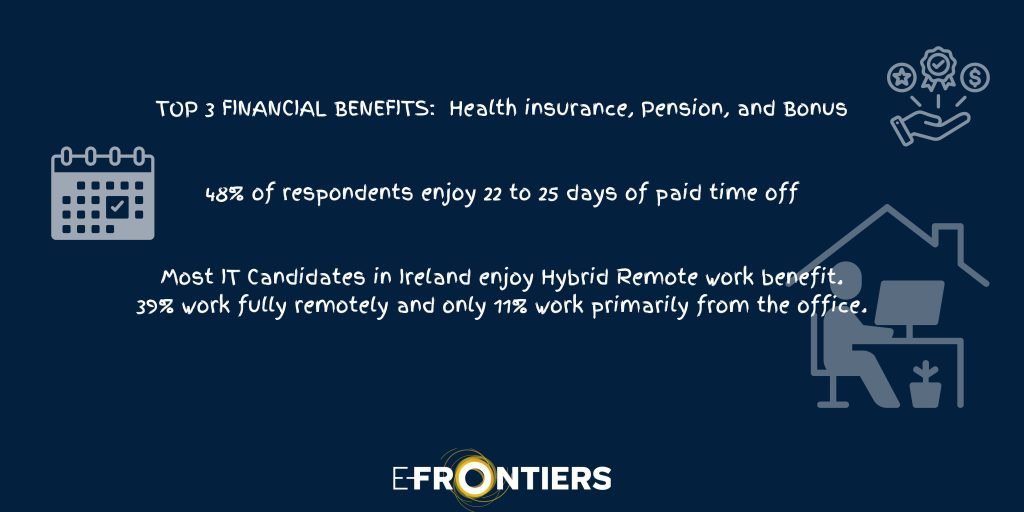
We asked the question: What financial benefits are being offered to you? Not surprisingly, Health insurance, Pension, and Bonus are the top 3 financial job benefits that are currently offered in the Irish IT market (Permanent and Fixed Term)
Annual Leave
Our survey data reveals that the majority of candidates typically enjoy 22 to 25 days of annual leave, constituting 48% of respondents. Conversely, merely 5% of candidates are privileged to receive 30 days or more of paid time off. On the lower end of the spectrum, 18% of surveyed candidates reported having fewer than 22 days of annual leave.
Remote Work VS Hybrid Work VS Onsite
The trend here is clear, as the majority of candidates continue to work remotely for at least some days each week. According to our data, 39% of respondents work fully remotely, while only 11% work primarily from the office.
Annual Leave by type of contract
Fixed Term Employees typically have one day less of annual leave, with 23 days compared to Permanent Employees’ average of 24 days.
Remote Work by type of contract
Contractors comprise the largest portion of fully remote workers, accounting for 44%, and are also the least frequent visitors to the office, at 10%. Data indicates that permanent employees predominantly work from home, with 38% fully remote, 33% working 3-4 days from home, and 20% working 1-2 days from home.
Adapting to Employee Needs: Prioritising Engaging Roles
So, while employers seek to hire the best talent, they must keep their finger on the pulse to keep up with the changing demands of employees and continue to innovate in this area.
Nevertheless, it’s essential not to overlook that an engaging role, offering challenges, ongoing learning opportunities, and personal fulfillment, should form the cornerstone of any job benefits program.
Conclusion
Overall, employers who prioritise these sought after benefits and adapt to evolving employee needs are more likely to attract and retain top talent in today’s competitive job market.
Employers must regularly assess and adjust their job benefits packages to remain competitive and meet the diverse needs of their workforce.
Contact us today and let’s explore how we can collaborate to address your talent needs effectively and drive sustainable growth in your workforce.
Article Author: Anca Antonica is a Principal Recruitment Consultant with E-Frontiers and brings exceptional value to both her candidates and clients by offering end-to-end services. Anca has a superb track record of hiring software engineers for a range of clients, from start-up companies to large multinationals across multiple industries. Anca offers great support to her candidates to enable them to succeed in their interviewing process for both contract and permanent IT jobs. She is superb at matching a candidate’s skills and needs to meet her client’s requirements. She focuses on IT jobs such as Java – Backend or Full stack, C# / .Net – Backend or Full Stack, C/C++/embedded, Middleware, and Microsoft Dynamics/Salesforce. Anca holds a degree in Social Work from the University of Bucharest.
Feel free to get in touch with our commercial team to discuss your recruitment needs:
IRE: Nigel Bolger : nigel.bolger@e-frontiers.ie (m: 00353 86 3888147)
UK: Kenneth O’ Connor : kenneth.oconnor@e-frontiers.com (m: 0044 740 365 1213)

Durante la última década hemos visto un crecimiento agigantado de empresas orientadas a servicios IT, tanto a nivel consultoría como empresas de desarrollo de producto propio. Esto ha supuesto un crecimiento en paralelo de la oferta de profesionales del sector, que no ha crecido de la mano con el número de profesionales especializados, por lo que la búsqueda de los mismos conlleva meses de trabajo para encontrar el candidato adecuado en un sector donde le llueven las ofertas. De esta manera, ha crecido a su vez las agencias de reclutamiento, que permiten agilizar y externalizar estos procesos a empresas que buscan talento constantemente. Pero, ¿en qué me puede beneficiar una empresa de estas características en mi día a día?
Ahorro del tiempo
Una agencia dedicará el 100% de su tiempo en la búsqueda del talento necesario para tu empresa, permitiendo que no inviertas tiempo en búsqueda y filtrado de candidatos en tu día a día y asó poder enfocarte por completo en tus verdaderas tareas.
Especialización
Las agencias de reclutamiento suelen estar especializadas en un sector o tipo de perfiles en concreto, teniendo en sus filas un banquillo de reclutadores que, desde el primer momento, conocen el perfil que se está buscando, las tecnologías en las que se tienen que centrar o, incluso, una red de contactos amplia en el sector que les permitirá presentarte al candidato ideal en poco tiempo.
Ahorro económico
Contando con un equipo de contratación externo te evitarás la contratación de otros servicios como portales de empleo, departamento interno de selección, tiempo, etc.
Acceso a una amplia red de candidatos
La mayor ocupación de las agencias de reclutamiento está orientada a la comunicación constante con candidatos en búsqueda activa de empleo o con interés en un cambio. Con ello, las agencias tienen siempre en su radar candidatos que puedan encajar con tus vacantes y que están abiertos a iniciar un proceso de selección, agilizando de esta manera la búsqueda inicial de posibles profesionales.
Asesoramiento constante
Colaborando con una agencia de reclutamiento tendrás a tu disposición profesionales en selección de personal que te darán apoyo constante en todas las fases, desde la toma de requerimientos, a la construcción de las descripciones de puestos, hasta la organización de entrevistas y negociación de la oferta, además de un apoyo posterior a la incorporación para asegurar que el candidato se ha integrado en tu empresa de manera correcta.

En conclusión, contar con un equipo de selección externo como el de e-Frontiers puede facilitar las cosas en tus procesos de selección, tanto por el ahorro económico y de tiempo, como por el apoyo que recibirás de un equipo profesional especializado, que agilizará tus procesos de manera que te permita enfocar tu tiempo en tus tareas reales.
E-Frontiers lleva 10 años operando en el mercado español, contando con un equipo de 5 reclutadores especializados en asesoramiento a clientes, búsqueda y selección de talento. Nuestra amplia red de contactos y recursos agilizan los procesos de selección para ofrecer un servicio eficiente a nuestros clientes.
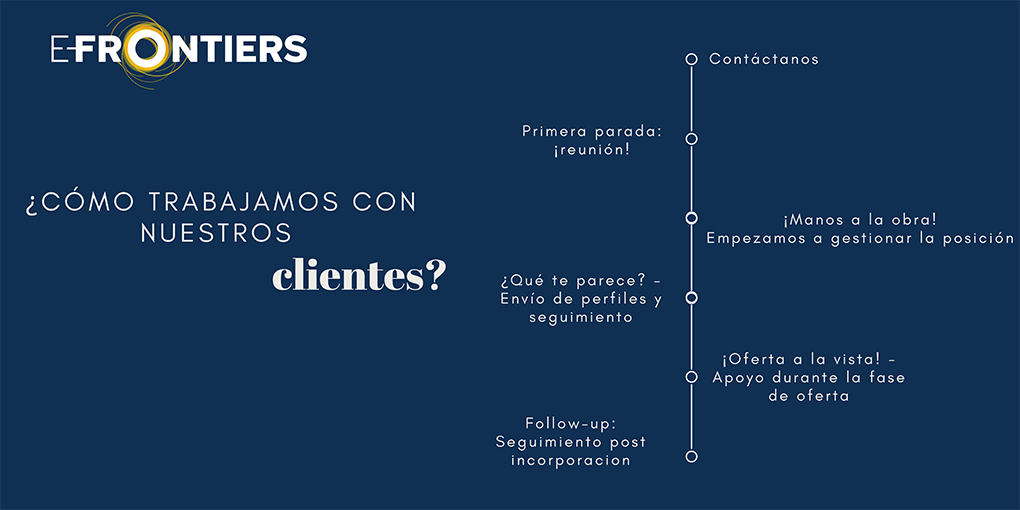
Necesito ayuda, ¿cómo es el proceso con vosotros?
Contáctanos – Alejandro Pino (Lead Recruiter – alejandro.pino@e-frontiers.ie) o Ana Martín (Technical Recruiter – ana.martin.romero@e-frontiers.ie)
Nos conocemos – Organizaremos contigo una llamada para saber más sobre tu empresa, los perfiles que necesitas y sobre vuestro proceso de selección. También te asesoraremos sobre el mercado, salarios, etc. Y te informaremos de nuestra manera de trabajar y que esperar si empezamos a colaborar.
¡Manos a la obra! – Uno de nuestros recruiters empezará a gestionar tu posición. La búsqueda activa por diferentes vías es esencial. También hará un filtrado por teléfono pudiendo recoger información extra y necesaria para que valores su perfil.
¿Qué te parece? Envío de perfiles y seguimiento – Una de nuestras señas de identidad es la calidad ante la cantidad. Si necesitas, podemos apoyaros en tareas más administrativas como gestión y cierre de entrevistas, envío de pruebas técnicas en vuestro nombre y recoger-ofrecer feedback.
¡Oferta a la vista! – Apoyo durante la fase de oferta. Si el candidato encaja con lo que estáis buscando y decidís ofertar, os ayudaremos durante este punto también.
Follow-up – Para nosotros no todo termina con la oferta e incorporación, ya que hacemos seguimiento post incorporación del candidato (de hecho, consideramos esta parte bastante importante). Estando en contacto con él o ella durante las primeras semanas para asegurar que todo va bien.
Si tienes alguna duda o te interesa saber más sobre esto, no dudes en contactarnos. Alejandro Pino (Lead Recruiter – alejandro.pino@e-frontiers.ie) o Ana Martín (Technical Recruiter – ana.martin.romero@e-frontiers.ie)

You have conquered the world as a top professional with vast skills and successes! Ironically, this can make top CV preparation for the next job a more difficult challenge! Preparing your executive resume can be daunting no matter how much experience you have in your chosen field. With that in mind, we wanted to share a few ideas on how experienced candidates can conquer that challenge and get their top CV right for the new opportunity!
Create a solid foundation for your top CV
When it comes to submitting your executive resume, one size simply doesn’t fit all, but it is important to spend some time putting together a core document that you can build your applications around. This may be time-consuming but will be worth it in the end and it is something you can enhance and enrich as you go through your career. Tailor your CV to each position that you are applying for, reflecting the language used and highlighting the experience that is directly relevant to the role. It doesn’t have to be two pages, but equally, don’t rely on a 5-page executive resume – the key bit is to make sure all the most important information goes on the front page.
Think ‘Professional Profile’
We are big fans of a “Professional Profile”, a short paragraph at the beginning that summarises you. It should briefly list years of experience and qualifications in a career summary. This allows the reader to get a feel for the applicant but should be interesting enough to encourage them to read your executive resume. We find this is very important for experienced candidates as while there may be less competition for some roles, the competitors are skilled and fierce with all having a fantastic experience.
Quality over Quantity!
When you have been in the workplace for over 20 years it can seem difficult and perhaps unfair of you to reduce a wealth of experience to a few pages. Remember though – an executive resume is just the carrot on the stick to get you that interview. You can expand further when you get past this first stage and a succulent top CV is key. It also shows your fine-tuned communication skills and your ability to strip back your entire career and pull the salient points to the front that matter to the client.
Think of the reader
If you are looking for permanent employment your two most recent roles are the most relevant. Briefly introduce the company you worked with, and your role by title followed by a bullet point description of what you do or did! The information should be easy to read with the right, consistent font, paragraph, and spacing. The reader is under time and attention pressure so help them spend more time on your executive resume! It should almost feel like the relevant information is jumping off the page rather than something that has to be combed through with a magnifying glass.
Do not hesitate to reach out to us to ask for help. Send us your CV, our recruiters will contact you if they find a job that suits you the best and supports you through the interview process.

Preparing your CV can be a daunting challenge no matter how much experience you have in your chosen field.
Once the decision is made to start looking at the market the prospect of putting together a CV can be enough to make you change your mind!
Before you begin
Before you even begin I always advise candidates to spend some time looking at different job specifications. This allows you to focus on the type of role you are looking for.
Taylor your CV to apply to different companies
When it comes to submitting your CV, one size doesn’t fit all but it’s important to spend some time putting together a core document. This may be time consuming initially but will be worth it in the end.
Tailor your CV to each position that you’re applying for, reflecting the language used and highlighting the experience that is directly relevant to the role.
How many pages?
It doesn’t have to be two pages but the most important information should all appear on the front page.
I’m a big fan of a “Professional Profile”, a short paragraph at the beginning that summarises the information below. It should briefly list years of experience, professional qualifications and industry experience as well as providing a few lines of a career summary. This allows the reader to get a feel for the applicant but should be interesting enough to encourage them to read on.
When you’ve been in the workplace for over 20 years it can seem hard to reduce a wealth of experience to a few pages. A CV is a door opener and should hit the right notes, these can then be expanded on in an interview.
Important details
If you’re looking for permanent employment your two most recent roles are the most relevant. Briefly introduce the company and then describe your role there by title followed by bullet points. The information should be easy to read, if the type is small and the document is densely written it’s unlikely that someone will battle through.
It should almost feel like the relevant information is jumping off the page rather than something that has to be combed through with a magnifying glass. Try to remember that it’s likely your CV will be one of many readers that day and you want it to be easy on the eye!
Earlier or more junior roles don’t need to be included in any great detail. The only exception I’d make to this point is to say that if the industry or work experience is directly relevant to the role you want, then include it.
The same goes for hobbies and interests. A brief mention is fine but if it’s not relevant to the role then it’s not so important that you were captain of the school’s debating team!
Questions – Answers
Use the CV to answer any questions that may arise on reading. If you have a gap in your career a few lines explaining it is better than hoping that the missing year won’t be noticed!
References
I don’t think that references should be included on a CV. Your referees can make the difference between whether or not you get a role. If they’ve received 10 calls to talk about how wonderful you are they may not be so patient when the important call comes.
Remember, you may be or may have been in a hiring position. Think about what you want to see from a CV. Taking the time to write an interesting and relevant document is actually a form of interview preparation! It focusses the mind and allows you to mentally prepare for questions that may arise when you’re face to face.
Do not hesitate to reach out to us. Send us your CV, our recruiters will contact you if they find a job that suits you the best and supports you through the interview process.
Good luck with the search!

At a face-to-face interview, interviewers can read interviewees’ personalities through their body language. You can take advantage of it to show your best to make you stand out among the talent pool. However, it is different from video interviews where they communicate through a screen.
1. Dress appropriately
You are free to set up a video interview at home but it doesn’t mean you should do it in your pyjamas or casual clothes. You just need to be in front of a camera in a clean and polite outfit. This is the first step to build up a confident and professional personal brand image.
2. Avoid being disturbed
You should find a quiet place with a tidy background behind you. Try to avoid places where you can’t control the background noise, ie coffee shops are not a good location to conduct an important interview. Assuming you are having the interview at home, tell everyone in the house and ask them to keep the noise to a minimum during the interview time. Turn off the irrelevant software or websites which may distract you during the interview. Turn off your phone, or put it on silent during the interview. All of the small details can show your respect to the interview and the interviewers’ time.
3. Prepare equipment well
Before every video interview, our recruiters always send out a checklist for you to prepare in advance. You should also check the connection, microphone, and camera to make sure it works well during the video call. A well-prepared call can make the interviewers more interested in learning about you than spending time waiting for you to fix your equipment. If you apply for a remote job, this is a way to persuade them that you are able to manage your work well technically. There are a lot of direct tools and apps being used now, so make sure you know which one will be used. Have you used it before? Do you need to download anything ahead of the interview?

4. Interact with interviewers
Eye contact is very crucial in all communication but through a video interview, sometimes it is hard to feel it. However, you can show that you are paying attention to the conversation by listening and asking more questions related to the conversation as well as the role you apply for. Feel free to present yourself as their future colleagues not only a stranger whom they only see on the screen. Also, even though you might be a bit nervous you should try to smile as much as is realistic in the interview.
5. Show the real you
Be transparent about yourself and your working experience. The interviewers are always expecting to hear the truth. You can list down the main points of your story and collect the proofs of your work in advance. You can show off your experience, passion, and your skills on-screen if it’s possible. This could be considered another advantage of a video interview as compared to a traditional interview.
6. The 30 minutes before the interview
Take some time before the interview to review the key points that you hope to get across. Lastly, take 5 or 10 minutes to quieten your mind from any outside distractions that are going on in your life so you can fully focus and be fully present in the interview.
E-Frontiers team with well-experienced recruiters are willing to help talent find their dream job and go through the challenging recruitment process. Don’t hesitate to reach out to us.
Contractors are in high demand right now. There are many reasons why people choose to be a contractor. This article will explore some of the main reasons why people choose to work as a contractor.
1. Flexibility
The first reason is that some contractors like the independence and flexibility of being a contractor. This can also suit employees that want to take some time out between their contracts. Some for travelling or those with families taking time off during summer months, making this a good option for full-time working parents.

2. Lucrative
With different types of contracts, contractors can decide whether to have their own company or to work under an umbrella company which gives them more control over their pay and benefits.
Using the Irish Euro tax calculator* will give you an approximation of your monthly take-home pay.
* The calculator forms information from a third party and should only be used as a guide. E-Frontiers are not responsible for the accuracy of the information within.
3. Exposure to a variety of industry sectors
Another reason why people choose to be contractors is that they get to work with different companies and industries instead of just one company or industry. Contractors get exposure to all kinds of industries which helps them build their skillset and provide more value for their clients in the long run.
E-Frontiers and Our Contractors
Along with the high demand for talented contractors of our clients in Ireland, the UK, and the US, we have an abundance of contract jobs that are often extended or we will help you find a new contract job quickly that matches your skills and expectation.
Our guide provides information on options available for working as a contractor, whether you prefer to work as your own limited company or under an umbrella company. Also included is information on our trusted financial partners who will guide you and take care of all your contracting needs.
If you want to learn more about contract opportunities, don’t hesitate to contact us.