


The fact that more women are being appointed to leadership positions in companies and increasing the female workforce representation is not an accidental trend. It’s part of a Global Acceleration plan adopted at the UN-sponsored Generation Equality Forum hosted in Paris, in 2021.
According to a study in 2021, 47% of the labour force in the USA were women. They are making slow but steady progress in creating a gender-balanced environment in the workplace. However, the numbers are much lower when one looks at female representation in US big tech companies, with women taking up fewer than 1 in 4 tech roles.

Recruitment specialists, who are an essential part of the hiring process for many companies, play a crucial role in supporting women in tech. At E-Frontiers, a recruitment agency sourcing candidates across Ireland, UK, USA and Spain, we strive to support the advancement of women in key positions, particularly leadership appointments. This support includes initiatives such as applying gender-neutral language in candidate information, emphasising capabilities and not just experience, and allowing time for passive candidates to consider.
Here are some of the strategies that we have developed and applied to support the advancement of women in tech.
- Appointing women to important positions
The E-Frontiers team is always looking for potential candidates for jobs, this very much includes the passive candidate. We encourage women applicants to grow out of their limits by challenging themselves at higher or new positions. They are booked for a call or meeting to discuss their background and skills and will receive professional advice from our recruitment specialists to enhance their career path. Our consultants truly become their allies in finding and connecting women in tech to exciting opportunities.
- Supporting women applicants through the hiring process
Our recruitment specialists will support the candidates by working with them on acknowledging their achievements, polishing their portfolio and practicing skills that will serve to represent themselves in the best way possible. Besides helping our candidates prepare the responses and necessary skills for interviews, our consultants also help women applicants emphasise and own their successes in tech and build confidence in order to highlight their strengths.
The visibility of women in the labour force in general or in a company is important not only for fairness, but also because it contributes to good decision-making, innovation, better organisational results, and more effectively run institutions.
- Being aware of the bias during the hiring process
When preparing panel members beforehand, and while debriefing on candidates’ performance afterward, we encourage interview panels to adopt a behavioural approach of a focus on capability, and not just experience. Our recruitment specialists focus on the link between the candidates’ strengths and the requirements of the role. This moves the focus to the candidates’capacity. We can also expand on a candidate’s strengths if they have been reluctant to highlight them in an interview.
Finally, we can explain some of the unintended biases that occur in the selection and thus help to focus the discussion on the key attributes of the job and away from the historical characteristics of past incumbents. We encourage conversations with clients to review internal policies and processes and foster a diverse and inclusive organisational culture.
We believe that recruitment agencies like E-Frontiers have an important part to play to create a more level playing field for women in tech by providing critical support and guidance throughout the hiring process.
Are you a woman looking for a job in tech?
Do you know a woman that needs to be supported to develop her career in tech?
Are you looking for a partner to represent your brand in the market and ensure a diversity of candidate options?
Don’t hesitate to contact our recruitment specialists for their support.
All the daily conversations I have with clients or with candidates always reflect and evaluate the Contracting market – How are you seeing it? Where is the opportunity? What skills are in demand? How are the rates?
Given my role and the industry we are in, we are always keen to hear our clients take on things as our demand will be driven by them. With all the talk of layoffs and the talk of an impending recession, it did feel like things would inevitably slow, which they did – on the permanent side of the recruitment world. Subsequently, we saw an increase in the flow of new contracting requirements coming in. This occurred from November through to the end of January and could be attributed to several factors such as year-end, budgets, and all the other usual reasons.
The expectation is that in times of uncertainty permanent headcount requirements can always be paused. This is true. Being the eternal optimist and working on the contracting side of the business, I am of the opinion uncertainty can be good for contracting. This has certainly been the case since November. A recent conversation with a senior figure in a large consulting firm has reinforced this viewpoint. Albeit some clients may choose the consultancy route over the contractor route.
The demand is remaining consistent across the PM/BA skillsets as well as the Software Engineering. Noticeable increases have been seen in the DevOps skillset in the last 6 months also – although this may not surprise many.
Additionally, a publication from Contractor UK echoes our own experience in the market for January, leaning toward cautious optimism.

Contracting Market: What we have seen in 2023 so far
Contractor renewals are extremely high with above 95% being renewed.
The number of requirements coming to us is maintaining.
Lead time has lengthened from interviews to offer – could be due to hesitancy in the market in general.
Candidates converting from permanent roles to go contracting have reduced (albeit not significantly).
Demand for 12-month contracts is at an all-time high.
Supply of 12-month contracts is not at an all-time high.
Rates are maintaining.
Now, why am I writing this article? I guess it is to try to convey a sense of optimism in the contracting market that is currently seeing lots of layoffs from Big Tech. While this is no doubt a very difficult transition period for those affected, I am speaking purely with my contract recruitment hat on. Outside of the fact that while there may be a slight softening at some stage, we are seeing signs of the contractor market maintaining for the foreseeable.
I am having more conversations with clients who are looking to explore or even just gather more information on the contractor market and process given some of the challenges around permanent headcount. My role is to advise and present the contractor route as a solution to our clients who still require projects to be delivered.
If this is you then do reach out, even if it is just to gain a better understanding of the area. We can provide a turnaround within 24 hours depending on the complexity of the request. Enough of the sell for now.
Demand is still there if you are thinking of becoming a contractor and leaving the security of a permanent job. Just do your research and speak to the agencies (or rather our recruitment company) to get a feel for what’s on offer.
Head of Contracting
To get hired fast, besides checking your rich experience and knowledge of the industry in your CV, employers also expect their software engineers to have some basic soft skills to integrate into their new team and work environment. Let’s discuss the 5 crucial soft skills for IT professionals.

1. Communication
This is the most basic soft skill that is required not only for software engineers but also in many other roles. Communication skill includes listening, understanding and sharing your opinions and perspectives. It often requires both verbal and written communication. This soft skill will contribute to effective teamwork.
2. Problem-solving
No matter how carefully we plan a project, there are always unexpected situations. Therefore, employers prefer software engineers who have the problem-solving skills to propose solutions for complex issues instead of avoiding them. They need to understand the project’s goals, processes, and technologies so that they can brainstorm solutions.
3. Adaptability
Technologies are constantly updated and developed, so adaptability becomes one of the vital soft skills of IT engineers. They need to adapt quickly and stay up to date with not only technology but also society. It will help them plan their projects, complete their tasks and solve problems faster.
4. Time management
Most of the tasks of software engineers require to commit to the schedule of a team or a whole project. Therefore, organising their daily tasks and priority jobs is crucial. Managing their time properly allows them to optimise their time for daily tasks, group work, or urgent tasks. This soft skill helps to reduce their stress and limit extended work while still being productive.
5. Teamwork
Most important projects are done by a group of developers. Therefore, teamwork is always the soft skill that determines whether you are hired or not. Teamwork includes listening skills, focusing on common goals, personal responsibility, and supporting other members. Exchanging experience and knowledge with other software engineers not only helps to achieve common success but also supports oneself to promote their strengths and self-development.
The soft skills above are only five of many other crucial skills that are expected in a developer. If you are looking for an IT job in Ireland, UK, USA or Spain, do not hesitate to reach out to us. Send us your CV, our recruiters will contact you if they find a job that suits you the best and support you through the interview process.
If you are lacking in one of those soft skills, it’s time to get out of your comfort zone and upgrade yourself.
Knowing when it’s the right time to change jobs is important. You want to make sure that you are not jumping into a new job too soon or too late. By knowing when the right time is, you can make the most of changing jobs and get the most out of your next role.
When you have one of the signs below, it may be time to consider a transition.
1. Lack of motivation to work
Does thinking of going to work tomorrow scare you? Do you always feel like your working day is too long? Do you just stare at the clock and expect time to fly faster?
It’s hard to find someone who always loves their job. Everyone has some good days and bad days. However, when your job no longer brings you joy and your negative feelings are becoming more common, it’s time for you to think about changing jobs.

2. Feel burned out
When you have noticed some negative changes in your health, you may need to review and measure your stress level. Does the stress from work impact not only your physical exhaustion but also your emotions and quality of sleep? When your health is suffering, you should think of looking for a job change.
3. No career progression in a long time
Everyone should have their own career goal. If you stay still for too long, no matter how comfortable you feel at work or how much you like your company, you run the risk of losing out on opportunities. Everyone needs an objective assessment of their situation occasionally. Maybe, the job is no longer suitable for you, or you have outgrown your current position. Please keep this in mind: new challenges and higher requirements are opportunities for your self-development.
4. Toxic working environment
Are the comments from your boss and your colleagues constructive to your work? Or do they seem to be more criticisms and personal attacks? Suggestions can help you improve your productivity at work, but negative outside factors will have a significant impact on your performance at work. In the long run, it will affect your career development and mental health. Maybe, changing jobs with a better working environment is a better choice for you.
5. Upskill yourself and ready for more challenge
When you set up a clear plan for your career, you should also do in-depth research about the industries and companies you want to work for. Before changing jobs, it’s time to increase your competencies, upskill, and retrain thus enabling you to be better qualified and focused to meet the bigger and more rewarding challenges ahead. This is a smart preparation before a recession in the economy or a downturn in your industry.
Our recruitment experts reveal that Spring is always a good time to start your job search when many of our clients are hiring and there are high volumes of vacancies for both permanent and contract jobs in IT, Business, Sales, Marketing, Accounting and Finance, and Construction. We have more than 300 open roles across Ireland, UK, US and Spain. Don’t hesitate to reach out to us to discuss in more depth the right timing for you to consider a change.
Every UX designer needs a portfolio.
Don’t underestimate the value of having a strong UX design portfolio in securing that first-round interview. It’s so important to create an impressive portfolio that showcases you. Employers want to see your talent when interviewing for creative roles. By having a comprehensive portfolio, you can prove your worth. Your creativity and uniqueness, your design ability and talent, and your personality are all vital attributes that you want to show to prospective employers. Create a portfolio that stands out from the crowd and that is easy to navigate and review.
Here are some top tips that you can follow to make your portfolio more effective and attract more attention.

1. Focus on important projects only
Include your best projects in your portfolio. Three to five projects presented in detail are best. Remember to include projects that are relevant to your potential employer’s field and industry.
2. Describe your process
Don’t just add your final images – explain your design process and your journey. Make your portfolio become your storybook. Focus on the HOW and WHY – how you design things and why you design them. Detail the problems you encountered and how you solved them. Show where you have added value because of your design.
3. Case Study
Take at least one project and expand on it as a case study. Do an end-to-end walkthrough:
– What was the brief?
– What was your role in the project?
– Who were the target users?
– What were the pain points?
– Tell your design process – user research, personas, user flows, journey maps
– Challenges and resolutions- highlight your problem-solving ability
– Results and impact on the business
– Learnings from the project
4. Easy navigation
Efficient navigation makes your portfolio easy to review. Challenging navigation will annoy the reviewer no matter how impressive your work is. Make it as easy as possible for the reviewer to look at your portfolio and immediately see all sections and details without having to go into the details of each section.
If you want to find out more about the available UX Design jobs, please get in touch.
You can contact our specialist recruiter Emma Bradley by InMail or at emma.bradley@e-frontiers.ie.
5. Updated and Online
It is so important to keep your portfolio up to date with your most recent work and projects. This shows your progression as a designer. Having your portfolio online helps you to build a vital online presence. An online portfolio looks more professional and provides easier navigation of the content.
And of course, don’t forget to include a Home/Landing page, an About me page, and a Contact page.
Contractors are in high demand right now. There are many reasons why people choose to be a contractor. This article will explore some of the main reasons why people choose to work as a contractor.
1. Flexibility
The first reason is that some contractors like the independence and flexibility of being a contractor. This can also suit employees that want to take some time out between their contracts. Some for travelling or those with families taking time off during summer months, making this a good option for full-time working parents.

2. Lucrative
With different types of contracts, contractors can decide whether to have their own company or to work under an umbrella company which gives them more control over their pay and benefits.
Using the Irish Euro tax calculator* will give you an approximation of your monthly take-home pay.
* The calculator forms information from a third party and should only be used as a guide. E-Frontiers are not responsible for the accuracy of the information within.
3. Exposure to a variety of industry sectors
Another reason why people choose to be contractors is that they get to work with different companies and industries instead of just one company or industry. Contractors get exposure to all kinds of industries which helps them build their skillset and provide more value for their clients in the long run.
E-Frontiers and Our Contractors
Along with the high demand for talented contractors of our clients in Ireland, the UK, and the US, we have an abundance of contract jobs that are often extended or we will help you find a new contract job quickly that matches your skills and expectation.
Our guide provides information on options available for working as a contractor, whether you prefer to work as your own limited company or under an umbrella company. Also included is information on our trusted financial partners who will guide you and take care of all your contracting needs.
If you want to learn more about contract opportunities, don’t hesitate to contact us.
Are you looking for an opportunity at a top company or a dynamic startup? These organisations often recruit talent for their team with a professional recruitment company. On the other hand, recruiters also search and support their candidates through the recruitment process by giving detailed insight and professional advice for their preparation before interviews and assessments. How can you attract the right recruiters who will help you get your dream job?
Our recruiters indicated some key points that they will look for in your profile before reaching out to you.

Upgrade your knowledge and skills
One of their first actions is to make sure your knowledge and skills match the requirements of a position you want. Therefore, you should update your profile to emphasise your strengths such as your working experience and your new skills which don’t need to be a part of your current job. They could be what you have learned, practiced, and achieved during your self-learning. Of course, it would be better if you can show recruiters the proof such as your trial projects or certificates.
Improve your digital footprint
In the technology era, your digital footprint can be the first impression for recruiters as well as employers. During the hiring process, your online activities which show your knowledge as an expert in your realm could be considered an important factor to make you stand out among the talent pool. It will be ideal for you to build your personal brand on the internet.
Grow your network
Don’t hesitate to connect to recruiters in some LinkedIn groups or at a professional event. They will reach out to you when they make sure they can bring you a great opportunity matching your experience and skills.
Be honest about yourself
Yes, it is an essential factor to bring you a further move in your career. Let recruiters know you are open to a new opportunity is the first step to attracting them. You should make it clear about your career orientation and expectations. You can also be transparent about your job-hunting background, your worries, and even your concern. Based on their understanding of the recruitment market, recruiters can give you some advice to improve your CV or upgrade your skills for the next step.
Along with the most famous tech hubs in the world such as San Francisco, Tel Aviv, and Beijing, Ireland is also well known as a technically advanced region dubbed the Silicon Valley of Europe. Thanks to the preferential taxation system, the developed infrastructure, and Brexit’s impacts, Ireland has attracted many European headquarters and talent worldwide. Here are some reasons why you should consider moving to Ireland to work as an IT Professional.
1. Working in the IT hub of the EU
There are many leading tech companies placing their headquarters in Ireland like Google, Facebook, Twitter, IBM, Microsoft and etc. To attract talent from all over the world, they offer competitive salaries and compensation for their employees. Furthermore, Ireland boasts some of the most exciting and dynamic tech start-ups within the European Union. Dublin is a great place to develop your career and gain exposure to great opportunities.

2. No work permit for the EU
Ireland is a member of the European Union allowing easy access to other member states. Citizens of EEA, Switzerland, and the UK can live and work in Ireland freely without a work permit. If you are not in that category, don’t worry. Ireland always welcomes skilled workers, especially employees working in the IT and financial realms. However, you must apply for a visa and an employment permit to live and work in Ireland.
3. Working in the fast-growing economy in the EU
Ireland has a thriving economy and is the fastest growing in the European Union for the past few consecutive years. Although 2020 was very challenging for the global economy and the domestic economy struggle, the nation’s GDP of Ireland grew by 3.4%.
According to the EY Economic Eye, the economy is predicted to grow by 5% in 2021 and 4.6% in 2022. Moreover, the labour market is expected to recover its peak by late 2023. Ireland is still an ideal country to offer attractive salaries and benefits.
4. Moving to Ireland, the only English-speaking country in the EU
The official language of Ireland is Gaelic. But you don’t have to worry because most of the population still use English more often in daily life, study, and work in Ireland. This is the only country in the EU that uses English as its first language.
5. Multinational culture
Over time, Dublin became an international city attracting senior talent from around the world to work in IT and financial areas. The working environment of companies is far more diverse. The foreign communities live in harmony with local people to develop and contribute to Ireland’s economy.
In addition, Dublin is certainly an LGBT-friendly city. Everyone is welcome to come and work in Ireland. Every June, the annual Dublin Pride Parade takes over the city centre to celebrate diversity too.
6. The world-leading business culture
The Irish Financial Services Centre was established in 1987 which aimed to attract investment sources and build up a centre of internationally traded financial services such as banking, funds, and insurance.
The governments offer business-friendly policies to attract international firms and talent. This helped to develop Dublin’s Docklands to become a new home for many technology and financial companies. Today, the Docklands is home to over 500 companies operating in this area, including more than half the world’s top 50 banks and top 20 insurance companies as well as headquarters to many big technology firms.
7. Friendly people
“There are no strangers here, only friends.”, WB Yeats.
Indeed, you will feel comfortable and charmed by the friendliness of the Irish people. Most people are more than happy to help you overcome any obstacles and support you while you adapt to your new life in Ireland. Interestingly, Galway and Dublin are Europe’s friendliest cities in the Condé Nast Traveller Reader Travel Awards 2020.
What you’ll need to work in IT in Ireland?
A good level of IT expertise.
Good knowledge of working English.
Check our website for available roles or send us your CV.
Are you considering changing your job? Where should you start? What do you need to stand up in the busy talent market? Here are some tips from our recruitment consultants which will help you prepare well before switching your workplace.

Research about the market
What do you want in your next job? Do you want to look for a similar job to your current one or a higher level? Do you want to work in a different realm?
After having the answers, you should search for jobs on career platforms or social media to learn how the job market has changed. Then, compare your skills and experience with the requirements. Are you good enough to change a job? Which skills are necessary for you to make a great move in your career?
Find out your core values
- What are your strengths and weaknesses?
- What are your successes and failures?
- Which experience and knowledge have you gained from your previous and current jobs?
- How are you different as compared with yourself in the last 6 months/last year/last 2-3 years?
- How have your colleagues and supervisors evaluated you?
- How have you contributed to the organisation(s)?
This is a crucial step to understanding your core values and finding out your “unique selling point”. It helps you prepare yourself better before changing a job.
Talk to a recruiter
Contacting recruiters will save you time when changing a job.
You should be honest about yourself, your situation, experience, expectations, and even reasons to change a job. This is key information for them to help you navigate the job market and to look for jobs that match your skills. A recruiter can be your ally to give your practical advice for your CV, interviews, skill tests, and insights about the employers to help you go through the recruitment process.
Search for a recruiter for your areas or send your CV to us, our recruiters will be in contact as soon we find a job that uniquely fits you.
Develop and execute your plan
Changing a job sometimes takes time. You should be patient to find your dream job. After mapping out the directions, you should activate your plan. During your job search, you will learn what to update and modify your plan.
Hope you will find your dream job soon.
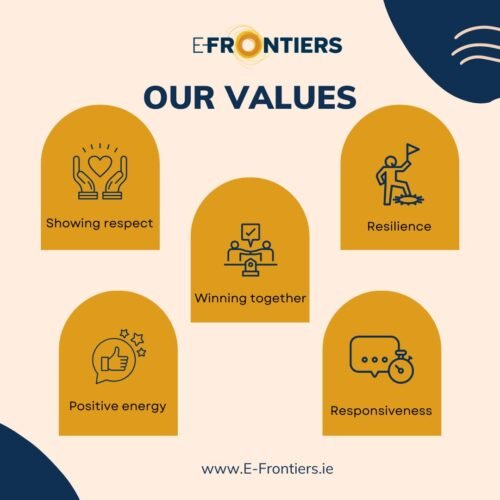
Being a recruitment company, E-Frontiers is aware of the importance of supporting talent in their career paths and providing highly skilled human resources for companies in various industries. Our focus in everything we do is built around the following five core values.
Our commitment to these values is what sets us apart and drives us to excel in all aspects of our business.
Showing respect
Respect is the foundation of a healthy relationship. When engaging with clients in relation to their requirements or listening to our candidates’ wishes, the respect we show to both sides, and valuing everyone’s opinions and needs is critical. It enables us to give the right support to all sides throughout the recruitment process. It also creates a welcoming and inclusive environment within our workplace.
Winning together
Our “winning together” value drives us to focus on the quality of our services to benefit all parties. Everyone is working towards a common goal, and success is achieved through shared effort and mutual support. Our candidates are interviewed and selected by our recruitment experts to ensure that they are best suited to the requirements of employers. This helps in-house HR teams and hiring managers save time in searching and screening the right candidates. The team at E-Frontiers are not just “head-hunters”, we are a partner to both job-hunters and companies.
Resilience
The resilience value helps us to constantly develop in the recruitment market. E-Frontiers are willing to change, adapt, and build agile teams and processes. It allows us to respond quickly to challenging situations at any stage of the recruitment process.
Responsiveness
Along with our practical knowledge in the technology and business fields, we understand that quality responsiveness is an integral part of the recruitment process. A quality and accurate response is as important as a speedy one. With our up-to-date tools and our personal touch via our experienced recruiters, we are proactive and confident to offer positive and on-time responses to our clients and candidate requests.
Positive Energy
E-Frontiers was established and is operated by genuine and passionate people, with domain expertise in all resource requirements we are working on. We have built up a team of employees with a “can-do” attitude. It is at the core of our approach to problem-solving and delivering exceptional service. This value radiates energy to everyone in the recruitment process. We approach challenges and opportunities with enthusiasm, seeking innovative ways to meets our clients’ needs. This honest, positive energy spreads and contributes to the success of our partners, clients, and candidates.
Don’t hesitate to reach out to us if you are looking for a job or talent to hire.