


The Irish construction industry is buoyant at present, with increasing demand for Housing/Apartments, Data Centres, Pharmaceutical projects, Infrastructure works etc. While a workforce shortage has made it challenging to secure skilled professionals for these areas, this also means exciting opportunities for top talent are available.
At E-Frontiers, we deal with the top Tier 1 and Tier 2 Contractors and Residential Developers in Ireland. If you’re currently based in Ireland and exploring new career options or looking to return home in the near future, now is the perfect time to take the next step in your career.
We have summarised some information below about the top construction roles that are in demand at present and how you can contribute to some of the most dynamic and high-profile projects in the industry.

Quantity Surveyors (QS’s)
Quantity Surveyors are indispensable for cost management and financial planning in construction projects. They ensure projects stay on budget without compromising quality.
-Salaries/Packages:
Junior/Project level – €45,000 to €70,000 plus transport & package
Senior QS level – €70,000 to €90,000 plus transport & package
– Qualifications:
A degree in Quantity Surveying, Construction Economics, or a related discipline. Membership in professional bodies like the Society of Chartered Surveyors Ireland (SCSI) is highly desirable though not essential.
As the candidate what’s in it for you:
QS professionals will have the opportunity to influence critical project decisions, develop in-depth financial expertise, and collaborate with multidisciplinary teams. Senior roles offer leadership and strategic planning experience in complex projects.
As the company what can you do:
Emphasise involvement in high-profile projects, flexible working options, and a strong focus on employee well-being to attract top QS talent, CPD opportunities are also very beneficial.
Site/Senior Engineers
Site and Senior Engineers play a critical role in the successful delivery of projects. They are responsible for setting out and ensuring design specifications are met, and maintaining quality standards.
-Salaries/Packages:
Site/Setting Out Engineers – €50,000 to €65,000 plus transport & package
Senior Engineers – €70,000 to €85,000 plus transport & package
-Qualifications:
A degree in Construction Management, Civil or Structural Engineering is typically required, alongside experience with setting-out equipment like total stations and GPS
As the candidate what’s in it for you:
This role offers a chance to bring your existing skillset and knowledge to assist high-profile projects and developments to completion, develop expertise in advanced engineering tools, and progress into leadership positions such as Site/Project Management. Engineers will gain exposure to dynamic environments that challenge their problem-solving and technical skills.
As the company what can you do:
Highlight opportunities for professional development, exposure to cutting-edge technologies, and a supportive team environment. Providing competitive benefits packages, CPD opportunities where possible and clear career progression pathways are vital.
Site Manager/Site Supervisor
These roles involve overseeing on-site operations, managing teams, and ensuring projects are delivered on time and within budget.
-Salaries/Packages:
Site Supervisor/Finishing Foreperson – €60,000 to €70,000 plus transport & package
Site Agent/Manager – €70,000 to €85,000 plus transport & package
-Qualifications:
A background in Construction Management, Engineering, or Trade Qualifications, coupled with strong leadership skills and relevant on-site experience.
As the candidate what’s in it for you:
Site Managers and Supervisors gain leadership experience, exposure to complex construction projects, and the satisfaction of seeing their work take tangible form. These roles are stepping stones to senior management positions in the construction industry.
As the company what can you do:
Highlight the opportunity to lead high-impact projects, provide ongoing leadership training, and offer performance-based bonuses.
Health and Safety Advisors
Health and Safety Advisors are key to ensuring compliance with safety regulations and creating a safe working environment.
-Salaries/Packages:
Junior/Inter level – €40,000 to €60,000 plus transport & package
Senior/Manager level – €65,000 to €85,000 plus transport & package
-Qualifications:
Diploma Level 6 in Occupational Health and Safety, NEBOSH, IOSH, or other recognised safety certifications, combined with experience in construction safety management.
As the candidate what’s in it for you:
Advisors will contribute directly to creating safer workplaces while building your expertise in risk management and compliance. The role offers opportunities for recognition through successful safety initiatives and pathways to senior safety leadership roles.
As the company what can you do:
Showcase your commitment to safety through robust training programs, and recognition schemes for safety performance, along with opportunities for certifications or further education.
Site Manager/Site Supervisor
These roles involve overseeing on-site operations, managing teams, and ensuring projects are delivered on time and within budget.
-Salaries/Packages:
Site Supervisor/Finishing Foreperson – €60,000 to €70,000 plus transport & package
Site Agent/Manager – €70,000 to €85,000 plus transport & package
-Qualifications:
A background in Construction Management, Engineering, or Trade Qualifications, coupled with strong leadership skills and relevant on-site experience.
As the candidate what’s in it for you:
Site Managers and Supervisors gain leadership experience, exposure to complex construction projects, and the satisfaction of seeing their work take tangible form. These roles are stepping stones to senior management positions in the construction industry.
As the company what can you do:
Highlight the opportunity to lead high-impact projects, provide ongoing leadership training, and offer performance-based bonuses.
Building Services Manager
Building Services Managers ensure that electrical, mechanical, and plumbing systems are integrated seamlessly into construction projects. They are pivotal for large-scale developments.
-Salaries/Packages:
Building Services/M&E Coordinator – €60,000 to €75,000 plus transport & package
Building Services/M&E Manager – €75,000 to €90,000 plus transport & package
-Qualifications:
A degree in Building Services, Mechanical, Electrical Engineering, and/or a trade background as a plumbing, electrician, or fitter, with extensive experience managing MEP services.
As the candidate what’s in it for you:
This role offers candidates the chance to get exposure to & to be involved in innovative high-profile Technology, Data Centre & Pharmaceutical projects, to specialise in green building practices, and work with cutting-edge technology. Building Services Coordinators & Managers are critical in shaping sustainable infrastructure and advancing their professional expertise.
As the company what can you do:
Stress the importance of their role in innovation and sustainability, offer opportunities to work on cutting-edge green building projects, and provide favourable benefits packages.
Conclusion
To thrive in Ireland’s competitive construction sector, it’s important to consider what makes a role truly stand out. Top candidates are looking for more than just a pay cheque – they want opportunities for career growth, professional development, work-life balance, and a positive workplace culture. Companies that prioritise employee satisfaction, offer unique benefits and create an environment where people feel valued will attract the best talent.
If you’re exploring new opportunities, look for employers who offer not only competitive salaries but also have a good work-life balance, good company culture, offer the chance to grow, showcase your skills, and be part of successful projects. Whether you’re a Site Engineer or a Building Services Manager, finding a company that aligns with your career goals and values is key to taking the next step in your professional journey.
Are you looking for your next role or top talent in the construction sector?
2. Connect on LinkedIn with our Construction Recruitment Specialist – Mark Kelly
3. For visibility of all our roles visit the jobs section of our website
4. Click here to find out more about our areas of expertise in the construction industry

Our Online Event
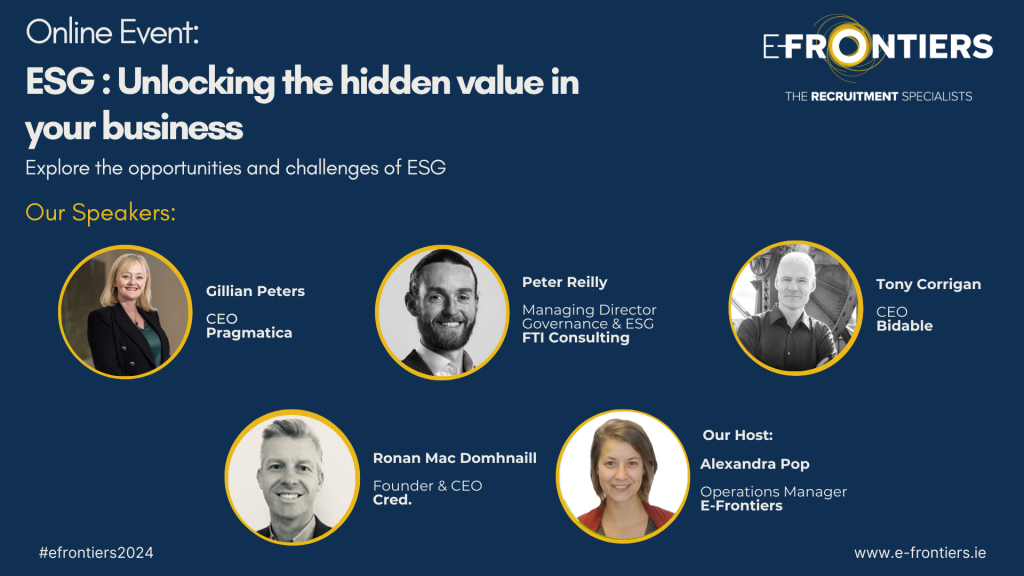
On October 24th we had the pleasure of hosting a roundtable event on ESG. This event was designed for business leaders, sustainability professionals, and anyone looking to explore how ESG is transforming business practices.
In this event, we brought together a panel of industry experts to share their perspectives on the trends, challenges, and opportunities that ESG presents. Alexandra Pop, Operations Manager @ E-Frontiers moderated and guided this conversation which addressed a wide range of topics.
Gillian Peters’ career has spanned various roles, primarily in marketing and business development within financial services. As Business Development Director at CPA Ireland, she earned her MBS in Business Practice and developed a deep interest in sustainability in business.
In February 2023, she transitioned to CEO of Pragmatica, where her mission is to create tailored roadmaps and innovative solutions that guide companies on their sustainability journeys.
Tony Corrigan With over a decade of experience in government bidding, Tony Corrigan has focused on helping SMEs succeed in public contracts. He founded TenderScout in 2014 to guide SMEs through the tendering process, equipping them with effective tools and strategies.
In 2023, Tony launched Bidable.ai, an AI-driven platform that enhances bids with precise insights, showing businesses their expected scores and ways to improve. This platform, built on Tony’s expertise, is a critical resource for SMEs aiming to win in the competitive tendering arena. His dedication to SME success remains the core of Bidable’s mission.
Peter Reilly Managing Director of Governance and ESG at FTI Consulting , advises major global companies on corporate governance, focusing on reporting, stakeholder engagement, remuneration, and ESG strategy development to meet institutional and regulatory standards. With deep expertise, Peter has led activist defense programs across the US and Europe, enhanced governance frameworks for boards, and conducted proxy support strategies.
Previously, he served as Lead Analyst for Northern Europe at Glass Lewis, overseeing ESG research and recommendations. He holds a BA in Economics, Politics, and Law from Dublin City University and an LLM from Trinity College Dublin.
Ronan Mac Domhnaill is the founder of Cred, a Sydney-based Education and Technology company.
Cred’s focus is on the “Social” side of ESG.
Cred helps organisations:
– Engage, retain, and attract top talent.
– Create the right culture – balancing profit, people and purpose.
– Bridge the generational leadership gap
– Identify future leaders
– Use ESG as a competitive advantage
So that they can increase their bottom line sustainably.
Our experts addressed topics such as:
Understanding ESG: Beyond Recycling
-Definition and scope of ESG (Environmental, Social, Governance) and how it differs from traditional sustainability practices.
-Discussion on why businesses are increasingly considering ESG, especially in B2B vs. B2C contexts.
External and Internal Factors Influencing ESG Strategy
-External factors: capital accessibility, supply chain, customer demands, and reporting obligations.
-Internal factors: workforce capabilities, talent competition, and aligning governance structures to support sustainability goals.
Navigating ESG Reporting and Social Responsibilities
-Overview of CSRD thresholds and VSME voluntary reporting for SMEs.
-Considerations for businesses when evaluating the social aspects, such as supply chain transparency, staff policies, and community engagement.
Our discussion helps to define ESG’s scope beyond traditional sustainability and explores the internal and external factors driving ESG strategies. Our expert panel sheds light on key issues shaping this evolving landscape and offers practical takeaways on ESG reporting and the importance of aligning social responsibilities with business goals.
If you missed it, reach out to our team today to learn how ESG can benefit your organisation.

Why put DEI on your agenda?
It is important that the diversity efforts of organisations are intentional and visible and drive meaningful change. Efforts must be visible both internally and externally, demonstrating the organisation’s commitment to diversity, equality, and inclusion and fostering trust among employees, customers, and other stakeholders.
Poll Results
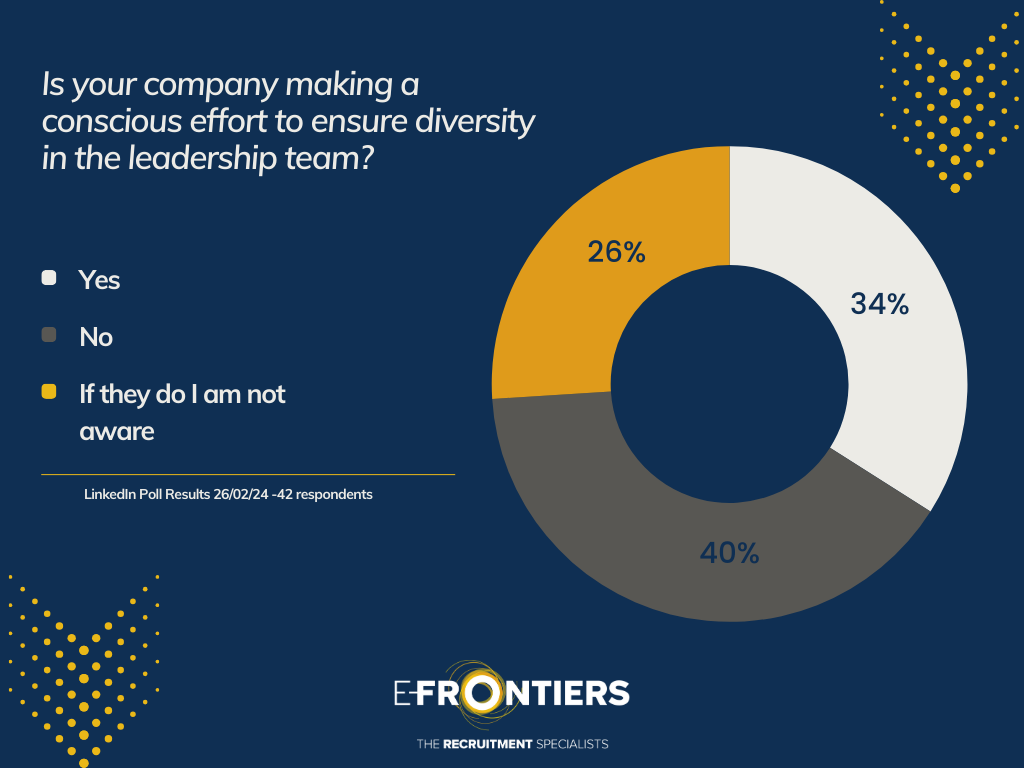
We recently asked our followers -‘Is your company making a conscious effort to ensure diversity in the leadership team?’ LinkedIn Poll 26/2/24
- 34% responded with Yes
- 40% responded with No
- 26% responded with ‘If they do, I am not aware’
It is food for thought that 66% felt that their company was not doing enough in terms of diversity and/or any efforts they were making were not visible, even to staff and team members.
Employers often require support and specialist external help in developing and amplifying the visibility of their Diversity, Equality, and Inclusion (DEI) initiatives, and could benefit from assistance with narratives and communication strategies. Coordinating a DEI plan requires guidance and planning to ensure alignment with organisational goals and foster a culture of genuine inclusion.
Diversity Live Event
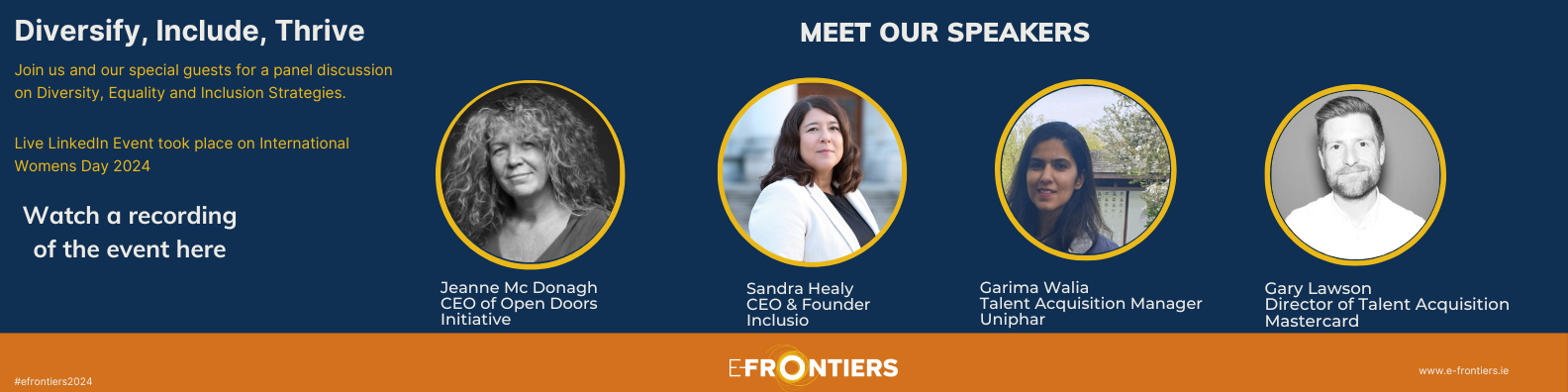
We recently hosted a live panel discussion event on Diversity, Equality and Inclusion. This was held on International Women’s Day and featured four incredible speakers who shared invaluable perspectives on fostering DEI within the workplace. Our E-Frontiers team members Alexandra Pop, Recruitment Operations Manager, and Kenneth O Connor, Head of Contract Recruitment UK & Ireland, facilitated the engaging conversations that delved into a wide range of topics.
Our Speakers
Jeanne Mc Donagh : CEO : Open Doors Initiative Jeanne has over 30 years’ experience in DEI, politics, campaigning, mental health and LGBTQ+ issues and board work
Sandra Healy : CEO & Founder : Inclusio : Sandra is an Engineer, an Organisational Psychologist and NLP Master Practitioner. She has championed and driven diversity and inclusion practice across industry for over 18 years.
Garima Walia : Talent Acquisition Manager : Uniphar : Garima possesses a rich and extensive background in recruitment and talent acquisition, accumulating over 15 years of invaluable experience spanning diverse industries.
Gary Lawson : Director of Talent Acquisition : Mastercard :Gary has over 20 years of experience as a recruitment specialist and is responsible for talent attraction, strategy & branding at Mastercard’s technology and innovation hub in Dublin.
Our speakers touched on areas such as:
- How to bring organisations on board with DEI
- Gaining leadership buy-in
- Cultivating a culture of inclusive leadership
- Addressing the gender gap
- Implementing metrics and tracking progress
- Offering advice for startups embarking on their DEI journey
- How organisations can be more visible with their DEI efforts
- Lessons they have learned along the way
Conclusion
The wealth of information shared during the event provides a roadmap for businesses and clients aiming to enhance diversity and inclusion. Whether you’re a seasoned company looking to add to your DEI efforts or a startup seeking to lay a strong foundation, our speakers offered invaluable insights to support your efforts and ambitions.
You can catch up with the full event here:
Let’s continue to learn, grow, and create more inclusive workplaces together!
Contact us to find out more about our commitment to DEI policies in our workplace and in our recruitment practices

Recruitment Trends for Contractors
In the fast-paced realm of HR & contract recruitment, the contractor market takes centre stage, playing a pivotal role in meeting the dynamic demands of businesses across various industries. As we step into 2024, the UK and Irish contractor market is undergoing a transformative dance, aligning with the latest recruitment trends and human resource hiring strategies. It is essential for contractors and employers to sync up with these changes to stay ahead of the game. According to our latest research on contractors, almost 67% are open to new opportunities in 2024. So, with this in mind, let’s delve into the five key hiring trends shaping the contractor market in the UK this year, weaving in the vital keywords for those scouring the internet for recruitment insights.
Remote Revolution Slowing Down
In 2023, the rise in remote work opportunities was not just a buzzword; it was a hiring trend that defined the HR and recruiting landscape. The COVID-19 aftermath has accelerated the adoption of remote work across industries, with businesses recognising the benefits of a flexible workforce. Read further research into this topic here in an article by Nigel Bolger, our Commercial Manager.
In 2024 we are expecting to see a pullback for this with companies pushing for more time in the office. Justifications are being made for this for both larger and smaller companies. 1 week per month onsite or 2 days per week are the current working habits for many. The only major shift we expect here is that companies will increase their requirements for contractors to be onsite.
Niche Skills
In navigating the competitive job market, businesses are on the lookout for contractors with specialised skills – a talent acquisition trend that dominated in 2023. Companies understand the importance of sourcing individuals with niche expertise to meet specific project requirements. After all, they expect the contractors to hit the ground running. 2023 saw a quiet year for contractors in the Software Engineering space with continued growth in demand on DevOps, Data, and interestingly in Finance. The Project Management and Business Analysis demand maintained in 2023 and we are seeing a slight growth in demand for these skillsets in 2024 already.
Compliance Checkmate
Compliance within contracting is always going to be a key area. In this market where companies want the work done asap and candidates aim to minimise the downtime between contracts, the escalating costs make compliance a critical factor for both parties. Companies are increasing the requirements for compliance and checks. For candidates, it is key to be well-prepped when going through the recruitment process. For clients it’s good practice when advancing through the process to give feedback to us, the recruitment agencies. This proactive communication enables agencies to initiate processes that contribute to reducing the onboarding time and fostering a smoother transition for all parties involved.
Diversity Equality and Inclusion
DEI Initiatives take the spotlight in 2024, not just in industries, but also in the contractor market, shaping recruitment in human resources. Businesses are actively engaging with agencies to source diverse contractor talent. As a contractor, embracing diversity and showcasing a multicultural skill set becomes a strategic move to open doors to new opportunities and partnerships in the realm of recruitment.
Conclusion
As the beats of 2024 resonate through the contractor market, recruitment professionals are invited to join the dance. Ride the wave of remote work, leverage specialised skills, champion flexibility, navigate compliance intricacies, and be a part of the diversity dance. This isn’t just a market; it’s a recruitment party, and your rhythm is the key to making a lasting impact.
Author Kenneth O Connor is Head of Contract Recruitment UK and Ireland at E-Frontiers.
Please feel free to get in touch with our commercial team to discuss your recruitment needs:
IRE: Nigel Bolger : nigel.bolger@e-frontiers.ie (m: 00353 86 3888147)
UK: Kenneth O’ Connor : kenneth.oconnor@e-frontiers.com (m: 0044 740 365 1213)

In today’s dynamic business landscape, where competitiveness and innovation are key, human resources management has become a vital component for organisational success. The convergence of People Analytics and Big Data has emerged as a revolution in talent management, providing companies with the tools necessary to understand, nurture, and empower their human capital strategically.
In today’s dynamic business landscape, where competitiveness and innovation are key, human resources management has become a vital component for organisational success. The convergence of People Analytics and Big Data has emerged as a revolution in talent management, providing companies with the tools necessary to understand, nurture, and empower their human capital strategically.
Put simply, People Analytics, a discipline within Human Resources, harnesses the vast world of Big Data to collect, analyse, and extract meaningful insights related to employees. From performance assessment to predicting hiring trends, People Analytics allows organisations to deep dive into the complexity of human interactions in the workplace.

The Strategic Importance of Applying Big Data in Human Resources:
1. Informed Decision-Making: Big Data empowers HR leaders with detailed, real-time information, enabling them to make strategic decisions based on solid data. From workforce planning to performance management, this capability transforms decision-making into an informed process.
2. Optimising the Hiring Process: The application of machine learning algorithms in personnel selection streamlines the recruitment process, improving the quality of your hires and reducing the time needed to fill key positions. The identification of patterns in historical data facilitates the search for candidates who align better with your company’s values and goals.
3. Personalised Performance Management: Analysing detailed data makes performance evaluation more accurate and tailored to each individual. This means employees get specific feedback based on facts, helping them grow professionally in a way that aligns with the organisation’s goals.
4. Talent Retention: The ability to analyse data on employee satisfaction and engagement allows organisations to both anticipate and proactively address issues that could impact talent retention. Retention strategies can be designed more effectively, contributing to team stability and continuity.
The Future of Talent Management:
The application of Big Data in Human Resources is not just a fleeting trend; it is a paradigm shift driving the ongoing evolution of talent management. As organisations adopt People Analytics and harness the potential of Big Data, they are better positioned to face future challenges, develop strong corporate cultures, and ensure sustainable growth through their most valuable asset: their human capital. In a world where information is power, People Analytics with Big Data stands as the beacon lighting the way to optimisation and success in human resources management.

The Future of Talent Management:
The application of Big Data in Human Resources is not just a fleeting trend; it is a paradigm shift driving the ongoing evolution of talent management. As organisations adopt People Analytics and harness the potential of Big Data, they are better positioned to face future challenges, develop strong corporate cultures, and ensure sustainable growth through their most valuable asset: their human capital. In a world where information is power, People Analytics with Big Data stands as the beacon lighting the way to optimisation and success in human resources management.
The Strategic Importance of Applying Big Data in Human Resources:
1. Informed Decision-Making: Big Data empowers HR leaders with detailed, real-time information, enabling them to make strategic decisions based on solid data. From workforce planning to performance management, this capability transforms decision-making into an informed process.
2. Optimising the Hiring Process: The application of machine learning algorithms in personnel selection streamlines the recruitment process, improving the quality of your hires and reducing the time needed to fill key positions. The identification of patterns in historical data facilitates the search for candidates who align better with your company’s values and goals.
3. Personalised Performance Management: Analysing detailed data makes performance evaluation more accurate and tailored to each individual. This means employees get specific feedback based on facts, helping them grow professionally in a way that aligns with the organisation’s goals.
4. Talent Retention: The ability to analyse data on employee satisfaction and engagement allows organisations to both anticipate and proactively address issues that could impact talent retention. Retention strategies can be designed more effectively, contributing to team stability and continuity.
We can see the value of big data tools when used in recruitment to enhance efficiency and effectiveness, and they give us insights into the marketplace. An Applicant Tracking System (ATS) is a software application designed to automate and streamline the recruitment process by managing the entire lifecycle of candidates, from application to hire. An ATS leverages big data principles to improve recruitment in several ways such as:
Data Centralisation, ensuring recruiters have access to a comprehensive and organised dataset.
Resume Parsing, ATS systems use natural language processing and machine learning algorithms to analyse resumes. This helps in extracting relevant information such as skills, experience, and qualifications, making it easier for recruiters to identify suitable candidates quickly.
Automated Screening, Recruiters can set specific parameters, and the system uses data-driven insights to shortlist candidates who best match the job requirements.
Talent Pool Management, ATS systems often include features for managing talent pools. Recruiters can use data on past interactions and candidate engagement to maintain relationships with potential hires.
Predictive Analytics, some advanced ATS platforms incorporate predictive analytics to forecast candidate success.
Performance Metrics, recruiters can track key performance metrics, such as time-to-fill, source effectiveness, and candidate conversion rates, to continuously assess and improve their recruitment strategies.
By leveraging big data principles, ATS systems help recruitment agencies save time, reduce manual effort, and make more informed decisions throughout the hiring process. Thus, contributing to greater efficiency, better candidate matches, and improved overall recruitment outcomes.
The author is Alejandro Pino. Alejandro is E-Frontiers Team Lead in Spain and a Recruitment Consultant with extensive experience in selecting top Data profiles for companies. In addition to his background in Human Resources, he holds a Master’s degree and specialises in Data Analytics & People Analytics. He also teaches classes at business schools on data analysis and its application in companies and human resources departments.
Feel free to get in touch with Alejandro to discuss new opportunities in Data both in Ireland and Spain: alejandro.pino@e-frontiers.ie

The rise of hybrid working as a key job seeker demand
Hybrid working has become more and more ingrained as a benefit that many candidates will demand when seeking a new role. It has evolved into a coveted benefit for job seekers and in many cases, candidates will put a tangible value on this benefit by valuing it as much as, if not more than, a higher salary.
As the workforce landscape continues to adapt, employers are faced with the challenge of striking the right balance between remote and in-office work. Many employers are looking to increase the number of days their employees return to the office to build a culture, enhance team collaboration, or simply keep up with what’s going on through informal chats with colleagues.
To that end, what is the status of hybrid working/working from home almost four years on from the outbreak of Covid?
Big Tech’s response to hybrid working
In September 2023, Meta paid £149 million (€171 million) to break its lease on a major London development near Regent’s Park. This was reported as being due to increased levels of hybrid working as well as part of a cost-cutting exercise. The news is the latest sign of Big Tech’s determination to control costs by scaling back its office footprint as more staff work from home. The tech contraction has hit cities such as San Francisco that rely heavily on tech companies. Office tenants and European markets including Dublin and London have not been spared.
Indeed, there are other more specific examples of companies embracing Hybrid working models with open arms. For example, in a recent radio advertisement, one of the Big4 consultancy firms promotes a unique hybrid working benefit, allowing employees to work abroad for up to 20 days during the summer months. Conversely, certain Financial Services companies advocate for a more traditional approach, requiring employees to be present in the office for four or five days each week.
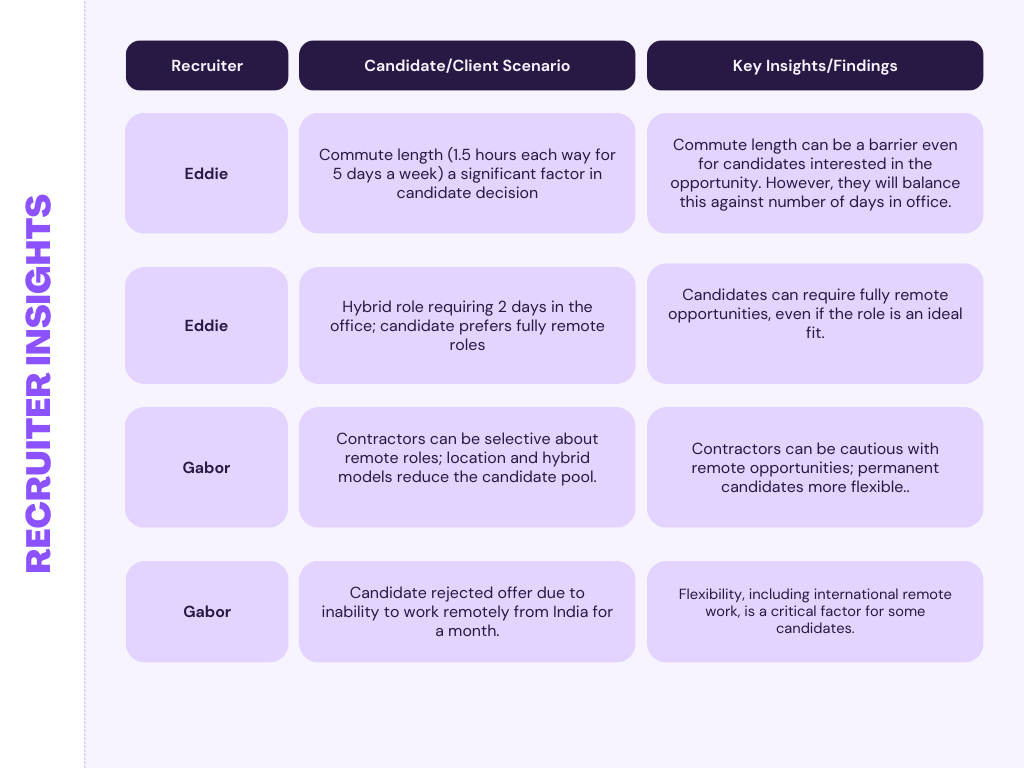
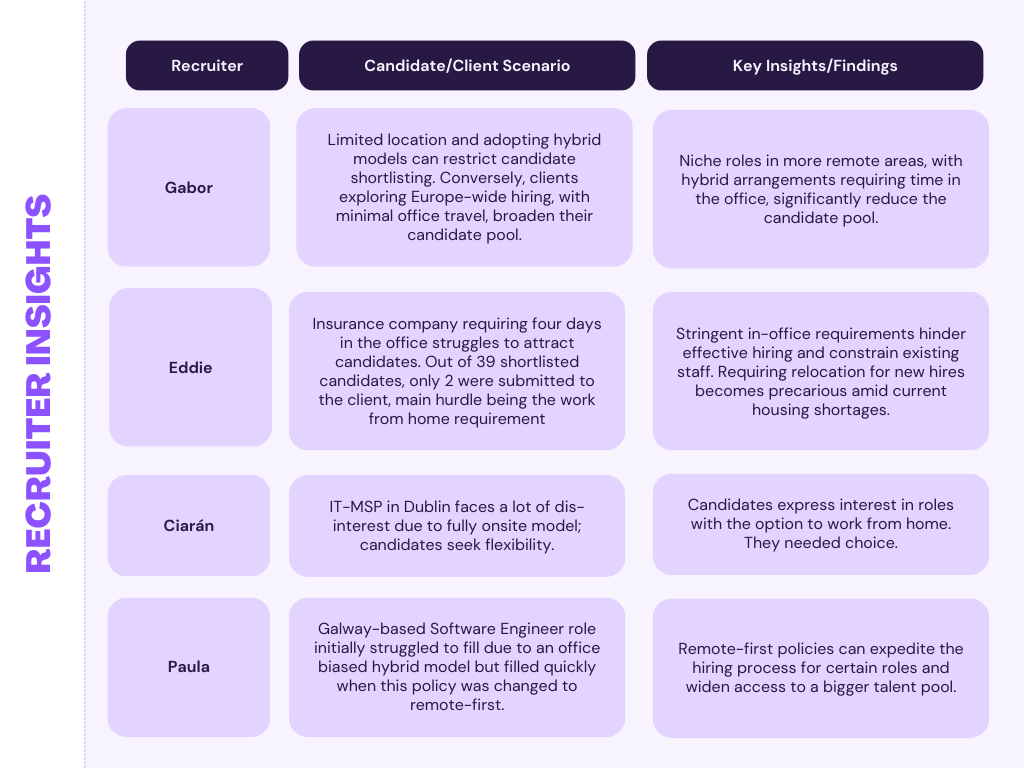
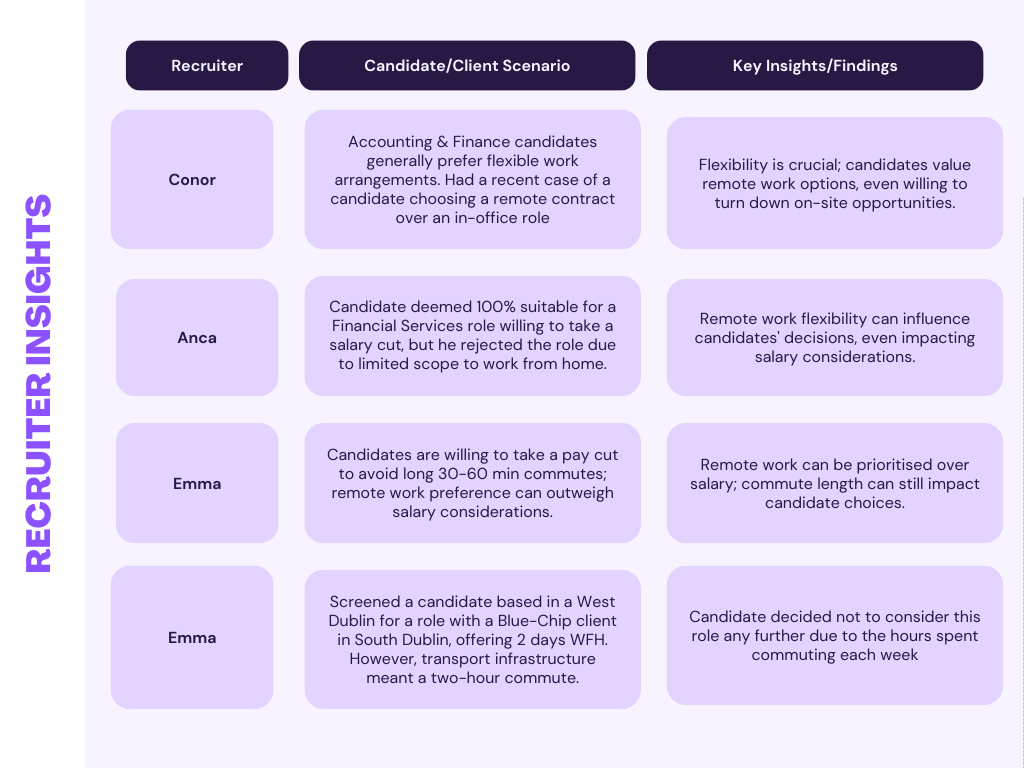
Hybrid working’s influence on recruitment and retention strategies
So, whether an organisation embraces or resists the evolving working environment, its ‘Working from Home’ policy significantly influences recruitment and retention strategies. Real-life examples gathered from our team of recruitment consultants shed light on the practical implications for companies seeking to attract and retain top talent in this dynamic landscape.
Conclusion
In conclusion, we are seeing that more and more candidates are requesting flexible Hybrid working models as a basic benefit when considering new roles with many forward-looking employers open to considering employee demands.
Embracing this as an employer can give a distinct advantage when attracting staff. These benefits range from expanding the pool of applicants from diverse locations, tapping into specialised and niche skillsets, and delivering a better work-life balance to staff. Additionally, offering hybrid work options becomes a compelling benefit in situations where there may be constraints on salary.
Author Nigel Bolger is the Commercial Manager at E-Frontiers.
Please feel free to get in touch with our commercial team to discuss your recruitment needs:
IRE: Nigel Bolger : nigel.bolger@e-frontiers.ie (m: 00353 86 3888147)
UK: Kenneth O’ Connor : kenneth.oconnor@e-frontiers.com (m: 0044 740 365 1213)

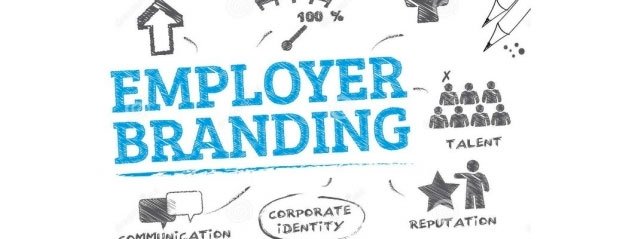
In the ever-evolving landscape of jobs and new career opportunities, where competition for top-tier talent is fierce, having a robust employer brand is a game-changer. In today’s world, it is critical to the success of an organisation as it plays a key role in attracting new talent to the company. It’s not just about finding the right people; it’s about making your company the irresistible choice for the best professionals. Let’s investigate the strategic world of employer branding and explore how you can stand out in the competitive job market.
1. Know Your Identity:
Start by understanding and defining your company’s identity. What sets you apart? Identify your core values, mission, and the unique aspects of your workplace culture. For potential employees, having this knowledge, will increase the number of applicants, and help in attracting the best fit. A positive employer brand can contribute to employee satisfaction, engagement, and loyalty, and reduce staff turnover rates.
Engagement and productivity are known to rise when your employees feel connected to your brand and understand their part in the overall company vision.
2. Showcase Company Culture:
Potential candidates want to envision their day-to-day in your workplace. Highlight your company culture through employee testimonials, office photos, and glimpses into team activities. A positive, inclusive, and supportive culture can be a powerful draw for prospective employees. From experience we know that job seekers look for employers that offer a good balance between work and personal life and genuinely care for their employees and their wellbeing.
3. Craft a Compelling Story:
Every brand has a story, and so should your employer brand. Share your journey, milestones, and the impact your business has had. Make it relatable and inspiring to resonate with potential candidates.
4. Leverage Online Platforms:
In the digital age, your online presence matters. Optimise your company website and social media channels to reflect your employer brand. Be consistent with your messaging across platforms as this creates a cohesive and memorable image for followers.
5. Employee Value Proposition (EVP):
Define and communicate your Employee Value Proposition. What unique benefits and opportunities does your company offer to employees? Whether it’s professional development, a flexible work environment, office perks, or wellness programs, make the benefits and advantages of working for your company well known.

6. Engage in Thought Leadership:<
Position your company as an industry leader by sharing insights, trends, and knowledge. This not only attracts top talent but also lends credibility to your brand and establishes your business as a go-to source in the field.
7. Prioritise Diversity and Inclusion:
Inclusive workplaces are attractive to a diverse pool of candidates. Showcase your commitment to diversity through initiatives, policies, and success stories within your organisation.
8. Employee Recognition Programs:
Implement and showcase employee recognition programs. Acknowledging and celebrating achievements creates a positive work environment and signals to potential candidates that their contributions are valued. When candidates feel valued, it serves to enhance your company’s reputation. Companies can do this through learning programs, feedback channels, rewards, and opportunities for career growth.
9. Seamless Recruitment Process:
The recruitment process is the first interaction the company will have with a potential employee, and it is critical. A positive candidate experience is an integral part of your employer brand. Make it smooth, transparent, and engaging to create a positive impression for prospective candidates. Streamline the process, provide timely feedback, and ensure a smooth transition from application to onboarding.
10. Monitor and Adapt:
Nothing stays the same forever. Regularly assess the effectiveness of your employer branding strategies. Building a brand is an ongoing process and is affected by outside influences and industry trends. Seek feedback from current employees and candidates and be open to adapting your approach.
In today’s environment, your employer brand is your secret weapon. By strategically showcasing your company’s identity, culture, and values, you create a magnet for top-tier talent.
Use your recruitment partner to your advantage. Recruiters can have significant influence and play a pivotal role in the hiring process.
It’s essential to acquaint your partnered recruiters with your company values and culture. They can sway candidates’ choices and use their connections to identify ideal matches from their pool of passive candidates.
As your recruitment firm, at E-Frontiers, we work with you, highlighting your employer brand in the talent market. As 2024 approaches, we encourage you to enhance your brand and see the difference it will make.
Get in touch with us to see how we can help you gain better insights into the priorities of candidates in the current jobs market.

If you have gone through the process of applying for a new job in recent times, then you will know that the landscape of interviewing has undergone a huge transformation. This is largely driven by the change in work dynamics due to the pandemic, coupled with advancements in technology. The traditional in-person interview, once the undisputed standard, and the only real way to secure a new job, now shares the stage with remote video interviews.
The assumption may have been that all would revert to ‘normal’ once we got back on our feet after the pandemic, but that had not been the case. Much like the office vs remote working conundrum, it would seem increasingly evident that remote interviews are here to stay in the evolving world of recruitment and hiring.
This raises the questions of which is the better approach and which do candidates prefer?
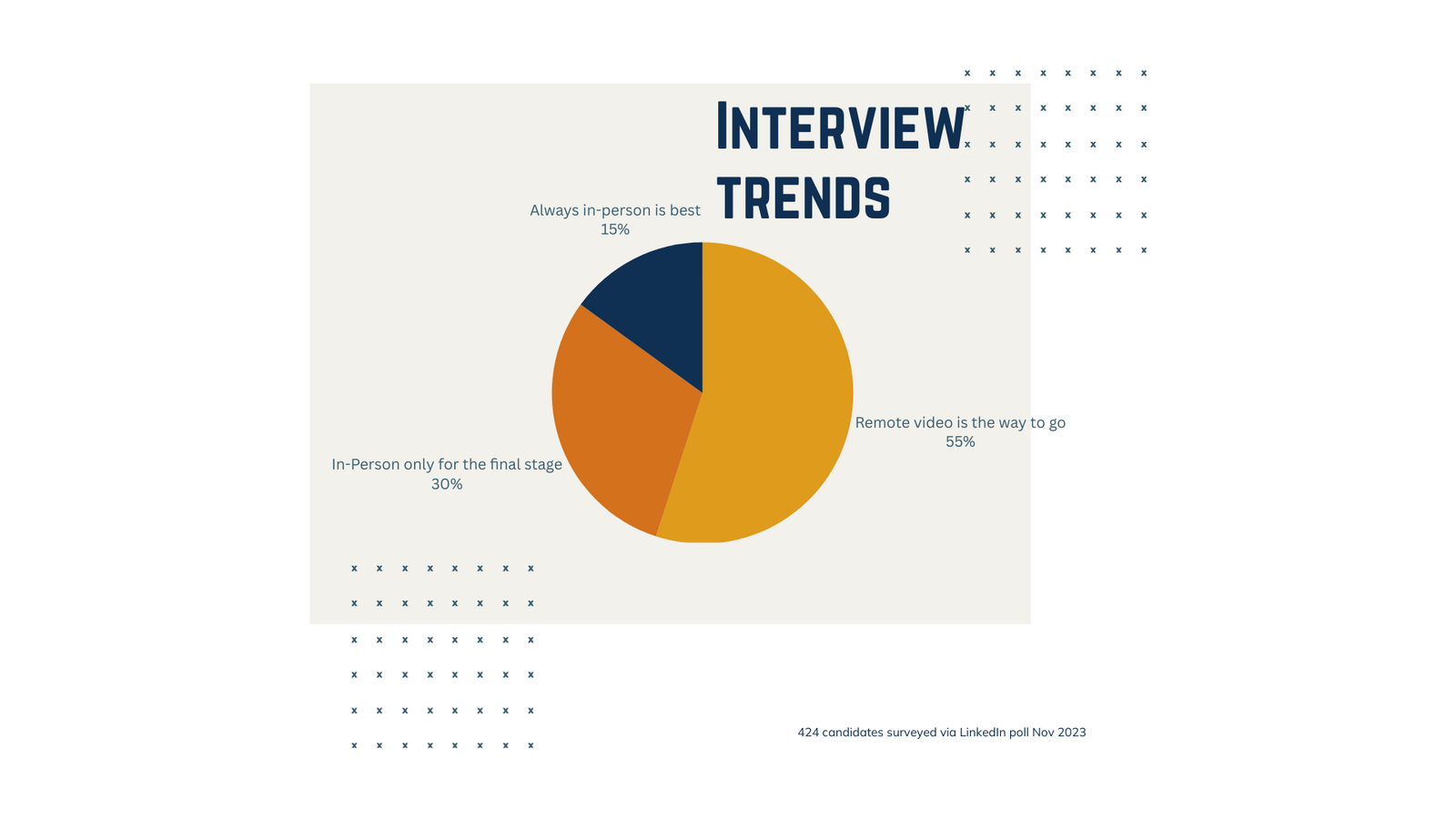
In a recent LinkedIn poll of 474 candidates who were asked what their interview preference was, a resounding 55% responded with the choice of ‘Remote video is the way to go’. This coupled with a strong response of 30% for the choice of ‘In-Person only for the final stage’, means a whopping 85% prefer remote video interviews. ‘Always in-person is best’ scored just 15%. Certainly food for thought for clients.
Let’s take a more in-depth look at the pros and cons:
In-person interviews have long been considered the gold standard for evaluating candidates. Not only can they assess the candidates’ qualifications, but they offer a personal touch, allowing candidates and interviewers to establish a direct, immediate connection. Perfect for showcasing soft skills.

In-person interviews also offer an insight into the company’s culture and environment, giving candidates a genuine feel for the company and potential new colleagues and thus helping to gauge compatibility. However, in-person interviews can be logistically challenging and simply not feasible for candidates who live in different locations or countries.
On the other hand, remote interviews are convenient and accessible thus offering undeniable advantages. They save time and resources and enable access to a much wider pool of talent simply due to not having any geographical constraints. They can also be less intimidating for some candidates, allowing them to showcase their skills without the anxiety often associated with face-to-face interactions.
At E-Frontiers, we recently conducted some research into this and asked the question ‘what do candidates prefer?’
Our team of recruiters report similar experiences to the above findings:
John Ryan, Technical Recruiter, reports that ‘candidates are still very keen to do remote interviews, purely for convenience as much as anything else. But, when it gets to the 2nd stage and they are onsite interviews, they are happy to attend, meet potential new employers, and see the site’.
Similarly, Eddie McAndrew, Recruitment Consultant for engineering and customer success roles at E-Frontiers, has found with recent roles that ‘2 stage interviews have proved most popular. The first stage is via teams, with the second onsite. It is rare that an offer will come without the client meeting the candidate face to face. Candidates prefer Teams interviews but generally for second stage interviews they are always comfortable with onsite, as they usually want to get a feel for the office and get to meet who they will be working for’.
This research tells us that the ideal approach for clients is not a one-size-fits-all solution. While the nature of the role, the industry, and personal preferences must be considered, a hybrid model that combines in-person and remote interviews seems to be the most promising path forward. And I think is the best solution for clients to ensure good hires.
Certainly, initial screening rounds and tech assessments can take place remotely and clients not already doing this should consider moving towards it. This works in accommodating obvious candidate preferences for video and works in favour of the client by casting a wider net to a broader talent pool and bringing efficiencies and inclusivity to their hiring process. In-person interviews can then be reserved for the final critical stages, where cultural fit and deeper personal evaluations are important.
Conclusion
The changing landscape of interviewing highlights the importance of flexibility and adaptability in the hiring process. Employers should adopt a flexible approach and consider a mix of both in-person and remote interviews, offering candidates genuine options. By embracing this diversity in interview formats, organisations can ensure they are making the best and most informed hiring decisions.


Feel free to get in touch with our commercial team to discuss your recruitment and resourcing needs:
IRE: Nigel Bolger : nigel.bolger@e-frontiers.ie (m: 00353 86 3888147)
UK: Kenneth O’ Connor : kenneth.oconnor@e-frontiers.com (m: 0044 740 365 1213)
Python is the 2nd most popular coding language, taking over the old reliables such as Java and .Net. Octoverse reported in 2022 that Python continues to see a surge in its usage across GitHub, experiencing a remarkable 22.5% year-over-year increase. This is no surprise given the advantages Python has.
-It’s easy to learn
-has an impressive library
-It is such a versatile language with a vast spectrum of applications, from Web Development to Automation, Machine Learning, Data Science, and AI

But more importantly, Python has a strong community and fosters collaboration. PyCon conferences are famous around the world with hundreds of Pythonistas attending every year. E-Frontiers has been a regular sponsor of PyCon Spain over the years, but this year we have moved our focus closer to home.
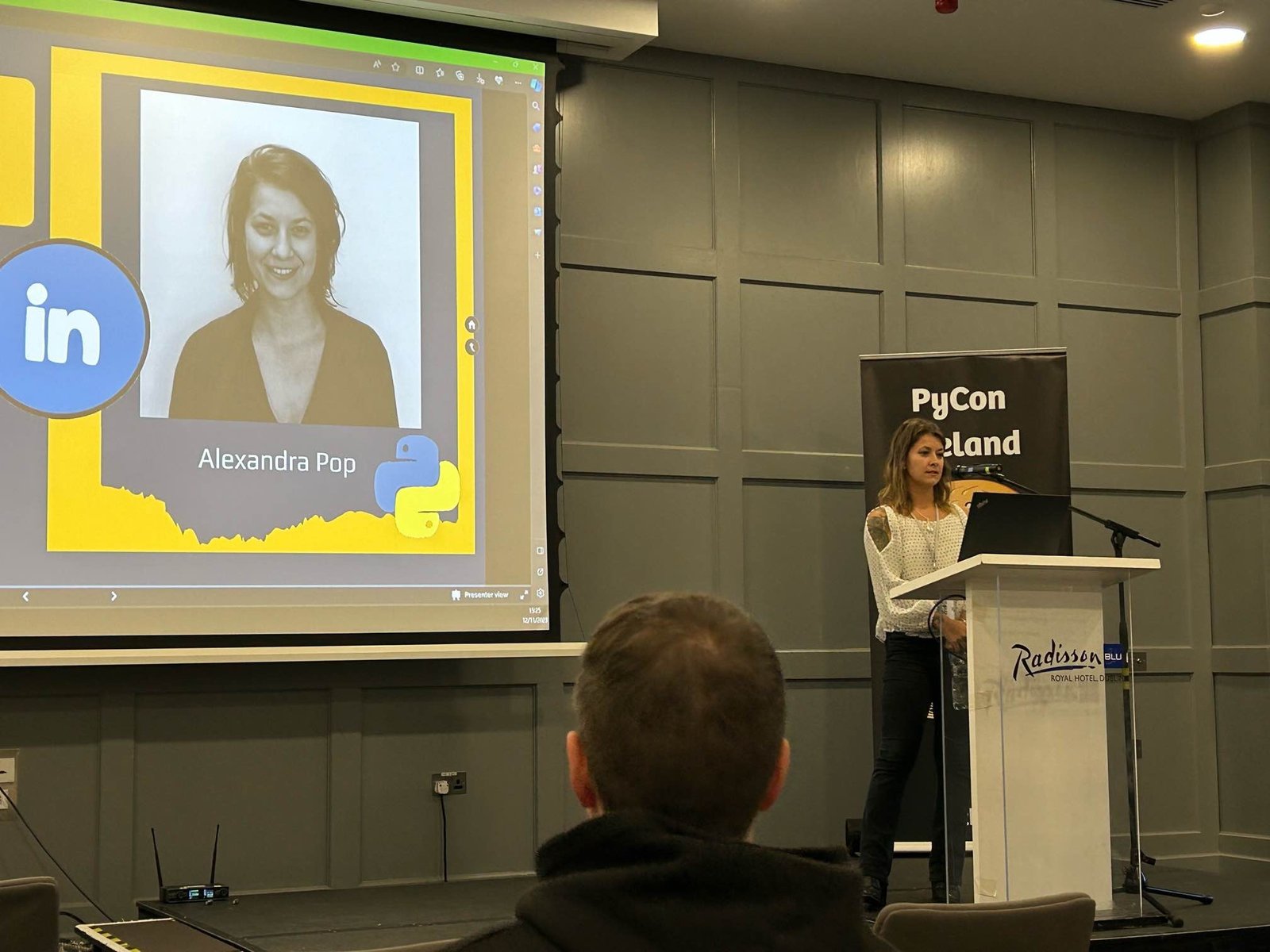
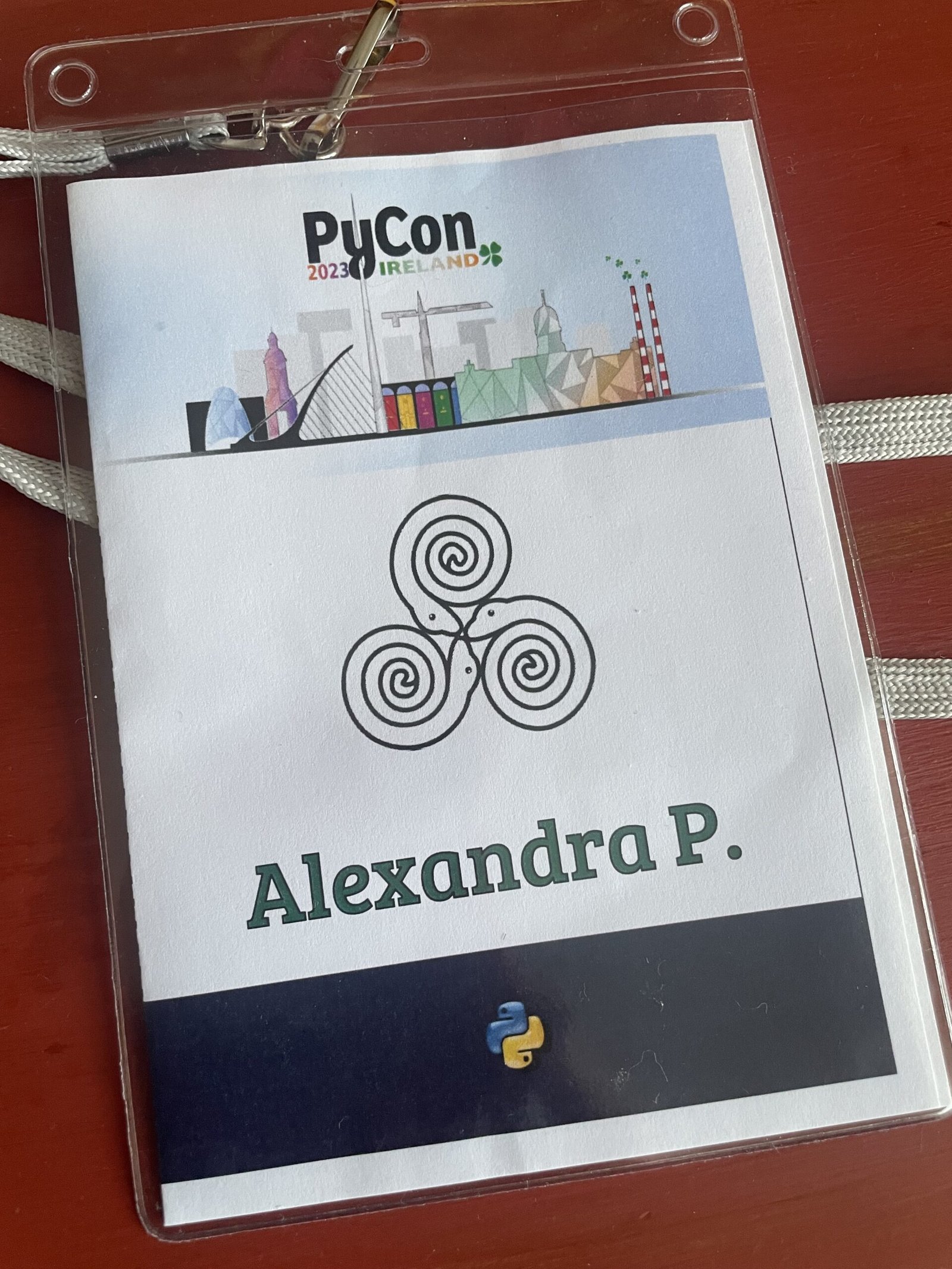
Our Recruitment Operations Manager, Alexandra Pop, has recently attended PyCon Ireland as a speaker. PyCon Ireland was organised by Python Ireland, and it’s now a fixture in the calendar for November. This year’s conference took place at Radisson Blu and the chairperson, Nicolas Laurance, put together a great team of staff and volunteers that delivered an excellent 2 days of networking, workshops, and talks.
PyCon Ireland 2023 featured an extensive and diverse range of talks, covering various Python-related topics. Insights on architecting dashboards and exploring AWS automation. Real-world applications of AI with AWS SageMaker. From Python’s latest updates and improvements to its applications in Quantum Computing and AI, the conference had something for everyone.
Important topics such as Python education, AI Biases were also addressed, and there was a mix of workshops where new and experienced Pythonista came together to share and collaborate.
It was interesting to see that the community is collaborating and making advancements in the areas that Python is lacking, such as improving speed and performance. It’s safe to say that the popularity trend will continue.
Alexandra spoke with a few of the attendees about the latest applications in AI, the trends that they are seeing, and the challenges that they are experiencing. The consensus is that while AI is growing and the buzz around it makes it a must-have for a lot of organisations out there, it is very hard to implement and adopt it in a way that will improve productivity and efficiency unless data quality is not there. The advice from the Python community is before adopting and implementing AI, make sure you know exactly what issue you are looking to solve and review your data first.
One of the final talks of the conference was delivered by Alexandra, and the focus was on applying Python coding principles to a job application, from CV writing to the interview. The session was very successful with a mix of graduate and senior engineers attending and taking great interest in how to approach the job search in the Irish Market and what the best ways are to showcase your skills to a potential employer. You can view Alexandra’s presentation here, and the talk will soon be uploaded on the Python Ireland Youtube channel.
It has been a great experience to meet and talk with the Python talent in Ireland. It’s great to see this area growing, and graduates taking a big interest, it is for sure one with a bright future.

The role of the data professional has evolved hugely in the last two decades. Big Data and Tech advancements are reshaping roles.
Alejandro, our specialist data recruiter, shares insights on the changes he has witnessed in 10 years and looks forward to what the future may hold for trends in Data.
Although there is no exact date for its creation, it can be said that the term Big Data began to be widely used in the mid-1990s and early 2000s. It is incredible how in just two decades, Big Data has evolved in terms of tools, technologies, data analysis methods, and even the professional profiles that work with it. The technology market is advancing at an unstoppable pace.
As a recruiter, I have witnessed firsthand how Big Data has transformed the way companies manage and utilise their data. But above all, I have seen how hiring needs in companies have been changing and, consequently, how professional profiles have been evolving.
I still remember when I took my first steps in the world of recruitment. By some stroke of luck, I have always been involved in selection processes for data analysis departments, which has allowed me to experience every change. It’s amazing how much everything has changed in a decade. And when the market transforms so quickly, one must study, investigate, and adapt to the changes in order not to be left behind.

And just when you think you know everything about the world of data, new terms start to emerge.
From Database Administrators and Data Analysts…
In the past, the focus was on hiring database administrators, professionals with skills in storing, cleaning, and processing data. At some point, I can’t remember when exactly, the role of Data Analyst emerged, where in addition to technical knowledge, they needed to have a more analytical profile and be able to use visualization tools to make the numbers understandable to everyone. This profile sparked a revolutionary shift.
Data analysts were the key professionals in the field of Big Data. These profiles had strong technical skills, such as database knowledge, SQL, and data visualization tools. Their main function was to extract, clean, and transform data for analysis and presentation. However, as data volumes increased and became more complex, it became clear that more advanced skills were needed to harness the full potential of Big Data.
And then came Business Intelligence…
Sometimes, it seems like trends even reach the recruitment processes. I remember the first time I heard the term Business Intelligence. Technically, it wasn’t a new term, but it arrived as a trend that was here to stay. While data scientists delve into the depths of data, Business Intelligence professionals are the guides who show us the way. They are the masters of visualisation tools and data analysis geared towards decision-making.
Overnight, recruiters learned about tools like Tableau, Power BI, or QlikView. And the best part… we realised that we could use them too. The data market had been liberalised, no longer requiring one to be a computer engineer to work with data. It’s interesting to see how the perception of companies has changed regarding the importance of data handling. Nowadays, there are even strategic departments analysing data in human resources, marketing, and more.
…to Data Scientists
It is in this context that the role of the Data Scientist emerged. Data Scientists are multidisciplinary professionals who combine technical skills, programming expertise, knowledge of mathematics and statistics, and experience in machine learning. In other words, suddenly companies no longer asked me to find a professional with computer skills and knowledge of SQL. Now they needed individuals capable of using advanced analytical techniques that went beyond basic descriptive analysis. Suddenly, new concepts appeared in my dictionary: algorithms, automations, predictions… My goodness, no one told me when I studied Political Science or Human Resources Management that I would have to learn all this new vocabulary. I suppose that justifies why I ultimately decided to study Data Analysis. If you can’t beat the enemy, better join them. Or at least that’s what people say.

The Future
Every year, new tools focused on data analysis, new ways of leveraging it, and new business needs emerge in the market. In the fascinating world of Big Data, where technological advancements and new analytical techniques emerge at a rapid pace, adaptability and continuous learning have become vital skills for professionals in this field.
As a recruiter, I have firsthand witnessed the importance of studying and adapting to stay ahead. Profiles that were once highly sought after can quickly become obsolete due to technological advancements or changes in market demands. That’s why I believe it is essential to never stop studying or learning, in order to understand the market and your clients.
Additionally, it is crucial to seek candidates who not only have current skills and knowledge but also have the ability to adapt and learn new tools, techniques, and concepts that the future will demand from them.
But that isn’t all. Every year, new concepts emerge: Data Engineering, Data Governance, Machine Learning. In such a dynamic field, challenges and learning opportunities are always present.
Conclusion
It has been a decade since I started working as a recruiter, searching for data analysis profiles. And it almost seems like all those roles I work with will soon become obsolete again. Perhaps, in a short time, recruiters will be seeking professionals who will exclusively work in Artificial Intelligence, Spatial Data Mining, or learning algorithms for nanobots. It sounds like science fiction, but the truth is that many are pointing towards it being the future. In the face of this imminent future, adaptability and continuous learning will be crucial characteristics for both recruiters and candidates.