


La ciberseguridad ha evolucionado rápidamente en los últimos años, y la incorporación de la inteligencia artificial (IA) ha impulsado esta transformación aún más.
Hoy en día, la IA permite que los equipos de seguridad detecten y respondan a amenazas en tiempo real, gestionen grandes volúmenes de datos y puedan predecir posibles ataques antes de que ocurran. Sin embargo, este avance también trae consigo un desafío para las empresas: encontrar y retener al talento adecuado para manejar esta tecnología avanzada.

La IA en Ciberseguridad: cambios clave
La inteligencia artificial ofrece beneficios significativos a la ciberseguridad, entre los que destacan:
1. Detección proactiva de amenazas:
Las soluciones basadas en IA pueden analizar patrones en grandes volúmenes de datos para detectar anomalías y amenazas antes de que ocurran. Esto reduce significativamente el tiempo de respuesta y la probabilidad de intrusiones.
2. Automatización de tareas repetitivas:
La IA permite automatizar tareas repetitivas y de bajo valor, como la clasificación de alertas o la revisión de registros, liberando a los especialistas para enfocarse en amenazas complejas y en la planificación estratégica.
3. Análisis predictivo:
Gracias al aprendizaje automático (machine learning), los sistemas de IA pueden prever posibles vulnerabilidades, anticipando las tendencias en ciberataques y mejorando así la capacidad de defensa de la organización.
4. Respuesta rápida y automatizada:
Con la IA, las empresas pueden implementar respuestas automáticas a ciertas amenazas, limitando los daños y conteniendo el riesgo sin intervención humana inmediata.
La nueva demanda de talento en Ciberseguridad
Con esta transformación, el perfil del profesional de ciberseguridad está evolucionando. Hoy se buscan habilidades que antes no se consideraban prioritarias en esta área. Veamos algunos de los conocimientos y competencias más demandados:
1. Especialización en Machine Learning y Data Science:
Los profesionales con conocimientos en algoritmos de machine learning, data science y big data se están volviendo esenciales. Son quienes desarrollan y afinan los modelos que permiten a los sistemas de IA mejorar continuamente en la detección de amenazas.
2. Programación orientada a IA:
La capacidad para programar en lenguajes como Python, R o Julia, y experiencia en marcos de trabajo de IA como TensorFlow y PyTorch, se está convirtiendo en una habilidad valiosa para implementar soluciones personalizadas de ciberseguridad.
3. Análisis de comportamiento e ingeniería de amenazas:
Con el uso de IA, es fundamental que los equipos de seguridad comprendan y puedan analizar patrones de comportamiento, ya que muchas amenazas modernas dependen de vulnerabilidades humanas.
4. Conocimiento en ética y sesgo de IA:
La IA no es infalible y puede aprender comportamientos sesgados. Los profesionales que entienden los riesgos éticos y de privacidad pueden ayudar a las empresas a evitar problemas de discriminación o errores de juicio al responder a una amenaza.
Cómo atraer y retener talento especializado en Ciberseguridad e IA
La alta demanda y la escasez de profesionales con estas habilidades especializadas hacen que la atracción y retención de talento sea un desafío.
Para captar a los mejores candidatos, las empresas deben enfocarse en:
Fomentar una cultura de innovación y colaboración:
Muchos de estos profesionales buscan empresas donde puedan trabajar en proyectos innovadores y colaborar con equipos multidisciplinarios.
Ofrecer oportunidades de desarrollo:
Los expertos en ciberseguridad e IA valoran las oportunidades de aprendizaje continuo. Ofrecer certificaciones, acceso a conferencias y programas de capacitación puede ser un diferencial importante.
Beneficios competitivos y flexibilidad laboral
Además de una compensación atractiva, los profesionales en este campo valoran la flexibilidad y los beneficios adicionales, como la posibilidad de trabajar en proyectos significativos que tengan un impacto real.
El futuro de la Ciberseguridad con IA
A medida que la IA sigue evolucionando, también lo harán las amenazas digitales. Las empresas que inviertan en equipos de ciberseguridad especializados en inteligencia artificial estarán mejor preparadas para proteger sus datos y su reputación. Contar con profesionales que comprendan tanto la ciberseguridad como la IA no es solo una estrategia de defensa: es una inversión en el futuro de la empresa.
En conclusión, el talento en ciberseguridad con especialización en inteligencia artificial es crucial para enfrentar los desafíos de seguridad actuales.
Trabajar con una agencia de reclutamiento como E-Frontiers especializada puede ayudar a tu empresa a encontrar los profesionales que realmente necesitas para estar a la vanguardia en seguridad digital.
No dudes en contactarnos para saber más sobre cómo podemos ayudarte.

Our Online Event
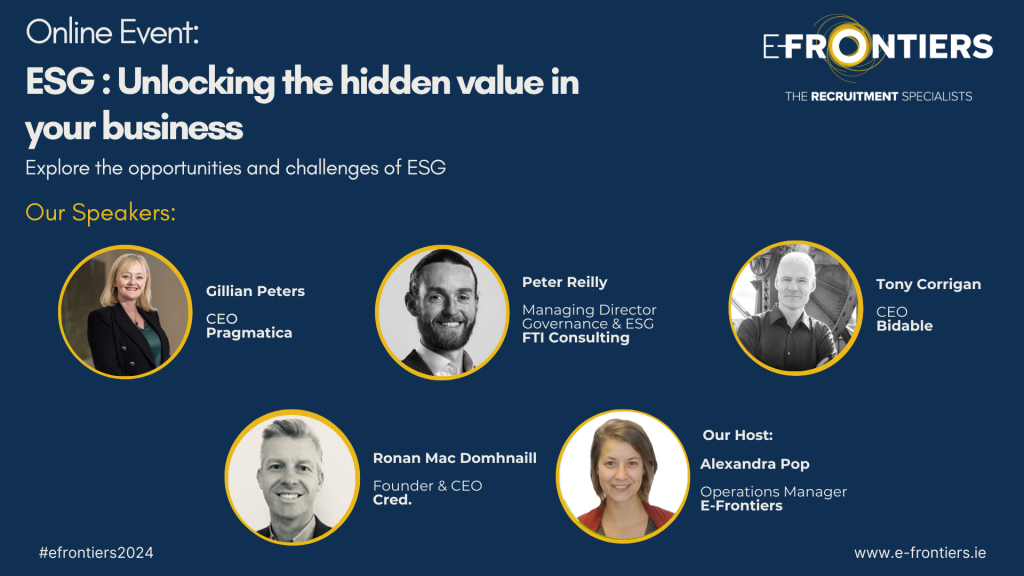
On October 24th we had the pleasure of hosting a roundtable event on ESG. This event was designed for business leaders, sustainability professionals, and anyone looking to explore how ESG is transforming business practices.
In this event, we brought together a panel of industry experts to share their perspectives on the trends, challenges, and opportunities that ESG presents. Alexandra Pop, Operations Manager @ E-Frontiers moderated and guided this conversation which addressed a wide range of topics.
Gillian Peters’ career has spanned various roles, primarily in marketing and business development within financial services. As Business Development Director at CPA Ireland, she earned her MBS in Business Practice and developed a deep interest in sustainability in business.
In February 2023, she transitioned to CEO of Pragmatica, where her mission is to create tailored roadmaps and innovative solutions that guide companies on their sustainability journeys.
Tony Corrigan With over a decade of experience in government bidding, Tony Corrigan has focused on helping SMEs succeed in public contracts. He founded TenderScout in 2014 to guide SMEs through the tendering process, equipping them with effective tools and strategies.
In 2023, Tony launched Bidable.ai, an AI-driven platform that enhances bids with precise insights, showing businesses their expected scores and ways to improve. This platform, built on Tony’s expertise, is a critical resource for SMEs aiming to win in the competitive tendering arena. His dedication to SME success remains the core of Bidable’s mission.
Peter Reilly Managing Director of Governance and ESG at FTI Consulting , advises major global companies on corporate governance, focusing on reporting, stakeholder engagement, remuneration, and ESG strategy development to meet institutional and regulatory standards. With deep expertise, Peter has led activist defense programs across the US and Europe, enhanced governance frameworks for boards, and conducted proxy support strategies.
Previously, he served as Lead Analyst for Northern Europe at Glass Lewis, overseeing ESG research and recommendations. He holds a BA in Economics, Politics, and Law from Dublin City University and an LLM from Trinity College Dublin.
Ronan Mac Domhnaill is the founder of Cred, a Sydney-based Education and Technology company.
Cred’s focus is on the “Social” side of ESG.
Cred helps organisations:
– Engage, retain, and attract top talent.
– Create the right culture – balancing profit, people and purpose.
– Bridge the generational leadership gap
– Identify future leaders
– Use ESG as a competitive advantage
So that they can increase their bottom line sustainably.
Our experts addressed topics such as:
Understanding ESG: Beyond Recycling
-Definition and scope of ESG (Environmental, Social, Governance) and how it differs from traditional sustainability practices.
-Discussion on why businesses are increasingly considering ESG, especially in B2B vs. B2C contexts.
External and Internal Factors Influencing ESG Strategy
-External factors: capital accessibility, supply chain, customer demands, and reporting obligations.
-Internal factors: workforce capabilities, talent competition, and aligning governance structures to support sustainability goals.
Navigating ESG Reporting and Social Responsibilities
-Overview of CSRD thresholds and VSME voluntary reporting for SMEs.
-Considerations for businesses when evaluating the social aspects, such as supply chain transparency, staff policies, and community engagement.
Our discussion helps to define ESG’s scope beyond traditional sustainability and explores the internal and external factors driving ESG strategies. Our expert panel sheds light on key issues shaping this evolving landscape and offers practical takeaways on ESG reporting and the importance of aligning social responsibilities with business goals.
If you missed it, reach out to our team today to learn how ESG can benefit your organisation.
Employee retention is crucial to allow business to grow and flourish but becomes more difficult when suitably skilled candidates are in short supply. This results in high demand for professionals and fierce competition among companies, leading to increased candidate turnover.
To highlight current trends, PWC recently published a survey outlining that 4 in 10 Irish workers are likely to switch jobs in the next year and detail some issues driving this trend. Read more here.
At E-Frontiers Recruitment, we provide a quality-driven recruitment service and take pride in seeing candidates we source have a long period of rewarding employment with our clients. We recognise the importance of retaining employees and are often asked by clients what are other companies doing to retain staff.
In this article, we want to share some actionable key employee retention strategies that are often easy to implement, to help your employees feel valued and prevent them from seeking opportunities elsewhere. Although some of these strategies may require financial investment, in most cases, significant budget increases are typically unnecessary.

10 Key Strategies for Employee Retention
Positive Work Environment
Create a collaborative and respectful environment where employees can share their opinions and participate in internal projects if they wish. Encourage participation in wellness projects, volunteering, and company events.
Promoting a culture of inclusion and diversity, where everyone’s ideas are respected and valued, will enhance well-being and help retain talent.
Employee Well-Being
Offer well-being programs that include psychological support, physical health programs, and general wellness activities.
A wellness committee composed of employees can be an excellent way to listen to the team, analyse their needs, and propose initiatives in this area.
Growth and Development Opportunities
Foster a culture where professional and personal growth is a priority. Offer continuous training and learning opportunities tailored to employees’ interests.
Establish clear and transparent career paths with internal promotions based on achievable milestones. Communicating these plans to all employees will significantly strengthen the team.
Encourage employees to participate in training other teams. Supporting those who wish to learn new technology or methodology and later share that knowledge through workshops is an initiative that makes them feel valued.
Recognition and Rewards
Recognising and rewarding good performance and significant contributions is crucial. Implementing both formal and informal recognition programs can be an excellent starting point to reinforce employee well-being and boost talent retention.
From performance bonuses to informal team awards, these initiatives effectively foster a sense of belonging and highlight the importance of each team member.
Competitive Compensation
Offering competitive salaries and benefits is essential. It’s crucial to avoid offering wages below market standards and ensure pay equity within the team. Proposing lower salaries to new employees can lead to feelings of undervaluation and motivate them to seek new opportunities.
Including bonuses, stock options, or equity participation can increase employee involvement in the business.
Workplace Flexibility and Remote Work
Implementing remote work options, hybrid models, and flexible schedules is essential. Numerous studies indicate that telecommuting benefits employee well-being, improves work-life balance, and increases productivity.
Although not all professions or projects allow for 100% remote work, offering a hybrid model and flexibility can be key to attracting, selecting, and retaining talent.
Challenging and Interesting Projects
Assign stimulating projects that allow employees to utilise and expand their skills.
Encouraging innovation and creativity at work while valuing and listening to employee ideas will help with employee retention.
Adequate Technology and Tools
Provide the necessary technologies and tools for employees to perform their work efficiently.
Staying up to date with the latest industry trends and advancements in the sector is fundamental for employee retention.
Good Communication and Feedback
Promote open and transparent communication at all levels. Leaders should consistently communicate their strategies and ensure smooth communication between employees, team leaders, operations departments, and executives.
Provide regular, constructive feedback through quarterly company meetings and one-on-one sessions with team members.
Attractive Company Culture
Align the company’s mission and values with those of the employees, starting with the recruitment process. Promote an inclusive and respectful culture with Diversity, Inclusion, and Equality policies.
Organise activities and events to strengthen team spirit. Team-building exercises are fundamental to fostering stronger relationships among employees and improving the sense of belonging, thereby enhancing talent retention.
Implementing these strategies can help companies keep their IT employees satisfied and engaged, reducing turnover and ensuring a solid and stable team. But do remember, the above strategies are neither exhaustive nor prescriptive so when considering what strategies will work best for your business, be sure to engage with your employees from the start of the process.
If you would like more advice or to share ideas, feel free to contact us for a call or meeting to discuss in more detail.

Nuestro Evento Online
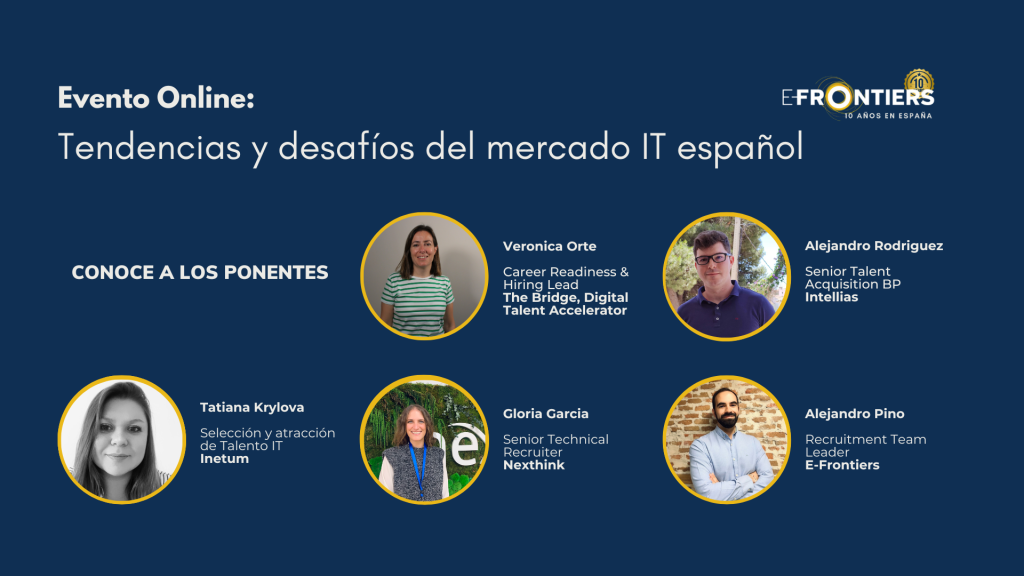
El pasado 3 de octubre tuvimos el placer de organizar una mesa redonda donde hablamos sobre las tendencias del mercado tecnológico en España para este 2024. En este evento reunimos a cinco expertos del sector del Talento IT, quienes compartieron valiosas perspectivas sobre cómo está evolucionando el mercado tech desde la perspectiva del talento. Los miembros de nuestro equipo de E-Frontiers España, Cristina Rafael (Marketing) y Alfonso Moreiras (Senior Technical Recruiter), moderaron y guiaron esta conversación, en la que se abordó una amplia gama de temas.
Los Panelistas
Verónica Orte Sánchez – Career Readiness & Hiring Lead @ The Bridge | Digital Talent Accelerator
Cuenta con más de 10 años de experiencia en el sector de RRHH. Especialista en talento digital y actualmente es responsable del departamento de carreras profesionales y relaciones con empleadores en la escuela The Bridge.
Tatiana Krylova Lekhanova – Selección y atracción de Talento IT – Inetum
Con más de 7 años de experiencia en Selección de Talento IT, se ha enfocado y especializado en el ámbito de la ciberseguridad.
Alejandro Rodríguez – Senior Talent Acquisition BP – Intellias
Está especializado en el área de selección dentro del sector tecnológico. Cuenta con diez años de experiencia en el mercado del talento Tech europeo y ha trabajado con empresas internacionales en las áreas de consultoría, SAAS y Fintech.
Gloria García Leis – Senior Technical Recruiter -Nexthink
Cuenta con 8 años de experiencia en el área de HR. Estudió Derecho, pero su pasión por las personas la orientó hacia Recursos Humanos. Está especializada en el sector IT tanto a nivel nacional como internacional, y ha trabajado en diferentes países, así como en consultoría y en empresa final.
Alejandro Pino Alamillo – Recruitment Team Lead – E-Frontiers
Con más de 10 años de experiencia como IT Recruiter, Alejandro se ha especializado en el mercado del Big Data. Además de ser responsable del equipo de E-Frontiers en España, es profesor de People Analytics en diferentes programas de bootcamps y másters.
Nuestros expertos abordaron temas como:
- Panorama del mercado en este 2024 y comparativa con 2023
- Perfiles más demandados
- Soft Skills e idiomas más valorados por las empresas
- Desde la perspectiva de la formación y bootcamps, ¿Qué es lo que más se está demandando?
- Consejos para perfiles junior en búsqueda de empleo
- Recomendaciones para perfiles senior
- Previsión para 2025 y tecnologías emergentes
Puedes ver la grabación del evento aquí:
El mercado está cambiando y esperamos que en 2025 continúe por el camino de este año. El auge de tecnologías en el ámbito de la ciberseguridad, los datos y la IA marcan el camino hacia una nueva era, combinándose, como siempre, con tecnologías de la última década, como la programación en Java, Python, etc.
Las habilidades blandas, como la capacidad de adaptación, flexibilidad y saber trabajar y comunicarse con equipos en remoto, son clave para los candidatos. En un mundo donde todo se mueve muy rápido, seguir actualizando los conocimientos es necesario para aportar valor y seguir progresando.
¡Sigamos aprendiendo y creciendo juntos!
Contáctanos para saber más sobre nosotros y cómo trabajamos con clientes y candidatos.
¡Te esperamos en la edición del año que viene!
La retención de talento es crucial, especialmente en el sector tecnológico, donde la alta demanda de profesionales y la feroz competencia entre las empresas incrementan la rotación. En E-Frontiers España comprendemos la importancia de conservar a nuestros trabajadores, por lo que queremos compartir algunas estrategias clave que, en muchos casos, son fáciles de implementar para que vuestros empleados se sientan valorados y no busquen oportunidades en la competencia.
Es importante destacar que siempre hay margen para la mejora. Aunque algunas de estas estrategias pueden requerir una inversión, en la mayoría de los casos no es necesario un aumento significativo del presupuesto.

10 Estrategias Clave para la Retención de Talento
Ambiente de Trabajo Positivo:
Crear un entorno colaborativo y respetuoso donde los empleados puedan aportar sus opiniones y colaborar en proyectos internos si lo desean. Promover la participación en proyectos de bienestar, voluntariados y eventos de empresa.
Fomentar una cultura de inclusión y diversidad donde las ideas de todos sean respetadas y valoradas favorecerá el bienestar y la retención de talento.
Bienestar del Empleado:
Ofrecer programas de bienestar que incluyan apoyo psicológico, programas de salud física y actividades de bienestar general.
Un comité de bienestar compuesto por empleados puede ser una excelente manera de escuchar a los empleados, analizar y proponer iniciativas en esta área.
Oportunidades de Crecimiento y Desarrollo:
Propiciar una cultura donde el crecimiento profesional y personal sea prioritario. Ofrecer formación continua y oportunidades de aprendizaje, ajustadas a los intereses de los empleados.
Establecer planes de carrera claros y transparentes, con promociones internas basadas en hitos alcanzables, es fundamental. Comunicar estos planes a todos los empleados fortalecerá significativamente al equipo.
Fomentar la participación de los empleados en la formación de otros equipos es crucial. Apoyar a aquellos que deseen aprender una nueva tecnología o metodología y luego compartir ese conocimiento mediante talleres, es una propuesta interesante que hará que se sientan valorados.
Reconocimiento y Recompensas:
Reconocer y recompensar el buen desempeño y las contribuciones significativas es fundamental. Implementar programas de reconocimiento, tanto formales como informales, puede ser un excelente punto de partida para reforzar el bienestar de los empleados y la retención de talento.
Desde bonificaciones por rendimiento hasta premios informales entre equipos, estas propuestas son efectivas para fomentar el sentido de pertenencia y la importancia de cada miembro del equipo.
Compensación Competitiva:
Ofrecer salarios y beneficios competitivos es esencial. Es crucial evitar sueldos inferiores a los del mercado y garantizar que sean justos y equitativos dentro del equipo. Proponer salarios más bajos a nuevos empleados puede generar sentimientos de infravaloración y motivar la búsqueda de nuevas oportunidades.
Incluir bonificaciones, acciones o participaciones en la empresa para aumentar la implicación en el negocio.
Flexibilidad Laboral y Trabajo en Remoto:
Implementar opciones de trabajo remoto, modelos híbridos y horarios flexibles es fundamental. Numerosos estudios indican que el teletrabajo beneficia el bienestar de los empleados, mejora el equilibrio entre su vida personal y laboral, y aumenta la productividad.
Aunque reconocemos que no todas las profesiones o proyectos permiten el teletrabajo al 100%, ofrecer un modelo híbrido y flexibilidad laboral puede ser clave para atraer, seleccionar y retener talento.
Proyectos Interesantes y Retadores:
Asignar proyectos estimulantes que permitan a los empleados utilizar y ampliar sus habilidades.
Fomentar la innovación y la creatividad en el trabajo, valorando y escuchando las ideas aportadas por los empleados ayudarán con la retención de talento.
Tecnología y Herramientas Adecuadas:
Proporcionar las tecnologías y herramientas necesarias para que los empleados puedan realizar su trabajo de manera eficiente.
Estar al día con las últimas tendencias y avances del sector es fundamental.
Buena Comunicación y Retroalimentación:
Promover una comunicación abierta y transparente a todos los niveles. Es esencial que los directivos comuniquen sus propuestas y que exista una comunicación fluida entre empleados, líderes de equipo, departamentos de operaciones y directivos.
Proporcionar retroalimentación constructiva y regular, mediante reuniones trimestrales de empresa y reuniones uno a uno con los miembros del equipo.
Cultura de Empresa Atractiva:
Alinear la misión y los valores de la empresa con los de los empleados desde el proceso de selección. Promover una cultura inclusiva y respetuosa, con políticas de Diversidad, Inclusión e Igualdad.
Organizar actividades y eventos que fortalezcan el espíritu de equipo. Los team building son fundamentales para que los empleados se conozcan mejor y refuercen el sentimiento de pertenencia, mejorando con ello la rentención de talento.
Implementar estas estrategias puede ayudar a las empresas a mantener a sus empleados de IT satisfechos y comprometidos, reduciendo la rotación y asegurando un equipo sólido y estable.
Si deseas más consejos o intercambiar impresiones, no dudes en contactarnos para concertar una reunión.
Autora del artículo: Cristina Rafael Sánchez
¿Hablamos? Organiza una llamada con nuestro Líder de Equipo, Alejandro Pino, aquí: Mi calendario
Our first 10 years doing recruitment in Spain
This year marks a decade since E-Frontiers took a significant step by expanding its operations to Spain. With a clear focus and defined mission, it arrived in Madrid with the firm conviction of providing effective solutions to both companies and candidates across the country. Today, looking back, we take pride in how our recruitment in Spain has transformed lives, advanced careers, and helped companies find the talent they need to thrive.

First conversations with E-Frontiers
My relationship with E-Frontiers goes back a long way. Even before working here, I had connections with its employees and some of its directors. Why? Because I knew that their team had a perfect understanding of the Spanish IT market; because their people were present at all the key tech events, and most importantly, because I knew they worked differently. Where other companies struggled to find qualified talent in a competitive market, the people at E-Frontiers were able to help their clients build highly qualified teams.
I remember one of my first conversations with one of the founders of E-Frontiers. While I was telling him about how I did my job at a large company in the sector, sharing data about how many interviews I conducted and how many hires I made, none of this seemed to impress him. What he said to me was:
“Pino, for us, the important thing here is the candidate and our clients. It’s quality, not quantity. The most important thing is to support individuals throughout their journey, whether they are candidates or hiring managers. For candidates, this means preparing them for interviews and ensuring they find a job where they truly fit and feel happy. For hiring managers, it involves leveraging our expertise to introduce them to strong candidates who will positively impact their teams”
It didn’t take long for me to realize that E-Frontiers really works differently. Their teams not only have great expertise in the market, but they also understand technology, the labor world, and they truly know how to prepare a candidate to achieve the desired job.
How we work
Our success in Spain is measured not only by the number of placements made but by the quality and impact of our solutions. Every company we collaborate with receives a personalized service tailored to their specific needs. We strive to deeply understand each client’s corporate culture, goals, and challenges. This understanding allows us to find the right talent—people who not only meet the technical requirements but also fit perfectly into the work environment and share the company’s vision.
However, our true passion and commitment are focused on the candidates. We know that job hunting can be an overwhelming and sometimes discouraging experience. That’s why we dedicate ourselves to accompanying each candidate on their journey, providing them with support, guidance, and life-changing opportunities.
From the first contact, our goal is to establish a relationship of trust with eachn individual. With candidates, we listen to their aspirations, understand their strengths, and work to find the perfect opportunity that allows them to develop both professionally and personally. It’s not just about finding a job; it’s about building a career and realizing dreams.
Success Stories
Over these ten years, we have witnessed countless success stories. From young graduates who found their first job to experienced professionals who discovered new opportunities and challenges that revitalized their careers. Each story is a testament to our commitment to the well-being and development of people.
I remember the case of Marta, a talented engineer who, after months of unsuccessful job searching, came to our agency feeling discouraged. After getting to know her skills and aspirations, we found her a position at a growing tech company. Today, Marta has not only advanced professionally but also leads innovative projects and has become an inspiration to others.
Another example of a client success story involves a mid-sized tech company struggling to find experienced software developers with experience with a new and unusual programming language. Despite numerous efforts, they were unable to attract the right candidates. After partnering with E-Frontiers, we conducted an in-depth analysis of their needs, culture, and the specific challenges they faced. We then leveraged our extensive network and market knowledge to identify and attract top talent. Within a few months, the company had successfully hired several highly skilled developers who not only met the technical requirements but also integrated seamlessly into the team, significantly boosting their productivity and project success rates.
Continued Growth – Recruitment in Portugal
We have recently expanded into the Portuguese market, supporting clients from Spain, Ireland and the UK as they grow in Portugal. Our goal is to deliver our quality service in this promising and expanding market.
Our mission
As we celebrate our tenth anniversary in Spain, we renew our commitment to excellence and dedication to our clients and candidates. We are more motivated than ever to continue providing effective and humane solutions to the labor market. Our mission remains clear: to connect people with opportunities that allow them to reach their full potential.
Thank you to everyone who has trusted us and been part of this story. We look forward to celebrating many more decades with all of you.
Alejandro Pino Alamillo – Team Lead Recruiter @E-Frontiers Spain
Do you want to speak with me? Book a slot here
In a recent webinar hosted by Anca Antonica and Paula Coffey from E-Frontiers Recruitment Agency, technology enthusiasts and industry professionals had the privilege of gaining valuable insights from Paul Lynch, the Co-founder of Showtime Analytics. This captivating webinar took participants on a journey through Paul’s extensive career in tech entrepreneurship and his experience in revolutionising the cinema industry through data analytics. Let’s dive into the highlights of this engaging discussion.

Exploring Paul’s career
Paul’s journey in technology began at a young age, influenced by his father’s role as a software developer. Growing up with computers in his household, Paul’s fascination with technology drove him to attend coding schools and develop his skills in building flash games and applications. His early exposure to technology laid a solid foundation for his future endeavours.
Starting his career at Vision, a consultancy firm, Paul gained a wealth of experience working across various industries. He highlighted the advantages of working in consultancy, where he had the opportunity to reinvent himself with each new client. This exposure allowed him to learn from talented individuals and strengthen his technical and business acumen.
Paul’s career path took an exciting turn when he joined Acceleration, a product-focused company within Vision. This experience made him realise his passion for working on innovative products, which led him and his co-founder, Richie, to establish Skupe Net—a global classified ads venture. While the ideas were promising, Paul acknowledged that the company faced challenges in implementation and eventually pivoted to focus on the lucrative motor industry.
Embracing the Value of Failure
During his career journey, Paul had a profound realisation about the importance of embracing failure and learning from it. A job interview that emphasised the need for a “fail fast” approach shaped his perspective. This valuable advice inspired him to constantly assess the value his initiatives provided to customers and iterate accordingly.
The Birth of Showtime Analytics
Paul’s passion for data analytics and an opportunity within his family’s cinema business sparked the birth of Showtime Analytics. Recognizing the data-rich nature of the cinema industry, Paul and his team aimed to provide actionable insights by consolidating and leveraging data assets. Their efforts quickly positioned Showtime Analytics as a leading player in the cinema data realm, working closely with cinemas and now expanding to collaborate with studios.
Paul Lynch’s webinar presentation illuminated the transformative power of data analytics in the cinema industry. His personal journey showcased the importance of early exposure to technology, embracing failure as a catalyst for growth, and the incredible potential of data-driven decision-making. As the co-founder of Showtime Analytics, Paul continues to drive innovation and empower the cinema industry with actionable insights derived from data.
Relationships between Showtime Analytics and E-Frontiers
Paul mentioned the relationship between Showtime Analytics and E-Frontiers recruitment has been mutually beneficial. Showtime Analytics values the screening and recruitment services provided by E-Frontiers, ensuring a more efficient hiring process. Additionally, E-Frontiers’ insights into various markets and their expanding technical talent pool have proven invaluable to Showtime Analytics. This partnership has facilitated the expansion of Showtime Analytics’ QA team in Spain and the exploration of new markets and countries. The collaboration between these two companies has fostered growth and success for both parties. Showtime Analytics expresses gratitude for E-Frontiers’ contributions and acknowledges their positive impact on their operations.
The webinar left participants inspired and eager to explore the limitless possibilities of data analytics in their respective fields. It served as a reminder that by harnessing the power of data, industries can unlock new opportunities, make informed decisions, and stay ahead in the ever-evolving digital landscape.
If you’re seeking growth and need top talent, don’t hesitate to contact us or explore our services as a premier recruitment agency. We operate internationally, with experienced recruitment teams based in Ireland, Spain, the UK, and the US.
The world of recruitment is crowded with jobseekers, job-providers, and the all-important middle-person (yes, that’s us!) whose job it is to fill an open vacancy with the person that is the best fit. This job can certainly seem like somewhat of a mystery to those who are not in the industry. What exactly do we do? how many CVs do we really read? who pays?
In this blog post, Lisa Cappelli, Senior Recruitment consultant (fomer) and Conor Hackett, Senior Recruitment consultant (accounting & finance) give an insight into a day in the life of a recruitment consultant and some (mis)perceptions of what people think recruiters do vs what recruiters really do.

Firstly, the science. Recruiters are responsible for handling all aspects of the recruitment process and need to be well-versed in applicable laws and regulations.
The job really does require excellent communication skills and negotiating abilities.
We devise campaigns and strategies to reach and engage with talent, screen candidates for suitability, and do background checks.
We work with our clients to define and refine job descriptions. We play an active role in advising at the interview stage, and the job negotiations phase and we assist with making a final offer. That seems like a lot of work, right?
At E-Frontiers, we have great flexibility with a hybrid working arrangement. We work in teams with an Account Manager for a more collaborative approach. Our main aim is to build a strong rapport and relationship with our candidates and to get to a stage where we are their career ally, in their corner, and always on the lookout for new opportunities for them. Communication and listening skills are key!
Popular misperception 1
Recruiters are seen as salespeople, someone to avoid for fear of a relentless sales pitch, with unsolicited emails and calls going on for months.
Reality
recruiters are only interested in making the perfect match between client and candidate. We have no interest in trying to twist the arms of candidates to apply for a position. It’s in our best interests to put forward the best candidates for consideration to the client and the candidates that are most likely to succeed. And critically, it must be someone who wants the job.
Popular misperception 2
The candidate will somehow be liable for payment- that must be how recruiters make their money.
Reality
Candidates do not pay a penny for the services of a recruiter. The fee is paid entirely by the client. So, a candidate will get expert advice and interview prep, an in-depth knowledge of the market they work in, and hopefully land their dream job- all for free!
Our work day
In truth, there is no typical workday for a recruitment consultant because every day is a new challenge depending on the open roles. Finding the perfect person in the talent pool for a client can sometimes be like finding a needle in a haystack. There can be days of full-on researching for candidates through databases, connections, and social media, screening those who are suitable for the role, and then engaging with the candidates on interview prep.
Our morning may be filled with screening CVs for new roles and reaching out to potential candidates to schedule interviews. Then, we might be responding to emails, setting up phone screenings, and reviewing job descriptions to make sure that we understand exactly what our clients are looking for.
In the afternoon, we might find ourselves in screening interviews, evaluating candidates for their technical skills and cultural fit. We will also check in with hiring managers to give updates on our progress with candidates and to discuss potential next steps. The priority is to ensure the candidate is a good fit for the company culture as well as the job requirements.
Before the workday comes to an end, we will update our candidate database and send follow-up emails to candidates we’ve recently spoken with. Then we make a plan for the next day and head for home.
Occasionally, we may spend some time networking with potential clients or attending industry events. We also have regular in-house training and upskilling sessions.
The recruitment process can tend to get some bad press. But good recruiters truly care about the candidate, the client and achieving the right fit between the two.
As a company, some of our core values include winning together, responsiveness, and respect, and we really do bring these values into play through our work daily.
The job is demanding and fast-paced, but exciting and full of opportunities to meet interesting people and help connect them with their dream jobs. Overall, for us, being recruiters is a challenging and rewarding job.
If you would like to discuss the next step in your career, please contact us and we will be more than happy to help.
DevOps & QA
The DevOps and QA Engineering fields have been evolving at a rapid pace with significant growth and change over the past few years and this trend is expected to continue in the coming years. In this blog post, we will discuss some of the trends in these fields and the emerging skills gap. We will also suggest some ways in which candidates can upskill, stand out and future-proof themselves for success in this area.

Emerging Trends
The world of DevOps, Cloud, and QA engineering is rapidly evolving, with new technologies and tools emerging almost daily. As a result, the market for these IT jobs has become highly competitive in Ireland and other regions, with difficulties in finding qualified candidates. This has led to an increase in demand for these jobs, and the need for organisations to hire professionals who can help them stay ahead of the curve.
DevOps
One of the most significant trends in DevOps is the increasing adoption of cloud technologies, such as Amazon Web Services (AWS), Microsoft Azure, and Google Cloud Platform (GCP). This trend is expected to continue as more and more organisations move their applications and infrastructure to the cloud. Another trend in DevOps is the use of automation tools for testing, deployment, and monitoring. Automation tools like Jenkins, Ansible, and Puppet are becoming increasingly popular and are expected to continue to be widely used.
QA Engineering
In the field of QA Engineering, one of the biggest trends is the adoption of Agile and DevOps methodologies. These methodologies emphasise collaboration, continuous integration, and testing, and are being widely adopted by organisations. Another trend in QA Engineering is the increasing use of Artificial Intelligence (AI) and Machine Learning (ML) for testing. AI and ML can help automate repetitive tasks, increase efficiency, and thus reduce errors in testing.
Skills Gaps
One of the biggest challenges in the market is the skills gap. Many companies are struggling to find qualified candidates with the necessary skills and expertise. Candidates need to find ways to stand out from the crowd and demonstrate their skills and experience. DevOps and QA engineers need to demonstrate a broad range of skills, including coding, testing, and automation. They also need to have good communication and collaboration skills to work effectively with different teams.
Candidates can achieve stand out by showcasing any relevant projects or open-source contributions that they have made. This can demonstrate their practical experience and ability to work with others in a collaborative environment. Additionally, candidates should ensure that their CVs are tailored to the specific job they are applying for, highlighting their relevant skills and experiences.
Upskill and Future Proof
To upskill and future-proof their careers, candidates can take courses and certifications in cloud technologies, Agile and DevOps methodologies, and automation tools. Candidates should highlight any relevant certifications or training that they have received. These can show that a candidate is committed to staying up to date with the latest technologies and practices. They can also participate in online communities, attend conferences and meetups, and read blogs and articles to stay updated on the latest trends and technologies. By following these strategies, candidates can increase their chances of landing their dream job in these exciting and in-demand fields.
For further careers advice and to find out about exciting DevOps and QA job opportunities in this area:
Contact John Ryan(Ireland) or Alfonso(Spain)
Open Doors Initiative
At E-Frontiers Recruitment, we have always recognised the importance of looking beyond our Recruitment agency business and considering the wider impact we can have on society and the environment. It is part of who we are and what we stand for – we want to have a positive influence and make a difference in a real way that benefits the wider community.
We have planned and implemented corporate social responsibility (CSR) programs for many years with the aim of involving E-Frontiers in meaningful activities within our society. Within the sporting arena, we are the main sponsors of Thurles Sarsfield GAA club. We also have a partnership with the Red Cross.
In 2018 we became the 15th member of the Open Doors Initiative, which now has over 100 members. Our director, Patrick Doyle is a director and Board Member of Open Doors.
So what is Open Doors Initiative and why did we join?
The Open Doors Initiative provides opportunities to marginalised members of our society, creating pathways to work through training, education, employment, and entrepreneurship.
Some of the people we work with include refugees, asylum seekers and migrants, people with disabilities and disadvantaged youth.
Becoming a member of the Open Doors Initiative was a very natural choice for E-Frontiers. Our staff come from a wide range of backgrounds just like the demographic that the ODI aims to help. Our commitment to the ODI is to help those in need on their journey to try and enter employment. As a career support company, we will do our best to make a positive change in their lives and thus in their communities.
But it is for sure a reciprocal relationship. ODI has helped us become better and be better. We lean on them to educate ourselves and upskill our team on awareness, inclusion and diversity. We strive to ingrain an ethos within our recruitment agency of giving all people a chance and we carry this ODI ethos with us, within our day-to-day work.


E-Frontiers contribution, as a Recruitment Agency
We have over 16 years of experience helping companies and candidates within the IT, Business and Financial sectors. At Open Doors Initiative, E-Frontiers is a key member in supporting the organisation in their work, listening and helping as required. There is a role to play in helping candidates with CVs, job applications and interviews as they embark on their employment journey. There is also a wider education and awareness role which is hugely important. We speak with our clients about inclusion and ensuring their business is open to a diverse range of candidates. On a practical level, we consider the clients open roles and encourage a different thought process whereby all types of candidates from all backgrounds will be considered. We are strong advocates for this initiative as we continue to spread the word through our clients, partners, and connections.
What help is available?
Participating companies offer a variety of employability interventions such as:
– Free interactive online training platform
– An internship programme specifically for people with autism to help them secure meaningful employment
– A Mentorship programme
– An employment programme for young people coming from the care system
– Pathways to Progress- Migrant Hub: this a variety of programmes aimed to support refugees and immigrants with pre-employment training, language, and integration.
– Development of access entry routes for school leavers and adults from socio-economically disadvantaged backgrounds and for people with disabilities.
– The establishment of a fund that provides grants to community groups, charities, and NGOs for new projects that support and inspire young people – helping to bridge the divide between education and the workplace
At E-Frontiers Recruitment, we believe that a small-scale enterprise with big intentions can create a great change in society.
Please come and talk to us and we can share our stories from our involvement in the Open Doors Initiative. Click here to learn more and see Open Doors progress and achievements in 2022.