

La retención de talento es crucial, especialmente en el sector tecnológico, donde la alta demanda de profesionales y la feroz competencia entre las empresas incrementan la rotación. En E-Frontiers España comprendemos la importancia de conservar a nuestros trabajadores, por lo que queremos compartir algunas estrategias clave que, en muchos casos, son fáciles de implementar para que vuestros empleados se sientan valorados y no busquen oportunidades en la competencia.
Es importante destacar que siempre hay margen para la mejora. Aunque algunas de estas estrategias pueden requerir una inversión, en la mayoría de los casos no es necesario un aumento significativo del presupuesto.

10 Estrategias Clave para la Retención de Talento
Ambiente de Trabajo Positivo:
Crear un entorno colaborativo y respetuoso donde los empleados puedan aportar sus opiniones y colaborar en proyectos internos si lo desean. Promover la participación en proyectos de bienestar, voluntariados y eventos de empresa.
Fomentar una cultura de inclusión y diversidad donde las ideas de todos sean respetadas y valoradas favorecerá el bienestar y la retención de talento.
Bienestar del Empleado:
Ofrecer programas de bienestar que incluyan apoyo psicológico, programas de salud física y actividades de bienestar general.
Un comité de bienestar compuesto por empleados puede ser una excelente manera de escuchar a los empleados, analizar y proponer iniciativas en esta área.
Oportunidades de Crecimiento y Desarrollo:
Propiciar una cultura donde el crecimiento profesional y personal sea prioritario. Ofrecer formación continua y oportunidades de aprendizaje, ajustadas a los intereses de los empleados.
Establecer planes de carrera claros y transparentes, con promociones internas basadas en hitos alcanzables, es fundamental. Comunicar estos planes a todos los empleados fortalecerá significativamente al equipo.
Fomentar la participación de los empleados en la formación de otros equipos es crucial. Apoyar a aquellos que deseen aprender una nueva tecnología o metodología y luego compartir ese conocimiento mediante talleres, es una propuesta interesante que hará que se sientan valorados.
Reconocimiento y Recompensas:
Reconocer y recompensar el buen desempeño y las contribuciones significativas es fundamental. Implementar programas de reconocimiento, tanto formales como informales, puede ser un excelente punto de partida para reforzar el bienestar de los empleados y la retención de talento.
Desde bonificaciones por rendimiento hasta premios informales entre equipos, estas propuestas son efectivas para fomentar el sentido de pertenencia y la importancia de cada miembro del equipo.
Compensación Competitiva:
Ofrecer salarios y beneficios competitivos es esencial. Es crucial evitar sueldos inferiores a los del mercado y garantizar que sean justos y equitativos dentro del equipo. Proponer salarios más bajos a nuevos empleados puede generar sentimientos de infravaloración y motivar la búsqueda de nuevas oportunidades.
Incluir bonificaciones, acciones o participaciones en la empresa para aumentar la implicación en el negocio.
Flexibilidad Laboral y Trabajo en Remoto:
Implementar opciones de trabajo remoto, modelos híbridos y horarios flexibles es fundamental. Numerosos estudios indican que el teletrabajo beneficia el bienestar de los empleados, mejora el equilibrio entre su vida personal y laboral, y aumenta la productividad.
Aunque reconocemos que no todas las profesiones o proyectos permiten el teletrabajo al 100%, ofrecer un modelo híbrido y flexibilidad laboral puede ser clave para atraer, seleccionar y retener talento.
Proyectos Interesantes y Retadores:
Asignar proyectos estimulantes que permitan a los empleados utilizar y ampliar sus habilidades.
Fomentar la innovación y la creatividad en el trabajo, valorando y escuchando las ideas aportadas por los empleados ayudarán con la retención de talento.
Tecnología y Herramientas Adecuadas:
Proporcionar las tecnologías y herramientas necesarias para que los empleados puedan realizar su trabajo de manera eficiente.
Estar al día con las últimas tendencias y avances del sector es fundamental.
Buena Comunicación y Retroalimentación:
Promover una comunicación abierta y transparente a todos los niveles. Es esencial que los directivos comuniquen sus propuestas y que exista una comunicación fluida entre empleados, líderes de equipo, departamentos de operaciones y directivos.
Proporcionar retroalimentación constructiva y regular, mediante reuniones trimestrales de empresa y reuniones uno a uno con los miembros del equipo.
Cultura de Empresa Atractiva:
Alinear la misión y los valores de la empresa con los de los empleados desde el proceso de selección. Promover una cultura inclusiva y respetuosa, con políticas de Diversidad, Inclusión e Igualdad.
Organizar actividades y eventos que fortalezcan el espíritu de equipo. Los team building son fundamentales para que los empleados se conozcan mejor y refuercen el sentimiento de pertenencia, mejorando con ello la rentención de talento.
Implementar estas estrategias puede ayudar a las empresas a mantener a sus empleados de IT satisfechos y comprometidos, reduciendo la rotación y asegurando un equipo sólido y estable.
Si deseas más consejos o intercambiar impresiones, no dudes en contactarnos para concertar una reunión.
Autora del artículo: Cristina Rafael Sánchez
¿Hablamos? Organiza una llamada con nuestro Líder de Equipo, Alejandro Pino, aquí: Mi calendario

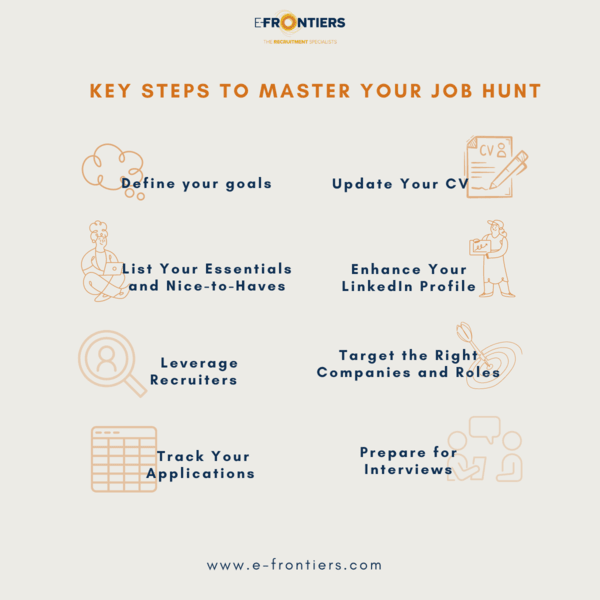
When it’s time to look for a new position, following these essential tips will help ensure your success:
1. Define Your Goals
Evaluate your current role and responsibilities to determine what you want in your next position.
Consider factors such as the type of role, responsibilities, salary, and benefits.
Identifying both your wants and your deal-breakers will help you focus your job search.
Reflect on your career aspirations, the skills you want to develop, and the work-life balance you aim to achieve. This self-assessment will not only clarify your goals but also increase your confidence and direction during your job hunt.
2. List Your Essentials and Nice-to-Haves
Create a list of essential requirements your next position and company must offer, as well as a list of nice-to-have but non-mandatory features. This clarity will guide you through the application, interview, and offer stages.
Essentials might include factors like job location, salary range, core responsibilities, company culture, and growth opportunities. Nice-to-haves could be perks like remote work options, flexible hours, additional benefits, or specific projects.
Having a clear distinction between these will help you prioritise and make informed decisions when evaluating job offers.
3. Update Your CV
Revise your CV to reflect new skills, responsibilities, and tools you’ve acquired since your last update.
If you’re aiming for a new area without work experience, highlight relevant personal projects and provide concrete examples.
If your line of work requires some type of portfolio or similar, now it is time to update this too with your recent projects.
4. Enhance Your LinkedIn Profile
A well-crafted LinkedIn profile is a powerful tool in your job hunt. Ensure it includes a professional photo, detailed work experiences, education, and courses.
Don’t forget to select the “Open to Work” option to signal to recruiters that you’re open to new opportunities.
Adding your personal touch is important too, so adding, sports you play, voluntary work you do, events you assist, counts!
For more tips on optimiszing your LinkedIn profile, check out our detailed guide here.
5. Leverage Recruiters
Reach out to your favourite recruiter or ask your friends or former colleagues for recommendations if you don’t know any.
A good recruiter can provide insights into the job market, assist with your CV, and help you prepare for interviews. Applying through a recruiter can increase your success rate as they understand the client, hiring process, and necessary competencies. Read our Insights post here on ‘A simplified recruitment process, making it easy for you’
Looking for a role can be stressful but having a professional leading this process for you, makes things easier.
6. Target the Right Companies and Roles
Reflect on why you want to leave your current job and what you’re seeking in a new role.
Use your earlier list to identify target companies and research their locations, missions, team structures, benefits, culture, and values.
This research will aid your application process and prepare you for interviews. You might also discover new, suitable companies that weren’t on your initial list.
7. Track Your Applications
Maintain a system to track your applications, like a list using a notepad, word or spreadsheets.
We suggest avoiding applying to too many positions at once in order to stay focused on each recruitment process.
Prioritisze companies most relevant to you if you’re not in a rush.
8. Prepare for Interviews
When you get an interview, thorough preparation is key.
- Research the company, including its mission, values, products, and recent news.
- Review the job description and match your skills and experiences to the key responsibilities and requirements.
- Practice common interview questions and prepare your own questions for the interviewer.
- Dress appropriately for the company culture, and ensure you know the interview logistics, such as the time, place, or virtual setup.
- Finally, bring copies of your resume, a notepad, and a positive, confident attitude.
For comprehensive interview preparation tips, visit our guide here.
And if your big interview is via virtual/video, then visit our Insights post here on how to show your personality in a video interview
Final Thoughts
If you’re considering a career transition and seek expert guidance, reach out to us!
We’re here to assist you every step of the way and be your career partner as you navigate this exciting change.
Our first 10 years doing recruitment in Spain
This year marks a decade since E-Frontiers took a significant step by expanding its operations to Spain. With a clear focus and defined mission, it arrived in Madrid with the firm conviction of providing effective solutions to both companies and candidates across the country. Today, looking back, we take pride in how our recruitment in Spain has transformed lives, advanced careers, and helped companies find the talent they need to thrive.

First conversations with E-Frontiers
My relationship with E-Frontiers goes back a long way. Even before working here, I had connections with its employees and some of its directors. Why? Because I knew that their team had a perfect understanding of the Spanish IT market; because their people were present at all the key tech events, and most importantly, because I knew they worked differently. Where other companies struggled to find qualified talent in a competitive market, the people at E-Frontiers were able to help their clients build highly qualified teams.
I remember one of my first conversations with one of the founders of E-Frontiers. While I was telling him about how I did my job at a large company in the sector, sharing data about how many interviews I conducted and how many hires I made, none of this seemed to impress him. What he said to me was:
“Pino, for us, the important thing here is the candidate and our clients. It’s quality, not quantity. The most important thing is to support individuals throughout their journey, whether they are candidates or hiring managers. For candidates, this means preparing them for interviews and ensuring they find a job where they truly fit and feel happy. For hiring managers, it involves leveraging our expertise to introduce them to strong candidates who will positively impact their teams”
It didn’t take long for me to realize that E-Frontiers really works differently. Their teams not only have great expertise in the market, but they also understand technology, the labor world, and they truly know how to prepare a candidate to achieve the desired job.
How we work
Our success in Spain is measured not only by the number of placements made but by the quality and impact of our solutions. Every company we collaborate with receives a personalized service tailored to their specific needs. We strive to deeply understand each client’s corporate culture, goals, and challenges. This understanding allows us to find the right talent—people who not only meet the technical requirements but also fit perfectly into the work environment and share the company’s vision.
However, our true passion and commitment are focused on the candidates. We know that job hunting can be an overwhelming and sometimes discouraging experience. That’s why we dedicate ourselves to accompanying each candidate on their journey, providing them with support, guidance, and life-changing opportunities.
From the first contact, our goal is to establish a relationship of trust with eachn individual. With candidates, we listen to their aspirations, understand their strengths, and work to find the perfect opportunity that allows them to develop both professionally and personally. It’s not just about finding a job; it’s about building a career and realizing dreams.
Success Stories
Over these ten years, we have witnessed countless success stories. From young graduates who found their first job to experienced professionals who discovered new opportunities and challenges that revitalized their careers. Each story is a testament to our commitment to the well-being and development of people.
I remember the case of Marta, a talented engineer who, after months of unsuccessful job searching, came to our agency feeling discouraged. After getting to know her skills and aspirations, we found her a position at a growing tech company. Today, Marta has not only advanced professionally but also leads innovative projects and has become an inspiration to others.
Another example of a client success story involves a mid-sized tech company struggling to find experienced software developers with experience with a new and unusual programming language. Despite numerous efforts, they were unable to attract the right candidates. After partnering with E-Frontiers, we conducted an in-depth analysis of their needs, culture, and the specific challenges they faced. We then leveraged our extensive network and market knowledge to identify and attract top talent. Within a few months, the company had successfully hired several highly skilled developers who not only met the technical requirements but also integrated seamlessly into the team, significantly boosting their productivity and project success rates.
Continued Growth – Recruitment in Portugal
We have recently expanded into the Portuguese market, supporting clients from Spain, Ireland and the UK as they grow in Portugal. Our goal is to deliver our quality service in this promising and expanding market.
Our mission
As we celebrate our tenth anniversary in Spain, we renew our commitment to excellence and dedication to our clients and candidates. We are more motivated than ever to continue providing effective and humane solutions to the labor market. Our mission remains clear: to connect people with opportunities that allow them to reach their full potential.
Thank you to everyone who has trusted us and been part of this story. We look forward to celebrating many more decades with all of you.
Alejandro Pino Alamillo – Team Lead Recruiter @E-Frontiers Spain
Do you want to speak with me? Book a slot here

Foto de Christina @ wocintechchat.com en Unsplash
Tienes una entrevista de trabajo: ¿Ahora qué?
A día de hoy, asegurarte una posición en la industria IT requiere más que un conocimiento en ciertas herramientas y tecnologías. Destacar a nivel personal y encajar a nivel cultural con la empresa con la que tienes interés es casi igual de importante.
Tanto como si eres un profesional senior como si eres un recién graduado entrando en el mundo laboral, prepararse una entrevista de trabajo es crucial para poder pasar con éxito un proceso de selección.
Para ello, contar con la ayuda de un recruiter de E-Frontiers es una ventaja que te hará destacar en cualquier entrevista. No solo ayudamos con la preparación del CV y tu posicionamiento dentro de una empresa, si no que también te asesoraremos durante todo el proceso de selección, dando tips para entrevistas y preparándote para ellas de la manera más eficaz posible.
¿Cómo prepararse antes de una entrevista de trabajo?
Interés
Puede parecer obvio, pero es crucial verse, sonar y actuar interesado en la posición en la que estás inscrito. Mostrarte afable cuando te llaman desde RRHH para concretar una primera entrevista, mantener el contacto con el reclutador que te está llevando la candidatura y preguntar dudas es una señal positiva que señala que de verdad te interesa el puesto al que te estás postulando.
Investiga la empresa
Antes del proceso de entrevista siempre recomendamos hacer una pequeña investigación acerca de la empresa. Comprender sus valores, su misión, los productos y servicios que desarrollan. No solo para responder a la típica pregunta de “¿Qué sabes acerca de nosotros?”. También para poder tener un contexto y hablar con más naturalidad con ellos.
¿Y qué investigo?
Investiga su página web.
Novedades en la compañía, últimas noticias, conoce a sus directivos.
Estudia en profundidad la descripción del puesto para el que estás aplicando, anticipándote de esta manera a posibles preguntas.
Descubre quién te entrevistará y aprende cosas sobre él. A través de LinkedIn podrás ver dónde ha trabajado, dónde ha estudiado, qué contactos tenéis en común. Es una forma de romper la barrera y puedes usarlo para romper el hielo y hacer la entrevista más amigable.
Demuestra tus conocimientos técnicos
En el sector IT, la experiencia técnica es uno de los puntos clave. Para poder demostrarla, son necesario una serie de matices:
La descripción del puesto de trabajo
Todo el proceso y evaluación técnica se va a basar en lo que salga allí listado. Revísala, conoce qué puntos dominas a la perfección y en qué puntos puedes llegar a fallar. Toda prueba técnica estará basada en las herramientas que salgan listadas en ella.
Refuerza puntos de mejora
Tras revisar la descripción quizá haya alguna herramienta que hace tiempo que no tocas. Tómate tu tiempo en repasarla para poder llevar esa información lo más fresca posible.
Destaca tus hitos
Quizá te pregunten de qué proyecto basado en Java te sientes más orgulloso. O cómo fue el despliegue de Kubernetes más duro en el que trabajaste. Párate un tiempo a pensar qué proyectos te gustaría destacar y tenlos siempre en mente para cuando te pregunten sobre los proyectos más relevantes de tu experiencia.
Ejemplos prácticos y repositorios
A través de un repositorio como Github o un portfolio personal puedes demostrar al entrevistador con ejemplos reales hechos por ti, parte de lo que puedes hacer. Mantenlo siempre actualizado ya que es una carta de presentación junto con tu CV.
Demuestra tus habilidades personales
En los procesos de selección siempre habrá un porcentaje elevado de importancia en competencias técnicas, pero no podemos dejar de lado las personales. Por lo general, habilidades comunicativas, de solución de problemas, trabajo en equipo o idiomas son en general skills que van a evaluarte.
Mejora tu discurso
Método STAR
Estructura tus respuestas usando el formato Situación, Tarea, Acción, Resultado. Esto ayudará a organizar tus pensamientos y presentar tus experiencias de manera clara y concisa.
Practica la entrevista
Practica en voz alta posibles respuestas a preguntas que sabes que te harán. Hacer esto en alto, junto con un familiar o amigo que haga a la vez de entrevistador, ayudará a anticiparte a la entrevista practicándola de forma real.
Prepara tus respuestas
Organiza posibles respuestas a las preguntas típicas que sabes que te harán.
Estudia los requisitos
Prepara tus respuestas basándote en qué se está pidiendo en la oferta de trabajo y alineándolo con los objetivos y valores de la empresa.
Haz preguntas
Prepárate siempre un par de preguntas para el propio entrevistador, en las que demuestres tu verdadero interés en la posición mostrando curiosidad por algunos de los aspectos de la empresa.
Tu ropa y actitud
La vestimenta es muy importante ante cualquier presentación frente a una empresa aunque no necesariamente tienes que ir con atuendo excesivamente arreglado. Explorando un poco la cultura de la empresa, o incluso preguntando al reclutador, podrás escoger la forma de vestir adecuada para reunirte con ellos.
Otro punto también importante sería tu comunicación no verbal y actitud: llegar puntual, un apretón de manos firma, mantener el contacto visual o escuchar atentamente son buenas señales para los entrevistadores.
La entrevista en Videollamada
Durante los últimos años hemos visto un crecimiento enorme de las entrevistas en vídeo. Agilizan el proceso de selección y permite una mayor flexibilidad para programarlas. A pesar de sus ventajas, puede acarrear varios inconvenientes como problemas técnicos y fallas de comunicación
Testea tu equipo
Antes de acceder a la entrevista, comprueba que el link que te han mandado funciona correctamente, que micrófonos y cámara están conectados. Prueba también tu conexión a internet, a ser posible conéctate mediante cable para evitar problemas.
Elige un fondo profesional
Un fondo en blanco o un ambiente bien ordenado dentro de tu casa. Evita fondos donde pueda haber distracciones para la persona que te está entrevistando.
Iluminación
Colócate cerca de una fuente de luz potente, a ser posible natural evitando crear sombras.
Domina la plataforma
Ya sea Zoom, Teams, Skype o cualquier otra plataforma de videoconferencias, haz siempre una prueba inicial para conocer sus comandos: Cómo mutearte, cómo encender el vídeo o cómo compartir pantalla.
Gestiona las interrupciones
Siempre puede pasar en mitad de la entrevista algún problema como un repartidor que llama a tu puerta o un ruido externo que se cuela en la llamada. Trata esto con naturalidad, discúlpate y sigue la entrevista como si nada.
¡Si estás considerando una cambio laboral, contáctanos! Estamos aquí para asistirte en cada etapa de emocionante cambio.
Síguenos en nuestras redes sociales y LinkedIn para estar al tanto de todas las novedades y nuevos blogs.

Picture by Michael Discenza
Meeting Brendan
I had visited America twice before on summer holidays, exploring New York in 2010 and Chicago in 2013. It had always been my plan to return after graduating, but this time, there seemed to be more on offer.
I met Brendan Carroll, the MD, for a coffee at the Anner Hotel in Thurles around midSeptember 2016. Funnily enough, I had spent the day making hurleys and just managed to rush home to shower and change before racing to Thurles. Brendan, whom I knew through the GAA and Thurles Golf Club, ran a recruitment company in Dublin. I thought he might have strong connections in the US to help me find a job.
How it started
Arriving in New York in 2017, truth be told, I knew very little about business, recruitment, or even life in general. I was 25 and had just graduated from Waterford Institute of Technology with a degree in Software Engineering. I was so undecided about my future that I spent four months making hurleys in my hometown of Borrisoleigh, Tipperary, with Bourke Sports.
We chatted for an hour or two about everything and anything, and jokingly, I quoted my dad saying,
“If Brendan was any good, he’d give you a job himself.”
For some reason, something clicked with Brendan, and he said, “I’ve got an idea. I’ll give you a buzz later today. I want to run something past Paddy and Vinny,” our other two founders.
Later that day, while I was back at Bourkes sanding down a few new hurleys, Brendan called and said, “We are going to give this a go.” I replied, “What do you mean?” as I had no idea what he was talking about.
“We’re going to open an office in New York, and you’re going to take it on.”
One week later…
One week later, I landed in New York with a phone, a laptop, and a hand-me-down suit from my brother. Initially, Brendan spent time with me explaining E-Frontiers’ offerings, how we positioned ourselves, and ultimately, why a specialist recruitment firm could be successful.
It was my first dive into the world of LinkedIn and networking, understanding who was connected to whom and how it all worked.
The beginning
From there, I began meeting people in the city as much as I could, some of Brendan’s connections and some new connections I found through Irish networks in New York and the GAA. Joining the IBO(Irish Business Organization) was a good move for networking. It was great to meet people, share my story, and develop my pitch, even if the person I was speaking with wasn’t interested. My main focus was connecting clients we had in Ireland, the UK and Spain with opportunities in the US. I checked to see their operations in NYC and tried to get a warm introduction to a hiring manager.
Then, I would try to meet the right person here, share a bit about my story and E-Frontiers, and hopefully win some business. It was a great personal learning curve. Growing up, I was always a bit of a class clown, loud and always with something to say, but in more formal settings, I tended to be quiet as a mouse.
How it’s going
Over the past eight years, we’ve stuck to the basics i.e. making connections and meeting the right people who understand what we do. We’re not competing with large recruitment firms; that would be a foolish strategy.
Instead, we provide quality professional services to save time and become trusted partners of our clients.
A partner is someone you can rely on to solve a problem. Just as companies turn to lawyers or financial advisors, we want to position ourselves as trusted partners in hiring top talent.
From 2017 to 2024
Now, we have a team of four in our 5th Ave New York office. We live and breathe the business every day. The mood in the office shifts with the smallest losses and the biggest wins.
Recruitment is a game of rejection; statistics show that only one in every eight submissions for a role ends up being a hire. That means seven personal relationships with candidates where the outcome is unsuccessful.
“Recruitment is about resilience and rolling
with the ups and downs. Those who can
manage and navigate through it succeed.”
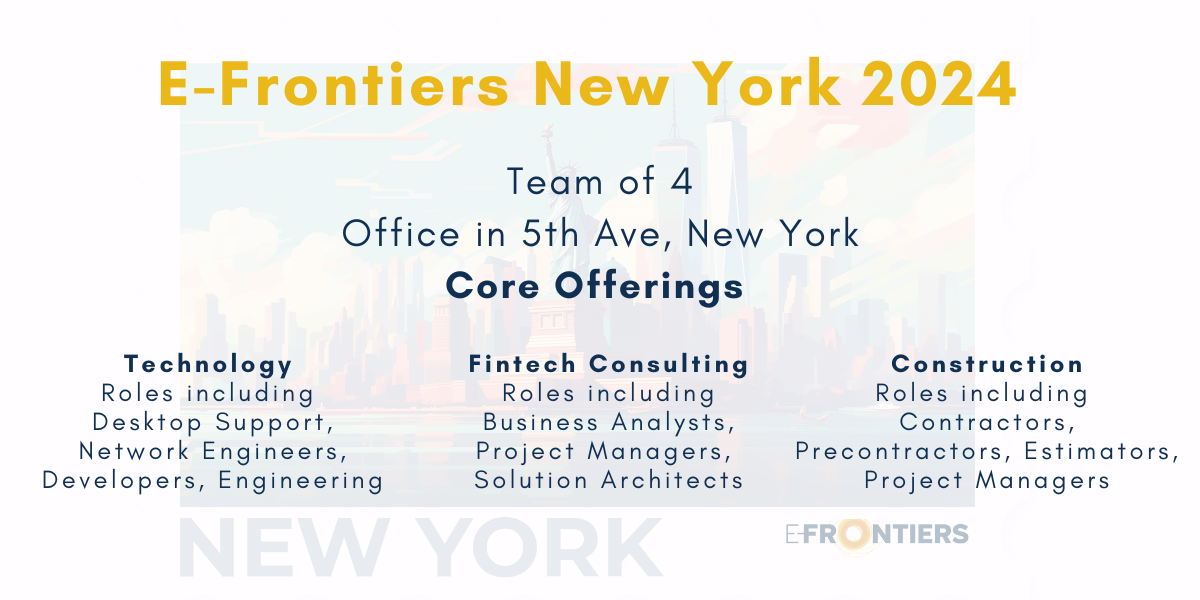
Our main focus in the US at the minute lies in 3 main areas: Technology (roles including Desktop Support, Network Engineers, Developers, and Engineering), Fintech Consulting (roles including Business Analysts, Project Managers, and Solution Architects), and finally Construction, an area that has grown massively in the past few years due to the large Irish
contingent involved in the industry here in the US.
Looking ahead, we hope for further growth and the building of a US team and business. We believe in what we’re doing and the solutions we provide.
The author of the article is Tommy Kavanagh, Head of Operations at E-Frontiers US. tommy.kavanagh@e-frontiers.com

El mercado de las tecnologías de la información (IT) en España ha experimentado una notable evolución en los últimos cinco años, impulsado por la creciente digitalización y la adopción de tecnologías emergentes. Este artículo examina los sectores tecnológicos que más están creciendo, las tecnologías más demandadas y aquellas que se perfilan como las más prometedoras para el futuro.
Sectores Tecnológicos en Crecimiento
1. Inteligencia Artificial (IA) y Machine Learning (ML):
La IA y el ML se han consolidado como pilares fundamentales en la transformación digital de las empresas españolas. Estos sectores no solo están creando nuevas oportunidades de negocio, sino que también están mejorando la eficiencia operativa y la toma de decisiones en tiempo real. Aplicaciones como chatbots, análisis predictivo y automatización de procesos son cada vez más comunes en empresas de diversos tamaños y sectores.
2. Ciberseguridad:
Con el aumento de los ciberataques y las crecientes amenazas a la seguridad de los datos, la demanda de soluciones de ciberseguridad ha aumentado significativamente. Las empresas están invirtiendo en tecnologías avanzadas para proteger sus activos digitales y garantizar la privacidad de la información de sus clientes.
3. Servicios en la Nube:
La adopción de servicios en la nube ha crecido exponencialmente, impulsada por la necesidad de flexibilidad, escalabilidad y reducción de costos. Las soluciones de infraestructura como servicio (IaaS), plataforma como servicio (PaaS) y software como servicio (SaaS) están siendo ampliamente adoptadas en diversos sectores.
Tecnologías Más Demandadas
Big Data y Analítica:
La capacidad de analizar grandes volúmenes de datos para obtener insights accionables es crucial para las empresas modernas. La demanda de profesionales capacitados en análisis de datos, científicos de datos y herramientas de big data ha crecido considerablemente.
Desarrollo de Software:
El desarrollo de aplicaciones móviles y web sigue siendo una de las áreas con mayor demanda. Lenguajes de programación como Python, Java, JavaScript y frameworks como React y Angular están entre los más solicitados.
Internet de las Cosas (IoT):
La interconexión de dispositivos a través de internet está transformando sectores como la industria, la agricultura, la salud y el hogar inteligente. La implementación de soluciones IoT está en auge, con una creciente demanda de ingenieros y desarrolladores especializados en esta tecnología.
España: Un Hub Tecnológico de Referencia en Europa
España se ha consolidado como uno de los hubs tecnológicos más importantes de Europa, impulsado en gran medida por la actividad en dos de sus ciudades más grandes: Madrid y Barcelona. Estas urbes no solo destacan por su vibrante ecosistema tecnológico, sino también por la cantidad de empresas que han decidido establecerse en ellas, convirtiéndolas en epicentros de innovación y desarrollo.
Madrid: Un Ecosistema en Expansión
Madrid se ha posicionado como un referente en el sector tecnológico gracias a la presencia de varios centros de innovación y emprendimiento. Entre los más destacados se encuentran Campus Madrid, Impact Hub, Silicon Alley y The Cube. Estos espacios no solo facilitan el crecimiento de startups y empresas tecnológicas, sino que también fomentan la colaboración y el intercambio de ideas, fortaleciendo así el tejido empresarial de la ciudad.
Barcelona: El Distrito Tecnológico por Excelencia
Por su parte, Barcelona no se queda atrás y brilla con su propio distrito tecnológico, conocido como 22@. Este área, dedicada a la innovación y el desarrollo empresarial, alberga iniciativas como Tech Barcelona, Disseny Hub y un Impact Hub, que funcionan como motores de crecimiento para la industria tecnológica. La ciudad se ha convertido en un punto de referencia para empresas y emprendedores que buscan un entorno dinámico y creativo para desarrollar sus proyectos.
El Auge de Nuevas Ciudades Tecnológicas
Además de Madrid y Barcelona, otras ciudades españolas están emergiendo como importantes núcleos tecnológicos. Málaga, Valencia y diversas localidades en Galicia están experimentando un notable crecimiento en este sector. Asimismo, Bilbao y Sevilla se están posicionando como destinos atractivos para empresas tecnológicas, gracias a sus esfuerzos por fomentar la innovación y la inversión en tecnología.
En conjunto, estas ciudades contribuyen a que España se mantenga a la vanguardia tecnológica en Europa, ofreciendo un entorno propicio para el desarrollo empresarial y la innovación continua.
Algunas conclusiones
En los últimos cinco años, el mercado IT español ha experimentado una transformación notable. La digitalización ha pasado de ser una opción a una necesidad imperativa para la supervivencia empresarial. La pandemia de COVID-19 aceleró la adopción de tecnologías digitales, con un aumento significativo del teletrabajo y las soluciones de colaboración en línea.
Además, el apoyo del gobierno y la disponibilidad de fondos europeos para la digitalización y la innovación tecnológica han jugado un papel crucial en el crecimiento del sector IT en España. Programas como el Plan España Digital 2025 buscan impulsar la conectividad, la ciberseguridad y el desarrollo de competencias digitales.
Las empresas tecnológicas españolas también han visto un aumento en la inversión y la financiación, con un creciente número de startups emergentes que están atrayendo la atención internacional. Esto ha contribuido a la creación de un ecosistema vibrante y dinámico, donde la innovación es una constante.
En conclusión, el mercado IT en España está en plena expansión, con sectores como la inteligencia artificial, la ciberseguridad y la nube liderando el crecimiento. Las tecnologías emergentes como el blockchain, la realidad aumentada y la computación cuántica prometen transformar aún más el panorama en los próximos años. La evolución de los últimos cinco años demuestra un compromiso claro hacia la digitalización y la innovación, posicionando a España como un actor clave en el ámbito tecnológico global.
Si te interesa saber más sobre esto, hacer algún apunte sobre el tema, o si te interesa trabajar con nosotros, no dudes en contactar a los autores de este artículo:
Alejandro Pino (Team Lead Recruiter – alejandro.pino@e-frontiers.ie)
Ana Martín (Technical Recruiter – ana.martin.romero@e-frontiers.ie)

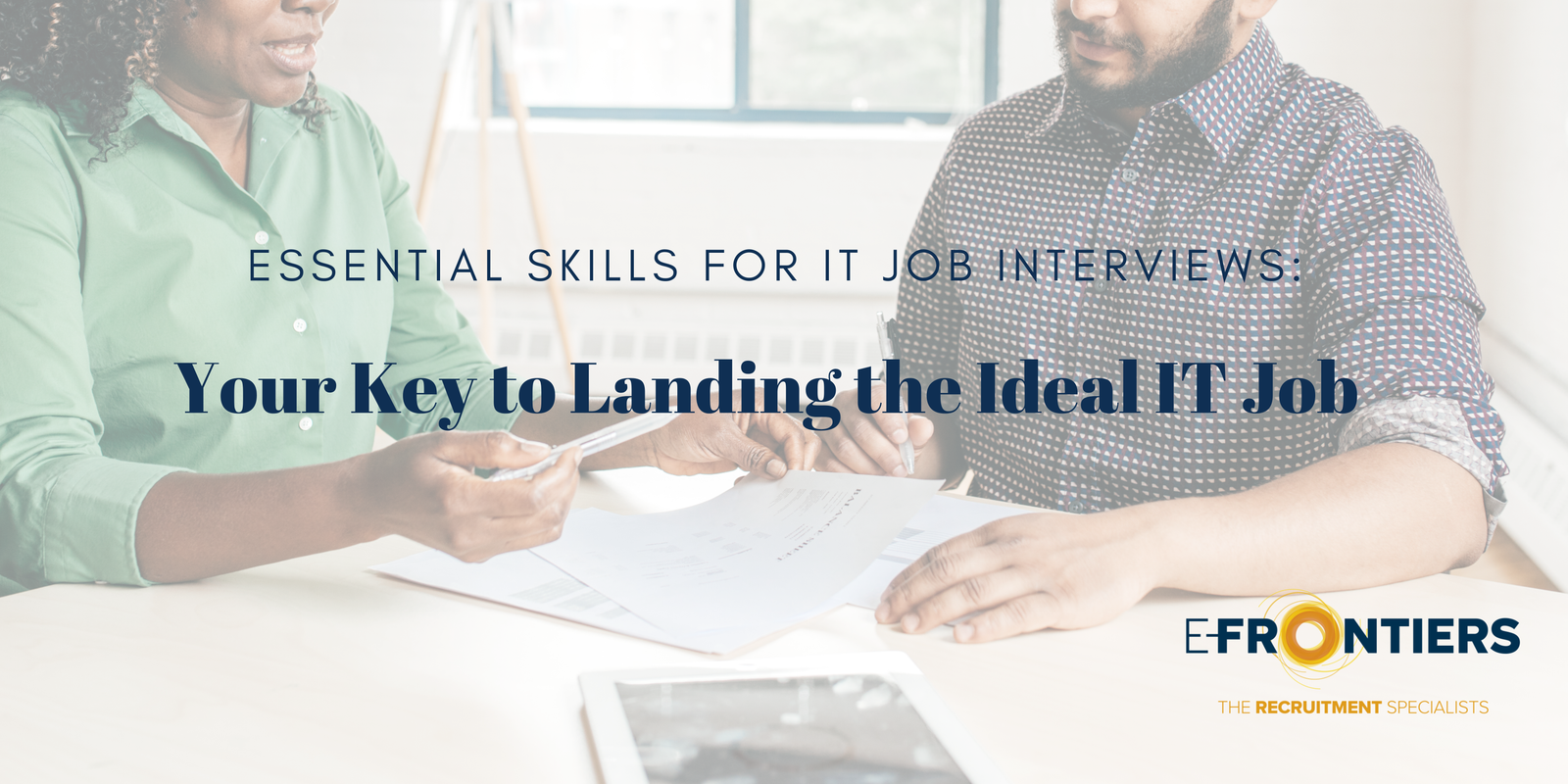
You’ve secured a big job interview: what’s next?
Nowadays, securing a position in the IT industry requires more than just technical skills. It demands a comprehensive approach to preparing for job interviews that showcases your expertise, personality, and cultural fit.
Whether you’re a seasoned professional or a fresh graduate entering the workforce, mastering the job interview process is essential for landing your dream role in Ireland’s thriving IT sector. Interview preparation is key.
It is a huge advantage to have the help of a recruiter from E-Frontiers throughout the hiring process. Not only can we help with your CV and give you visibility with different companies, but we can also support you throughout the hiring process, providing coaching for interview preparation, giving you a heads up on information about the type of interviews planned, and vitally, following up with the Hiring Manager on your behalf.
So, how do you prepare for an IT job interview? The following are points to consider in your interview preparation:
Be Interested
This may seem obvious, but it is crucial to be pleasant and to look, sound, and act interested in the position you are applying for. If you give a vibe that you would rather be somewhere else, then you can probably assume you won’t be getting a call back. It can be quite a challenge for interviewers when they encounter disinterested candidates, so don’t set yourself up for failure before you’ve even begun.
Research the Company and Role
Before stepping into the interview room/virtual room, take the time to research the company thoroughly. Understand its mission, values, products, and services. Familiarise yourself with their recent news, industry trends, and the company’s position within the market. And don’t just limit this research to a quick Google search, be more thorough.
- Look at their latest annual report, check out their latest advertising, and chat to people you may know within the industry about the company -this will give you a feel for what the company is about and how they are perceived within your industry.
- Additionally, delve into the specifics of the role you’re applying for, including specific job responsibilities, the required skills, and qualifications. This knowledge will enable you to tailor your responses during the interview and demonstrate your genuine interest in the company and the position.
- Try to find out in advance who is on the job interview panel so that you may be able to connect with them on a personal level. Check their LinkedIn profiles for mutual connections, and common experiences through education, location, or sport.
Demonstrate your Technical Proficiency
In the IT industry, technical expertise is paramount. Ensure that your skills are up-to-date and aligned with the job requirements.
Job Spec:
Review core concepts, programming languages, software tools, and methodologies and mention certifications, courses, and training you have that are relevant to the role.
Is upskilling necessary?
Consider refreshing your knowledge through online courses, tutorials, or hands-on projects to make your experience more relevant.
List Your Achievements:
Before the job interview, make a list of your key tech projects and accomplishments. For each item on your list, write down the specific role you played, the IT skills you used, the challenges you faced, and the outcomes.
Practical examples:
How have you applied your technical skills to solve problems or improve processes? This could involve software you developed, systems you implemented, or complex data you analysed.
Do you have a Portfolio?
Do you have a github account or portfolio with your personal projects? Make sure they have access to that.
Technical proficiency coupled with practical examples will instill confidence in your abilities and set you apart from other candidates.
Display Your Soft Skills
While technical competence is crucial, don’t overlook the significance of soft skills in the IT sector.
Effective communication, problem-solving, teamwork, agility in project management and the ability to work effectively in remote teams are highly valued attributes in today’s workplace. Be prepared to share examples of how you’ve effectively handled challenges, resolved conflicts, or contributed positively to team dynamics in previous roles.
Showing strong interpersonal skills will demonstrate your ability to thrive in diverse work environments and foster positive relationships with colleagues and clients.
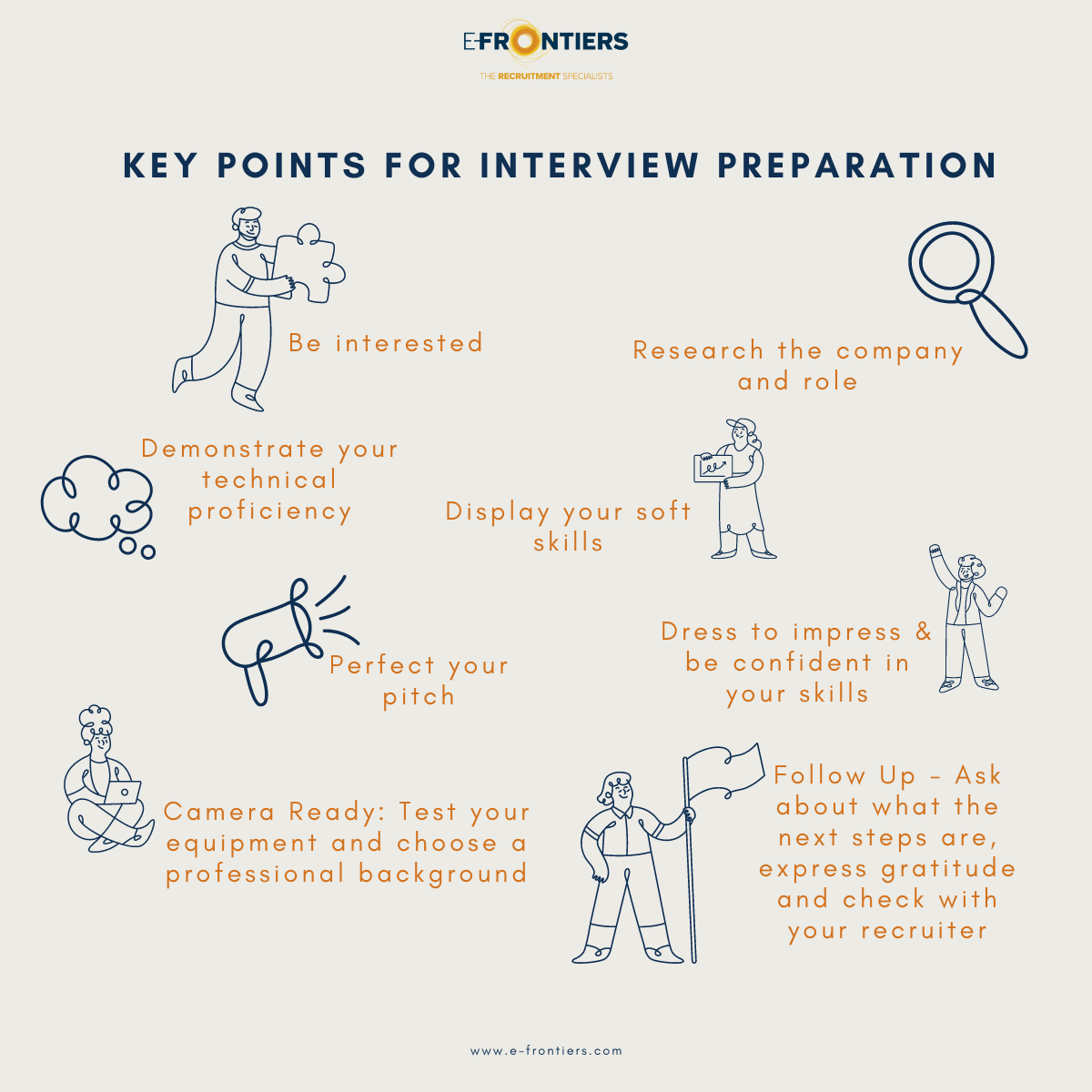
Perfect your Pitch
Use the STAR Method:
Structure your responses using the Situation, Task, Action, Result (STAR) format. This method helps organise your thoughts and present your experiences clearly, concisely, and engagingly to the interview panel.
Mock Interview:
Practice articulating your ideas confidently and clearly. Practice describing your strengths, experiences, and STAR examples. Be prepared with specific examples that demonstrate your problem-solving abilities, leadership potential, and ability to be agile and quickly adapt to change. Practice your responses out loud, preferably with a friend or mentor who can provide feedback. This will help you refine your delivery and ensure that your examples are communicated effectively.
Prepare Thoughtful Responses:
Anticipate the common interview questions and formulate responses that showcase your qualifications and suitability for the role. And make sure to link your skills back to the job description.
Skills Alignment:
Tailor your responses to highlight how your skills and accomplishments align with the company’s objectives and how you could contribute to its success.
– Ask Questions:
Finally, prepare a couple of questions to ask the interviewer or hiring panel that demonstrate your interest in the role, the company culture, and opportunities for your professional growth within the company.
Dress and Act Professionally
Dress to impress! Choose attire that is appropriate for the company culture and industry standards, this can vary hugely by industry. Your recruiter can give you a hint on the dress code. The same rules apply if you are doing a video interview.
Small but Serious: Some very important considerations are things like being punctual, having a firm handshake or a calm smile if the job interview is online, maintaining eye contact, listening attentively, and demonstrating a keen interest in the opportunity and company are KEY. This advice is especially important for video interviews. Aim to look at the camera when speaking, not the screen. This creates the illusion of direct eye contact with the interviewer, making the conversation feel more personal and engaging.
Perception: Be confident in your abilities while remaining humble and approachable. Pay attention to nonverbal cues such as posture, gestures, and facial expressions, as they can influence the interviewer’s perception of you.
Camera Ready: Mastering the Art of Video Interviews
Video interviews have become a staple in the recruitment process, especially for IT jobs. Here are some specific tips to help you excel in a virtual interview –
Test Your Equipment: It’s most important to do a run-through to ensure everything is working. As a tech professional, it’s not a good look if you cannot get your camera or sound to work. Ensure your camera, microphone, and speakers/headset are all working properly. Check your internet connection for stability and consider using a wired connection to avoid any potential disruptions.
Choose a Professional Background: Opt for a neutral background or a tidy room. Avoid busy or distracting backgrounds that can divert attention away from your conversation.
Lighting: Position yourself so that your face is well-lit, ideally with natural light facing you or a lamp that illuminates your face without creating shadows.
Familiarise Yourself with the Platform: Whether it’s Zoom, Microsoft Teams, Skype, or another platform, understand how it works. Know how to mute/unmute, turn the video on/off, and share your screen, as you might need to demonstrate something or share relevant documents during the job interview.
Manage Interruptions: If you experience an interruption (e.g., a noise, a technical issue), apologise briefly, address it if possible, and continue with your point. This shows your professionalism and adaptability.

As a recruitment agency with offices in multiple countries, we have a great advantage in being able to watch and compare recruitment trends from region to region. My role is to help grow E-Frontiers in the UK, and having access to this information is incredibly helpful. It allows us to spot new opportunities and find the best ways to support our clients as we continue to expand our operations in the UK.
E-Frontiers UK – Unlocking Opportunities Across Borders
At E-Frontiers we work with our clients across most skillsets and all industries by providing recruitment services for Permanent and Contract roles within the UK.
As an Irish headquartered company, we have an extensive reach on both sides of the Irish Sea. This is important to our clients for several reasons:
Talent Relocation:
We have access to talent relocating between the 2 countries. For certain skills and talent (Funds, FP&A as examples) this can provide access to a broader talent pool for the more challenging skillsets. Additionally, we have USA and Spanish offices to further broaden our reach for clients.
Legislation:
Our understanding of the requirements around legislation for both countries is excellent – built up by 10 years of experience operating in both the UK and Ireland. For example, this applies to contract support with IR35 and the required considerations.
Executive Search:
UK: We have supported several Irish companies in making their first key UK hire. As an Enterprise Ireland company ourselves who have gone on this journey, we are uniquely aware of the importance of this hire for companies. An example of such a client that we have supported with their UK growth is ClubForce (Sales Director UK).
Ireland: With vast experience in the market and a broad and deep market reach we can help clients build up management and leadership teams to support growth. We understand the importance of these hires and provide solutions that will ensure success for clients.
International Trends: Operating in several countries allows us to effectively observe and leverage trends. This global perspective helps us anticipate changes in one market based on trends in another, offering a broader, more comprehensive strategy for our clients.
UK Market Outlook
At present, the UK market is not showing many signs of growth. A recent report by S&P along with KPMG recently shows that the contract market has experienced its sharpest contraction since the summer of 2020, somewhat alarming from my perspective, given what happened then. While this is worrying by its nature, we have noticed some encouraging trends in Q2 so far.
Permanent Recruitment Trends
We have noticed a positive shift with increases in sales role requirements over the past two months. This is encouraging as it shows us companies are starting to think about growth again, instead of struggling to survive the recent tough times. The demand spans various positions, including Sales Development Representatives, Senior Business Development Managers, Account Managers, and Country Managers across a range of industries and companies.
At E-Frontiers, we have a proven track record of successfully assisting companies as they establish their presence in the UK. Securing that crucial first sales hire is often a key initial step, and we are experts at facilitating this process and work closely with companies to support them and ensure that this key hire is successful. These roles have traditionally stemmed from Irish companies expanding into the UK (given our Irish HQ). This has slowed over the last 18 months, but encouragingly, we are seeing companies starting to look for this type of hire again in the UK.
Contract Recruitment Trends
Although the UK contracting market has also slowed significantly over the last year and a half, recent positive developments suggest a resurgence.
A very encouraging trend we have noticed in this quarter is Professional Services firms are beginning to release more contract roles to us. This resurgence is significant as it indicates a return to post-pandemic activity levels within recruitment. This is hugely positive for us and for the wider market. Some of these clients have not had the requirements over the last 18 months due to a high percentage of staff on their “bench”. Now that we are starting to see these types of requirements come through, we can start to look optimistically ahead to Q3.
Market Outlook for Q2 & Q3
As a recruitment agency we love it when the wider talent market is tight resulting in a candidate-led market. Currently, this market can be described as more of a buyers’ choice market. However, the signs are encouraging for us. Coming out of covid we saw requirement numbers at their highest in decades, followed by a reduction over the last 18 months. In Q2 and especially on the contract side, we are now seeing signs of recovery with demand trending back to what it was in 2022. Companies are building out their sales teams, and professional services firms are resuming hiring. This, coupled with the apparent end to widespread layoffs, signals a positive trend in the job market.
In Summary
At E-Frontiers in the UK, we serve a broad spectrum of industry needs. Our services include recruiting for key management and leadership roles, and filling both contract and permanent positions. Our commitment extends beyond mere staffing; we partner with companies to strategically build their management and leadership teams, supporting your business’s growth and expansion in the UK.
Our extensive experience and strong market presence equip us to offer customised recruitment solutions tailored specifically to your needs. Whether you’re building a dynamic sales team or filling specialised roles, E-Frontiers is here to facilitate you on every step of your journey.
Article Author: Kenneth O’Connor is the Head of Contract Recruitment (UK & Ireland) at E-Frontiers. Kenny is a very experienced IT recruitment specialist with over 10 years of experience in both recruitment and tech sales. Kenny currently leads the E-Frontiers Contracting division while also managing E-Frontiers UK, helping our clients secure the talent required to drive their growth plans. Kenny’s specialist areas of expertise cover all aspects of contract recruitment across the full IT lifecycle, Finance, Compliance, and multiple other areas. He holds a degree in Sport and Exercise Science from the University of Limerick and is the Vice-Chair of the London Irish Business Society.
Feel free to get in touch with our commercial team to discuss your recruitment needs:
UK: Kenneth O’ Connor : kenneth.oconnor@e-frontiers.com (m: 0044 740 365 1213)
IRE: Nigel Bolger : nigel.bolger@e-frontiers.ie (m: 00353 86 3888147)
En este artículo queremos ofrecer una introducción al fascinante mundo del cloud computing, desde sus inicios hasta su relevancia actual. Se destacan las ventajas empresariales, las principales opciones de servicios en la nube y las oportunidades laborales en el sector, con un enfoque particular en España. Es una lectura para comprender este campo en constante evolución y su impacto en la tecnología y el empleo.
Introducción al Cloud Computing
Ya desde finales de los años 60 el informático John McCarthy propuso la idea de que “la computación podría ser organizada de manera pública”, asentando las bases, sin saberlo de la computación en la nube que hoy conocemos.
No fue hasta finales de los años 90 que la empresa Salesforce dio los primeros pistoletazos a la nube actual, siendo Amazon Web Services en 2002 quien elaboró una serie de servicios basados en la nube dando lugar a EC2 y arrancando de esta manera la carrera de la computación en la nube que conocemos hoy en día.
Pero, ¿qué ha supuesto esto en el paradigma de desarrollo que conocemos en la actualidad? Desde entonces los servicios y tecnologías en la nube han ido incrementando y mejorando exponencialmente, dando lugar a una serie de beneficios a las empresas que se han adaptado a estos entornos.
Entre sus múltiples ventajas, nos gustaría destacar:
– Reducción de costes: un punto primordial en cualquier empresa. Los servicios en la nube no requieren de inversión en infraestructuras físicas, por lo que permite una reducción importante de gastos para cualquier entidad.
– Acceso remoto: uno de los puntos clave. Con una simple conexión a internet cualquier persona es capaz de acceder a los servicios en la nube facilitando de esta manera el trabajo remoto y la rapidez.
– Seguridad: aspecto importante para grandes empresas con un volumen importante de datos sensibles. Los proveedores de servicios Cloud cuentan por lo general con las medidas de ciberseguridad más modernas del mercado, superando con creces cualquier medida que pudiera tomar cualquier empresa de menor tamaño con recursos limitados.
¿De qué puedo trabajar en el sector Cloud?
El mundo del Cloud Computing ha abierto puertas a nuevos roles con profesiones que hace años ni se pensaban. Entre ellas podemos encontrar:
– Cloud Architect: encargado del diseño de la arquitectura de los sistemas y aplicaciones en la nube.
– Administrador Cloud: responsable de la administración, supervisión y configuración de todos los recursos en la nube.
– Desarrollador de aplicaciones en entornos Cloud: un paso más en el desarrollo de software donde los desarrolladores están empezando a trabajar en entornos en la nube para el despliegue de aplicaciones.
– Cloud Security Engineer: persona encarga de garantizar la seguridad de los datos y los sistemas, monitoreando e identificando posibles amenazas.
Puedes echar un vistazo a los roles cloud que tenemos actualmente abiertos aquí
¿Qué opciones tengo como empresa?
En el mercado actual existen numerosas empresas que ofrecen servicios Cloud a terceros, destacando actualmente estas 4:
– Amazon Web Services: pioneros en el mercado, con una enorme presencia global, ofrecen una amplia gama de servicios a sus clientes y una actualización constante de los mismos.
– Microsoft Azure: respaldados por el gigante de Microsoft, en 2010 nació Microsoft Azure, dando un soporte descomunal en computación en la nube especialmente beneficioso para aquellas organizaciones que ya utilizaban productos y servicios Microsoft.
– Google Cloud Platform: Google también se quiso unir a la marea del Cloud Computing sacando su propia versión. Desde entonces han ido creciendo de manera gigante convirtiéndose en uno de los principales motores Cloud del mercado.
– Alibaba Cloud: Principal motor Cloud dentro del mercado asiático. Desde los últimos años se han estado abriendo poco a poco un hueco dentro del mercado más occidental.
¿Cómo son las oportunidades del sector Cloud en España?
Actualmente, podemos observar una creciente demanda de estos perfiles en el mercado, tanto a nivel internacional como nacional. Solo en España, hay más de 200 empresas en búsqueda activa de talento con estas habilidades y conocimientos y todo apunta a que la demanda de estos perfiles crezca en los próximos años.
También vemos como la oferta de estudios superiores de especialización (Posgrado y Master) en Cloud Computing se amplía haciendo notable la necesidad de actualización de profesionales IT hacia esta área.
Tanto si eres una empresa que necesita perfiles Cloud como si eres profesional del sector en búsqueda de un cambio, no dudes en contactarnos. Alfonso Moreiras (Senior Technical Recruiter) está especializado en entender estos requerimientos de este tipo de posiciones y encontrar perfiles que más se adapten a las necesidades de nuestros clientes.

Why put DEI on your agenda?
It is important that the diversity efforts of organisations are intentional and visible and drive meaningful change. Efforts must be visible both internally and externally, demonstrating the organisation’s commitment to diversity, equality, and inclusion and fostering trust among employees, customers, and other stakeholders.
Poll Results
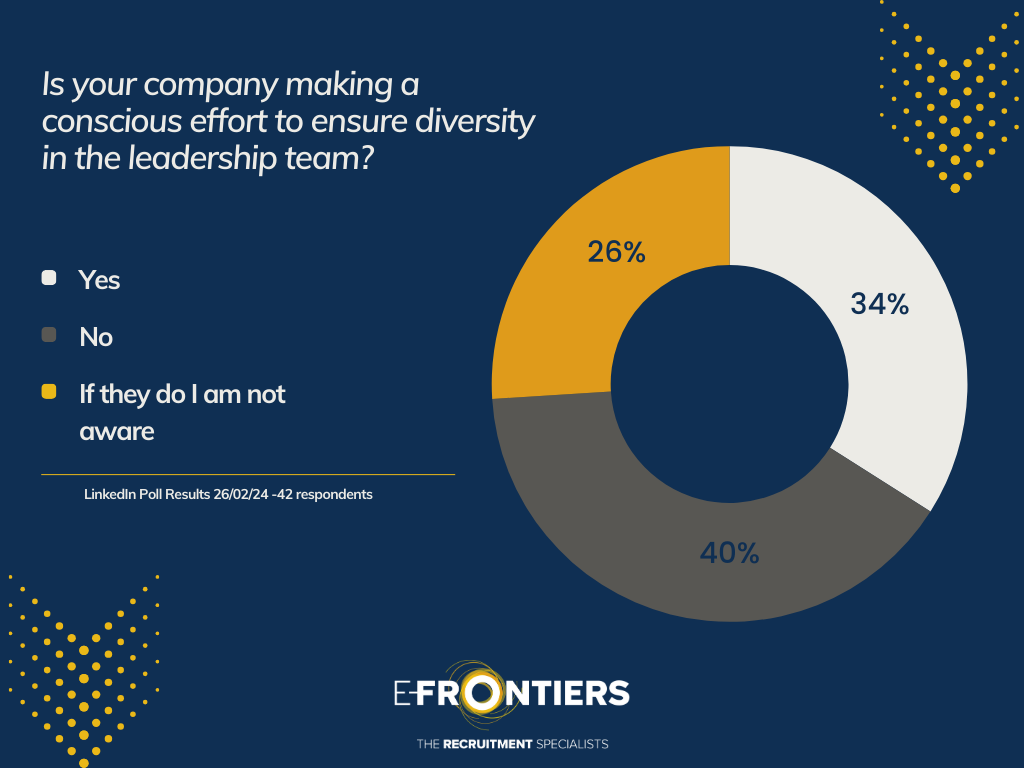
We recently asked our followers -‘Is your company making a conscious effort to ensure diversity in the leadership team?’ LinkedIn Poll 26/2/24
- 34% responded with Yes
- 40% responded with No
- 26% responded with ‘If they do, I am not aware’
It is food for thought that 66% felt that their company was not doing enough in terms of diversity and/or any efforts they were making were not visible, even to staff and team members.
Employers often require support and specialist external help in developing and amplifying the visibility of their Diversity, Equality, and Inclusion (DEI) initiatives, and could benefit from assistance with narratives and communication strategies. Coordinating a DEI plan requires guidance and planning to ensure alignment with organisational goals and foster a culture of genuine inclusion.
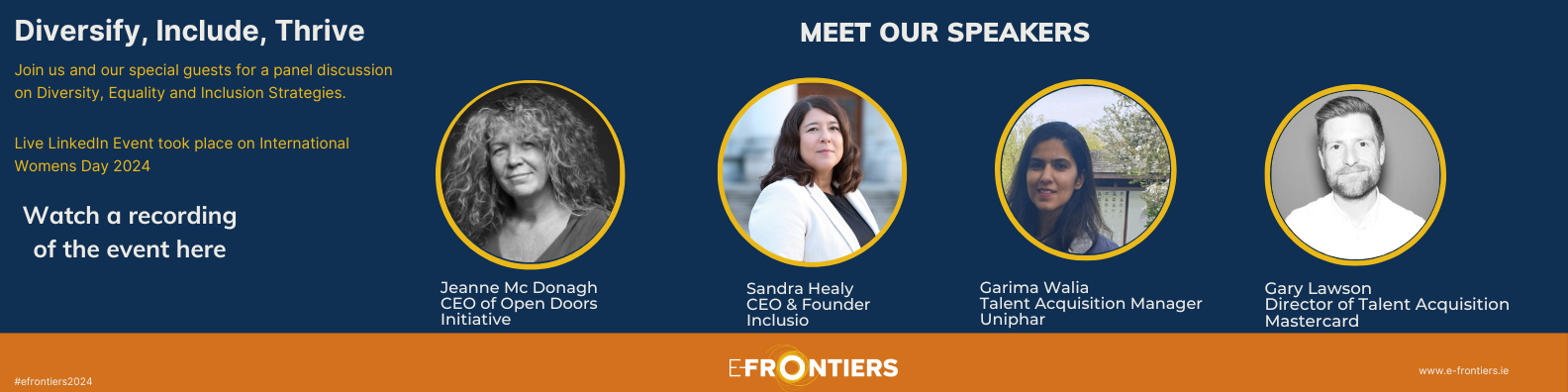
Diversity Live Event
We recently hosted a live panel discussion event on Diversity, Equality and Inclusion. This was held on International Women’s Day and featured four incredible speakers who shared invaluable perspectives on fostering DEI within the workplace. Our E-Frontiers team members Alexandra Pop, Recruitment Operations Manager, and Kenneth O Connor, Head of Contract Recruitment UK & Ireland, facilitated the engaging conversations that delved into a wide range of topics.
Our Speakers
Jeanne Mc Donagh : CEO : Open Doors Initiative Jeanne has over 30 years’ experience in DEI, politics, campaigning, mental health and LGBTQ+ issues and board work
Sandra Healy : CEO & Founder : Inclusio : Sandra is an Engineer, an Organisational Psychologist and NLP Master Practitioner. She has championed and driven diversity and inclusion practice across industry for over 18 years.
Garima Walia : Talent Acquisition Manager : Uniphar : Garima possesses a rich and extensive background in recruitment and talent acquisition, accumulating over 15 years of invaluable experience spanning diverse industries.
Gary Lawson : Director of Talent Acquisition : Mastercard :Gary has over 20 years of experience as a recruitment specialist and is responsible for talent attraction, strategy & branding at Mastercard’s technology and innovation hub in Dublin.
Our speakers touched on areas such as:
- How to bring organisations on board with DEI
- Gaining leadership buy-in
- Cultivating a culture of inclusive leadership
- Addressing the gender gap
- Implementing metrics and tracking progress
- Offering advice for startups embarking on their DEI journey
- How organisations can be more visible with their DEI efforts
- Lessons they have learned along the way
Conclusion
The wealth of information shared during the event provides a roadmap for businesses and clients aiming to enhance diversity and inclusion. Whether you’re a seasoned company looking to add to your DEI efforts or a startup seeking to lay a strong foundation, our speakers offered invaluable insights to support your efforts and ambitions.
You can catch up with the full event here:
Let’s continue to learn, grow, and create more inclusive workplaces together!
Contact us to find out more about our commitment to DEI policies in our workplace and in our recruitment practices