


The Irish construction industry is buoyant at present, with increasing demand for Housing/Apartments, Data Centres, Pharmaceutical projects, Infrastructure works etc. While a workforce shortage has made it challenging to secure skilled professionals for these areas, this also means exciting opportunities for top talent are available.
At E-Frontiers, we deal with the top Tier 1 and Tier 2 Contractors and Residential Developers in Ireland. If you’re currently based in Ireland and exploring new career options or looking to return home in the near future, now is the perfect time to take the next step in your career.
We have summarised some information below about the top construction roles that are in demand at present and how you can contribute to some of the most dynamic and high-profile projects in the industry.

Quantity Surveyors (QS’s)
Quantity Surveyors are indispensable for cost management and financial planning in construction projects. They ensure projects stay on budget without compromising quality.
-Salaries/Packages:
Junior/Project level – €45,000 to €70,000 plus transport & package
Senior QS level – €70,000 to €90,000 plus transport & package
– Qualifications:
A degree in Quantity Surveying, Construction Economics, or a related discipline. Membership in professional bodies like the Society of Chartered Surveyors Ireland (SCSI) is highly desirable though not essential.
As the candidate what’s in it for you:
QS professionals will have the opportunity to influence critical project decisions, develop in-depth financial expertise, and collaborate with multidisciplinary teams. Senior roles offer leadership and strategic planning experience in complex projects.
As the company what can you do:
Emphasise involvement in high-profile projects, flexible working options, and a strong focus on employee well-being to attract top QS talent, CPD opportunities are also very beneficial.
Site/Senior Engineers
Site and Senior Engineers play a critical role in the successful delivery of projects. They are responsible for setting out and ensuring design specifications are met, and maintaining quality standards.
-Salaries/Packages:
Site/Setting Out Engineers – €50,000 to €65,000 plus transport & package
Senior Engineers – €70,000 to €85,000 plus transport & package
-Qualifications:
A degree in Construction Management, Civil or Structural Engineering is typically required, alongside experience with setting-out equipment like total stations and GPS
As the candidate what’s in it for you:
This role offers a chance to bring your existing skillset and knowledge to assist high-profile projects and developments to completion, develop expertise in advanced engineering tools, and progress into leadership positions such as Site/Project Management. Engineers will gain exposure to dynamic environments that challenge their problem-solving and technical skills.
As the company what can you do:
Highlight opportunities for professional development, exposure to cutting-edge technologies, and a supportive team environment. Providing competitive benefits packages, CPD opportunities where possible and clear career progression pathways are vital.
Site Manager/Site Supervisor
These roles involve overseeing on-site operations, managing teams, and ensuring projects are delivered on time and within budget.
-Salaries/Packages:
Site Supervisor/Finishing Foreperson – €60,000 to €70,000 plus transport & package
Site Agent/Manager – €70,000 to €85,000 plus transport & package
-Qualifications:
A background in Construction Management, Engineering, or Trade Qualifications, coupled with strong leadership skills and relevant on-site experience.
As the candidate what’s in it for you:
Site Managers and Supervisors gain leadership experience, exposure to complex construction projects, and the satisfaction of seeing their work take tangible form. These roles are stepping stones to senior management positions in the construction industry.
As the company what can you do:
Highlight the opportunity to lead high-impact projects, provide ongoing leadership training, and offer performance-based bonuses.
Health and Safety Advisors
Health and Safety Advisors are key to ensuring compliance with safety regulations and creating a safe working environment.
-Salaries/Packages:
Junior/Inter level – €40,000 to €60,000 plus transport & package
Senior/Manager level – €65,000 to €85,000 plus transport & package
-Qualifications:
Diploma Level 6 in Occupational Health and Safety, NEBOSH, IOSH, or other recognised safety certifications, combined with experience in construction safety management.
As the candidate what’s in it for you:
Advisors will contribute directly to creating safer workplaces while building your expertise in risk management and compliance. The role offers opportunities for recognition through successful safety initiatives and pathways to senior safety leadership roles.
As the company what can you do:
Showcase your commitment to safety through robust training programs, and recognition schemes for safety performance, along with opportunities for certifications or further education.
Site Manager/Site Supervisor
These roles involve overseeing on-site operations, managing teams, and ensuring projects are delivered on time and within budget.
-Salaries/Packages:
Site Supervisor/Finishing Foreperson – €60,000 to €70,000 plus transport & package
Site Agent/Manager – €70,000 to €85,000 plus transport & package
-Qualifications:
A background in Construction Management, Engineering, or Trade Qualifications, coupled with strong leadership skills and relevant on-site experience.
As the candidate what’s in it for you:
Site Managers and Supervisors gain leadership experience, exposure to complex construction projects, and the satisfaction of seeing their work take tangible form. These roles are stepping stones to senior management positions in the construction industry.
As the company what can you do:
Highlight the opportunity to lead high-impact projects, provide ongoing leadership training, and offer performance-based bonuses.
Building Services Manager
Building Services Managers ensure that electrical, mechanical, and plumbing systems are integrated seamlessly into construction projects. They are pivotal for large-scale developments.
-Salaries/Packages:
Building Services/M&E Coordinator – €60,000 to €75,000 plus transport & package
Building Services/M&E Manager – €75,000 to €90,000 plus transport & package
-Qualifications:
A degree in Building Services, Mechanical, Electrical Engineering, and/or a trade background as a plumbing, electrician, or fitter, with extensive experience managing MEP services.
As the candidate what’s in it for you:
This role offers candidates the chance to get exposure to & to be involved in innovative high-profile Technology, Data Centre & Pharmaceutical projects, to specialise in green building practices, and work with cutting-edge technology. Building Services Coordinators & Managers are critical in shaping sustainable infrastructure and advancing their professional expertise.
As the company what can you do:
Stress the importance of their role in innovation and sustainability, offer opportunities to work on cutting-edge green building projects, and provide favourable benefits packages.
Conclusion
To thrive in Ireland’s competitive construction sector, it’s important to consider what makes a role truly stand out. Top candidates are looking for more than just a pay cheque – they want opportunities for career growth, professional development, work-life balance, and a positive workplace culture. Companies that prioritise employee satisfaction, offer unique benefits and create an environment where people feel valued will attract the best talent.
If you’re exploring new opportunities, look for employers who offer not only competitive salaries but also have a good work-life balance, good company culture, offer the chance to grow, showcase your skills, and be part of successful projects. Whether you’re a Site Engineer or a Building Services Manager, finding a company that aligns with your career goals and values is key to taking the next step in your professional journey.
Are you looking for your next role or top talent in the construction sector?
2. Connect on LinkedIn with our Construction Recruitment Specialist – Mark Kelly
3. For visibility of all our roles visit the jobs section of our website
4. Click here to find out more about our areas of expertise in the construction industry
En los últimos años, España se ha consolidado como un referente en la transición energética global, liderando el desarrollo de energías sostenibles – renovables y avanzando hacia un futuro sostenible. Este cambio profundo no solo implica la adopción de tecnologías limpias, sino también una creciente demanda de talento especializado que pueda materializar estos proyectos.
En este artículo, exploramos las principales energías renovables en auge, los perfiles profesionales más demandados y cómo E-Frontiers Spain puede ayudarte a encontrar los mejores candidatos para impulsar tus proyectos.

Principales Energías Renovables en España
España ha hecho importantes avances en la transición hacia fuentes de energía limpia, reduciendo su dependencia de los combustibles fósiles. Estas son las energías renovables que están transformando el sector:
Energía Solar:
España, con su abundante sol, se ha posicionado como líder en energía solar fotovoltaica. Con una capacidad instalada en crecimiento constante, esta fuente es crucial en la transición hacia un sistema energético renovable, impulsada por avances tecnológicos y políticas gubernamentales.
Energía Eólica:
Con amplias zonas ideales para aerogeneradores, tanto terrestres como marinos, España se encuentra entre los líderes mundiales en generación eólica. Su capacidad de producción constante y eficiente la convierte en una de las principales fuentes de energía limpia.
Hidrógeno Verde:
Producido a partir de energías renovables, el hidrógeno verde está transformando sectores clave como el transporte y la industria. España aspira a ser líder europeo en esta tecnología, contribuyendo significativamente a la descarbonización.
Biomasa y Biogás:
Estas fuentes renovables aprovechan residuos orgánicos para generar energía, ofreciendo soluciones sostenibles para calefacción, electricidad y gestión de residuos, mientras reducen las emisiones de gases contaminantes.
Energía Geotérmica:
Con un gran potencial por explotar, esta fuente constante y de baja huella ambiental es una pieza clave para un futuro energético sostenible.
Energía Marina:
Aunque en fases iniciales de desarrollo, España está explorando tecnologías como la undimotriz (olas) y mareomotriz, que prometen ser fuentes renovables clave en el futuro.
Perfiles Profesionales para el Sector de Energías Sostenibles
La transición energética no sería posible sin el talento especializado que lidera estos cambios. En E-Frontiers Spain, tenemos experiencia reclutando profesionales clave para proyectos de energía sostenible. A continuación, destacamos los perfiles más demandados en el sector:
Producción de Hidrógeno Verde:
Técnicos de Mantenimiento: Garantizan la operatividad y mantenimiento de infraestructuras críticas.
Ingenieros de Procesos: Optimizan los procesos de producción para mejorar su eficiencia y sostenibilidad.
Consultoría y Gestión de Proyectos:
Consultores Técnicos: Diseñan soluciones a medida para proyectos energéticos.
Project Managers: Gestionan la planificación, ejecución y éxito de proyectos complejos.
Energy Analysts: Analizan datos energéticos y tendencias de mercado.
Security Specialists: Aseguran la protección de infraestructuras y datos críticos.
Perfiles IT para Proyectos Digitales:
- Desarrolladores: Crean soluciones tecnológicas para la gestión eficiente de energía.
- Ingenieros de Redes y Cloud Engineers: Mantienen la infraestructura tecnológica avanzada.
- Especialistas en Ciberseguridad: Protegen los sistemas del sector frente a ciberamenazas.
- Expertos en Big Data: Analizan datos para optimizar recursos y procesos energéticos.
Ingeniería y Operaciones:
Ingenieros Mecánicos, Eléctricos, Industriales y de Automoción: Diseñan y desarrollan tecnologías e infraestructuras clave.
Finanzas:
Analistas Financieros: Evaluación económica y gestión presupuestaria de proyectos.
Business Analysts: Identifican oportunidades estratégicas y optimizan procesos financieros.
¿Por Qué Elegir E-Frontiers Spain?
Con más de 18 años de experiencia en reclutamiento internacional y 10 años en España, hemos trabajado con una amplia variedad de sectores, incluyendo el energético. Estas son las ventajas de confiar en nosotros:
- Ahorro de Tiempo: Nos encargamos al 100% de la búsqueda y filtrado de candidatos, permitiéndote enfocarte en tus objetivos clave.
- Especialización: Nuestro equipo cuenta con experiencia en sectores específicos, entendiendo a fondo los perfiles y tecnologías necesarias para cada proyecto.
- Ahorro Económico: Reducimos costos al evitar la necesidad de portales de empleo, equipos internos de selección y procesos largos.
- Acceso a Talento: Mantenemos comunicación constante con candidatos activos y pasivos, acelerando los procesos de selección.
- Asesoramiento Integral: Te acompañamos en todas las fases del proceso, desde definir el perfil hasta la incorporación y adaptación del candidato.
Haz Crecer tu Proyecto con el Mejor Talento
En E-Frontiers Spain, sabemos que la clave del éxito en el sector de las energías renovables es contar con los profesionales adecuados para liderar el cambio. Si buscas talento cualificado y especializado para tus proyectos, estamos aquí para ayudarte.
Descubre más sobre cómo podemos colaborar:
- Alejandro Pino (Lead Recruiter): alejandro.pino@e-frontiers.ie
- Ana Martín (Senior Technical Recruiter): ana.martin.romero@e-frontiers.ie
Construyamos juntos un futuro más limpio y sostenible.
As we step into 2025, businesses across Ireland are seeing a real shift in how data is used to drive operations. With advancements in technology, tighter regulations, and a push for more efficiency and transparency, organisations are turning to data-driven strategies like never before. The days of reactive decision-making are fading, making way for insight-led approaches that are reshaping industries and creating exciting growth opportunities.
In this blog, Emma Bradley (Principal Recruiter who specialises in Data) and Patrick Doyle (Co-founder and Director of E-Frontiers) explore how data transforms business operations, the growing need for companies to reskill existing employees or invest in training new hires to work with emerging data tools, and how specific roles or skills are becoming critical, including data analysts, IoT specialists, AI/ML experts, or ESG compliance consultants.

A New Era of Data-Driven Decision-Making
It’s no longer just about collecting data—it’s about turning it into real, actionable insights. Thanks to artificial intelligence (AI) and machine learning (ML), companies can now process massive amounts of data in real-time, identifying patterns and trends that were previously invisible. This means they can predict market trends, stay ahead of customer needs, and fine-tune their operations with incredible accuracy.
Take retail, for instance. AI-driven tools are helping businesses personalise shopping experiences, building stronger loyalty from customers. In manufacturing, predictive maintenance ensures machines run efficiently, cutting down on costly downtime.
At E-Frontiers, we see these advancements mirrored in recruitment. By using AI-powered tools, we match candidates to roles faster and more accurately, ensuring businesses find the right talent to drive their data-driven strategies forward.
Ethical and Responsible Data Use
Ireland is no stranger to the importance of data ethics, especially with GDPR setting the gold standard for data privacy. But in 2025, we’re seeing companies go even further, embedding ethics and accountability into how they use data.
This isn’t just about ticking boxes for compliance—it’s about earning trust. Businesses that prioritise data transparency and adopt “privacy by design” are strengthening relationships with their customers, building loyalty that lasts.
Employees and job seekers now have a big focus on ethics, meaning they will choose employers who take their responsibility seriously. It’s not just about what a company does with data, but how they do it.
Sustainability Powered by Data
One of the most inspiring things about this data revolution is how it’s helping businesses become more sustainable. Across Ireland, companies are using data to track their environmental impact, cut down on energy use, and make supply chains more efficient.
For example, logistics companies are using smart data to optimise delivery routes, reducing both fuel costs and emissions. With more focus on environmental, social, and governance (ESG) goals, businesses that can demonstrate a commitment to sustainability are not just doing the right thing—they’re gaining a competitive edge.
Collaboration Through Data Democratization
2025 is also the year we’re seeing data become more accessible to everyone within a business. This trend, known as data democratization, is levelling the playing field. Now, even small and medium-sized businesses (SMEs) in Ireland can access cloud-based analytics tools, giving them the same advantages as larger competitors.
For many Irish businesses, this shift is sparking collaboration like never before. Teams can now share insights quickly and easily, breaking down silos and working together more effectively. This also means hiring candidates who are comfortable using these tools to contribute across departments—a win for businesses and employees alike.
This trend means businesses need employees who can effectively use cloud-based tools. At E-Frontiers, we help organisations find professionals skilled in leveraging these technologies to foster collaboration and innovation.
Real-Time Insights Driving Efficiency
With the rise of technologies like edge computing, IoT, and 5G, businesses in Ireland are making decisions faster than ever. Being able to process data in real-time is a game changer for industries like healthcare, finance, and logistics.
Hospitals can now use real-time data to improve patient care, while banks and financial institutions are spotting fraud as it happens. Even in logistics and construction, IoT devices are transforming how companies monitor and optimise operations.
This demand for real-time insights is also creating fresh opportunities for professionals skilled in IoT development, data analytics, and cybersecurity.
In E-Frontiers, we understand the need for agility in recruitment. We leverage data driven insights to identify top talent faster. Our data-driven approach ensures that businesses find talent who can thrive in industries prioritising real-time insights.
Conclusion: Data at the Heart of Progress
Data is proving to be the backbone of modern business in Ireland. From predicting market shifts to driving sustainability, its role is transforming industries and changing how companies operate.
As organisations embrace this transformation, the demand for skilled professionals who can navigate this data revolution has never been higher. To stay ahead of this shift means having the right talent on board – the right people who can navigate this data-driven world and bring fresh ideas to the table.
At E-Frontiers, we’re here to help Irish businesses and professionals make the right connections, ensuring talent meets opportunity in this exciting new era of data innovation.
Check our open roles in the data space here
Get in touch with Nigel Bolger, our Commercial Manager, at nigel.bolger@e-frontiers.ie.
Whether you’re looking for top talent or strategic hiring solutions, we’re here to make recruitment easier for you.
En un mundo cada vez más digitalizado, la ciberseguridad se ha convertido en un pilar fundamental para empresas y organizaciones de todos los sectores. Los avances tecnológicos, junto con el aumento de las amenazas cibernéticas, han generado una creciente demanda de profesionales especializados que puedan garantizar la protección de datos, sistemas y redes.
Según estudios recientes, las violaciones de seguridad cibernética cuestan a las empresas millones de euros cada año, no solo en términos económicos, sino también en pérdida de reputación y confianza de los clientes. A medida que las amenazas evolucionan, también lo hacen las soluciones y las estrategias necesarias para combatirlas, lo que ha dado lugar a un mercado laboral dinámico y altamente competitivo.
En este contexto, el papel de los recruiters especializados en ciberseguridad es clave. No solo necesitan comprender las complejidades técnicas de los perfiles que buscan, sino también identificar talentos capaces de adaptarse a un entorno en constante cambio.

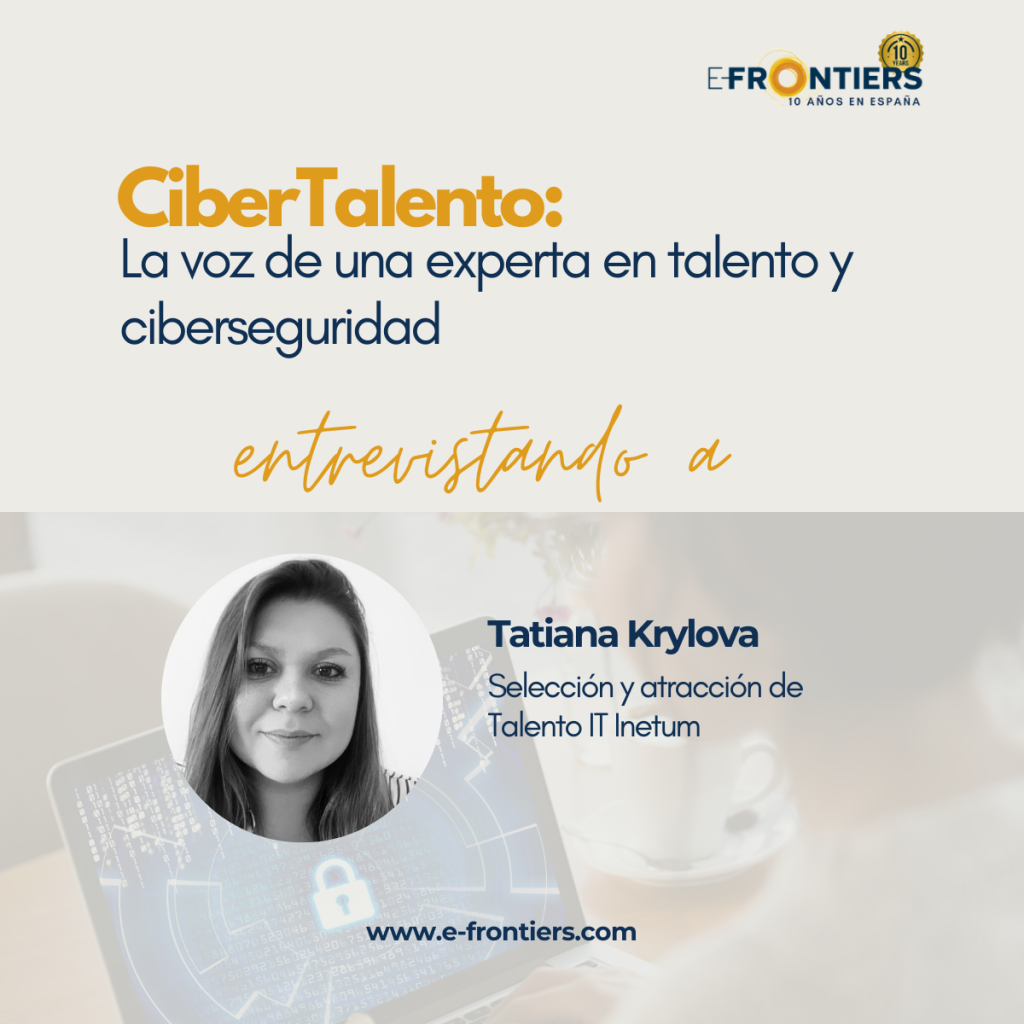
Hoy tengo el placer de compartir una entrevista con Tatiana Krylova, una experta en identificar y atraer a los mejores profesionales en ciberseguridad. En nuestra conversación, exploraremos su perspectiva sobre el mercado, los retos de la selección en este sector y las habilidades más demandadas en el ámbito de la ciberseguridad en España.
¿Cuáles son los roles más demandados en ciberseguridad hoy en día? ¿Nos podrías dar algunos ejemplos?
Los perfiles más demandados son: (1) Analistas SOC, quienes monitorizándoos redes y sistemas para identificar posibles amenazas y responder a incidentes; (2) Consultores de seguridad de la información, quienes ayudan a las empresas a cumplir con normativas y diseñar estrategias para minimizar riesgos. Por ejemplo, hablamos de: Consultores GRC, Consultores de Cumplimiento Normativo, Analistas de Riesgos; (3) también habría que hablar de los Ingenieros de seguridad en infraestructuras y redes; como por ejemplo: Ingenieros de seguridad perimetral con experiencia en fabricantes como Checkpoint, Cisco, Palo Alto, Fortinet ; y por último, (4) especialistas en seguridad en la nube, con experiencia en tecnologías SSE/SASE.
¿Qué habilidades técnicas y blandas son clave para estos perfiles?
Para los profesionales del SOC: se valora la habilidad para identificar, mitigar y responder a amenazas, familiaridad con sistemas de detección de intrusiones (IDS/IPS) y gestión de eventos de seguridad (SIEM).
En el caso de redes y seguridad se valora la experiencia en herramientas de seguridad como firewalls (Palo Alto, Cisco, Fortinet, Checkpoint), CASB, ZTNA, protección contra fugas (DLP), protocolos de red.
También es importante en el caso de roles de seguridad de la información, tener conocimientos en gestión de riesgos y normativas como GDPR, ENS, ISO27001; capacidad para realizar auditorías.
Es un plus y, para ciertos puestos, necesario, contar con certificaciones de ciberseguridad. Dependiendo del puesto, certificaciones como Splunk Core Certified User / Power User; CISA, CISM, CISSP, entre otras.
De cara a las habilidades blandas, siempre se valora la actitud y las ganas de aprender, ya que es un sector en constante crecimiento y cambio.
Se habla mucho sobre la falta de talento en ciberseguridad. ¿Qué tan real es esta brecha y cómo la están afrontando las empresas?
Quizás este sea un déficit global, por el aumento constante de las amenazas cibernéticas, digitalización acelerada y falta de profesionales cualificados para cubrir esta demanda tan creciente. La pandemia fue propulsora del trabajo en remoto, lo que expuso a las empresas a nuevos riesgos e hizo crecer los ataques cibernéticos, haciendo que fueran más frecuentes y sofisticados.
¿Cuáles son los mayores retos a la hora de identificar y atraer talento especializado en este campo?
Muchos puestos requieren ciertos conocimientos técnicos avanzados, unido a que parte de esos conocimientos sean en tecnologías emergentes, lo que hace más difícil identificar perfiles que cumplan con los requisitos solicitados.
¿Qué estrategias recomiendas a las empresas para competir en este mercado tan competitivo?
Aparte de un proyecto atractivo, es importante ofrecer beneficios competitivos como la posibilidad del trabajo en remoto, flexibilidad horaria, formación continua y un salario acorde a las características del rol y del mercado actual.
¿Cómo están influyendo las herramientas de IA y automatización en el proceso de selección para este tipo de roles?
Son herramientas que nos pueden facilitar mucho llevar a cabo tareas repetitivas, como la programación de entrevistas, mejores flujos de comunicación con los candidatos, mayor retroalimentación, y reducción de tiempos de respuesta.
Por último, ¿cómo ves el futuro de la ciberseguridad en relación con el talento humano? ¿Algún mensaje final para empresas y candidatos?
Veo el futuro de la ciberseguridad muy prometedor, sobre todo para los profesionales que decidan especializarse en este campo. Con el aumento de los ataques cibernéticos, la creciente digitalización y constante evolución tecnológica, las oportunidades en esta carrera están en auge. Además, hay mucha diversidad de roles y especializaciones, con lo que hay un amplio abanico donde elegir lo que más guste o interese.
Autor del artículo: Alejandro Pino Alamillo, Recruitment Manager en E-Frontiers Spain.
No dudes en contar con nosotros si estás buscando ayuda en Recruitment. Puedes agendar una llamada con Alejandro aquí.
La ciberseguridad ha evolucionado rápidamente en los últimos años, y la incorporación de la inteligencia artificial (IA) ha impulsado esta transformación aún más.
Hoy en día, la IA permite que los equipos de seguridad detecten y respondan a amenazas en tiempo real, gestionen grandes volúmenes de datos y puedan predecir posibles ataques antes de que ocurran. Sin embargo, este avance también trae consigo un desafío para las empresas: encontrar y retener al talento adecuado para manejar esta tecnología avanzada.

La IA en Ciberseguridad: cambios clave
La inteligencia artificial ofrece beneficios significativos a la ciberseguridad, entre los que destacan:
1. Detección proactiva de amenazas:
Las soluciones basadas en IA pueden analizar patrones en grandes volúmenes de datos para detectar anomalías y amenazas antes de que ocurran. Esto reduce significativamente el tiempo de respuesta y la probabilidad de intrusiones.
2. Automatización de tareas repetitivas:
La IA permite automatizar tareas repetitivas y de bajo valor, como la clasificación de alertas o la revisión de registros, liberando a los especialistas para enfocarse en amenazas complejas y en la planificación estratégica.
3. Análisis predictivo:
Gracias al aprendizaje automático (machine learning), los sistemas de IA pueden prever posibles vulnerabilidades, anticipando las tendencias en ciberataques y mejorando así la capacidad de defensa de la organización.
4. Respuesta rápida y automatizada:
Con la IA, las empresas pueden implementar respuestas automáticas a ciertas amenazas, limitando los daños y conteniendo el riesgo sin intervención humana inmediata.
La nueva demanda de talento en Ciberseguridad
Con esta transformación, el perfil del profesional de ciberseguridad está evolucionando. Hoy se buscan habilidades que antes no se consideraban prioritarias en esta área. Veamos algunos de los conocimientos y competencias más demandados:
1. Especialización en Machine Learning y Data Science:
Los profesionales con conocimientos en algoritmos de machine learning, data science y big data se están volviendo esenciales. Son quienes desarrollan y afinan los modelos que permiten a los sistemas de IA mejorar continuamente en la detección de amenazas.
2. Programación orientada a IA:
La capacidad para programar en lenguajes como Python, R o Julia, y experiencia en marcos de trabajo de IA como TensorFlow y PyTorch, se está convirtiendo en una habilidad valiosa para implementar soluciones personalizadas de ciberseguridad.
3. Análisis de comportamiento e ingeniería de amenazas:
Con el uso de IA, es fundamental que los equipos de seguridad comprendan y puedan analizar patrones de comportamiento, ya que muchas amenazas modernas dependen de vulnerabilidades humanas.
4. Conocimiento en ética y sesgo de IA:
La IA no es infalible y puede aprender comportamientos sesgados. Los profesionales que entienden los riesgos éticos y de privacidad pueden ayudar a las empresas a evitar problemas de discriminación o errores de juicio al responder a una amenaza.
Cómo atraer y retener talento especializado en Ciberseguridad e IA
La alta demanda y la escasez de profesionales con estas habilidades especializadas hacen que la atracción y retención de talento sea un desafío.
Para captar a los mejores candidatos, las empresas deben enfocarse en:
Fomentar una cultura de innovación y colaboración:
Muchos de estos profesionales buscan empresas donde puedan trabajar en proyectos innovadores y colaborar con equipos multidisciplinarios.
Ofrecer oportunidades de desarrollo:
Los expertos en ciberseguridad e IA valoran las oportunidades de aprendizaje continuo. Ofrecer certificaciones, acceso a conferencias y programas de capacitación puede ser un diferencial importante.
Beneficios competitivos y flexibilidad laboral
Además de una compensación atractiva, los profesionales en este campo valoran la flexibilidad y los beneficios adicionales, como la posibilidad de trabajar en proyectos significativos que tengan un impacto real.
El futuro de la Ciberseguridad con IA
A medida que la IA sigue evolucionando, también lo harán las amenazas digitales. Las empresas que inviertan en equipos de ciberseguridad especializados en inteligencia artificial estarán mejor preparadas para proteger sus datos y su reputación. Contar con profesionales que comprendan tanto la ciberseguridad como la IA no es solo una estrategia de defensa: es una inversión en el futuro de la empresa.
En conclusión, el talento en ciberseguridad con especialización en inteligencia artificial es crucial para enfrentar los desafíos de seguridad actuales.
Trabajar con una agencia de reclutamiento como E-Frontiers especializada puede ayudar a tu empresa a encontrar los profesionales que realmente necesitas para estar a la vanguardia en seguridad digital.
No dudes en contactarnos para saber más sobre cómo podemos ayudarte.
The software development landscape in Ireland has undergone significant changes over the past decade. The rise of cloud computing, AI, and DevOps practices has transformed the skills companies seek, while remote work and digital transformation have broadened opportunities for tech professionals.
As we approach 2025, staying ahead of these trends is critical for candidates looking to remain competitive in this fast-evolving market.
In this Q&A, we sat down and chatted with Anca Antonica, one of our most experienced IT recruitment consultants, to get her views about how these shifts have shaped the market and what developers should focus on to thrive.
Learn how the IT Market in Ireland is evolving below.

Market Evolution
Over the past 5+ years, how have you seen the IT and software development recruitment market evolve in Ireland?
Over the last 5-6 years, the market has evolved significantly, with increased demand for cloud computing (AWS, Azure, etc.), AI, data science, and cybersecurity roles. DevOps has risen due to the need for faster software delivery, along with growing demand for full-stack developers. Remote and hybrid work models post-pandemic have expanded the talent pool, while digital transformation projects continue to fuel demand for tech talent across industries
Skills Evolution
Are there any skills that were in high demand 5+ years ago that have become less relevant now?
Five to six years ago, demand was higher for traditional web development, especially JavaScript frameworks like AngularJS and Backbone. While JavaScript is still essential, the focus has shifted to modern frameworks like React and Vue.js. Legacy system skills (COBOL, older .NET) are now niche. Today, cloud infrastructure, DevOps, and automation skills dominate, reflecting the shift to scalable, cloud-based solutions and CI/CD pipelines as companies prioritise agility and speed in software development.
Qualifications
How important were formal qualifications (degrees, certifications) 5 years ago compared to today?
Five years ago, degrees and certifications were essential. Today, employers focus more on practical experience and hands-on skills. Coding bootcamps and alternative learning paths are widely accepted, especially in development and DevOps, as real-world problem-solving now outweighs formal education.
Programming Language Trends
How have the preferred programming languages in the industry changed in the last 5+ years?
Python and JavaScript have become dominant, especially in data science and web development. Languages like Ruby and PHP have declined, while Kotlin has risen in mobile development. Objective-C has largely been replaced by Swift in iOS, and older frameworks like Perl are now rarely requested, with newer languages like Python and Node.js becoming more common, taking the spotlight for scripting and backend development. This trend highlights the industry’s shift towards languages that enhance developer productivity and streamline the development process.
Impact of Remote Work
How has this shift influenced the skills companies are seeking?
Remote work has shifted company priorities, with skills in collaboration tools (Slack, Jira) and remote-first experience now highly valued. Soft skills like communication, time management, and teamwork are crucial in flexible work settings, as candidates must thrive independently while staying productive and connected.
The Importance of Soft Skills
How has the emphasis on soft skills evolved – have these skills become more critical as remote work and cross-functional collaboration have increased?
The emphasis on soft skills has evolved significantly in recent years, particularly with the rise of remote work and cross-functional collaboration. Skills like communication, teamwork, and adaptability have become more critical than ever, as teams now operate in diverse, virtual environments. Effective communication is essential for clear understanding, while strong teamwork ensures successful collaboration among remote and cross-functional teams. Adaptability is also vital, as professionals must navigate changing circumstances and new technologies. Employers increasingly prioritise candidates with robust soft skills, recognising that these qualities enhance team dynamics and contribute to overall organisational success.
Work Environment and Culture
What changes have you noticed in work environments and company culture for IT professionals over the last 5+ years?
Agile methodologies and DevOps cultures have become mainstream in tech teams, valuing collaboration and quick iteration. Employee benefits like remote work, flexible hours, and mental health support have shifted from “nice-to-haves” to essential offerings, as work-life balance is increasingly prioritised by top talent. I’ve seen a real increase in companies offering mental health support, wellness programs, and overall flexibility to stay competitive. It’s clear that to secure the best talent, employers need to offer more than just a good salary—they have to create an environment where people can thrive both professionally and personally.
Moving Towards 2025
What skills or qualifications do you believe will be critical for candidates to stay competitive as we approach 2025?
Looking to 2025, adaptability and expertise in emerging technologies will be key. AI/ML, blockchain, and cybersecurity skills are growing in demand. Cloud services (AWS, Azure), automation frameworks, and AI tools are critical for future-proofing careers. Candidates should consider building expertise in areas such as DevOps automation, AI tools, and cloud-based infrastructure.
What advice would you give to candidates looking to stand out in the IT and software development field as we move towards 2025?
My advice for 2025: balance specialisation and versatility. If you’re passionate about areas like AI, cloud computing, or cybersecurity, deepening your expertise in those fields will make you highly valuable as these technologies continue to grow. But, being versatile across different technologies—whether it’s cloud platforms like AWS or Azure, or learning automation tools and frameworks—will give you the flexibility to adapt to evolving demands in the industry.
Industry Challenges
Are there specific skill shortages in areas like cloud computing, cybersecurity, or AI?
There are notable skill shortages in cloud computing, cybersecurity, and AI. To navigate these challenges, candidates should focus on gaining hands-on experience through projects, certifications (AWS, Azure), and networking within the industry to stay informed and open up new opportunities.
For keeping up with industry changes, online platforms like Coursera, Udemy, or LinkedIn Learning are great for continuous learning.
Other valuable platforms for continuous learning in IT and software development.
– edX offers courses from top universities in AI, cybersecurity, and cloud computing.
– Pluralsight focuses on tech skills like programming, cloud infrastructure, and DevOps,
– Codecademy is ideal for learning languages like Python and JavaScript.
– Kaggle is great for hands-on learning in data science and machine learning through projects.
– GitHub, though not a traditional learning platform, is essential for building a portfolio and contributing to open-source projects.
These resources help candidates stay current with industry trends and gain practical experience. Future-proofing your career is all about being open to learning and adapting to new technologies, as the pace of change in IT isn’t slowing down anytime soon.
If you’re looking to dive deeper into the IT software market in Ireland or have specific questions, don’t hesitate to reach out to our expert, Anca. She’s here to help you navigate the trends and opportunities in this field. Get in touch today! anca.antonica@e-frontiers.ie

Our Online Event
On October 24th we had the pleasure of hosting a roundtable event on ESG. This event was designed for business leaders, sustainability professionals, and anyone looking to explore how ESG is transforming business practices.
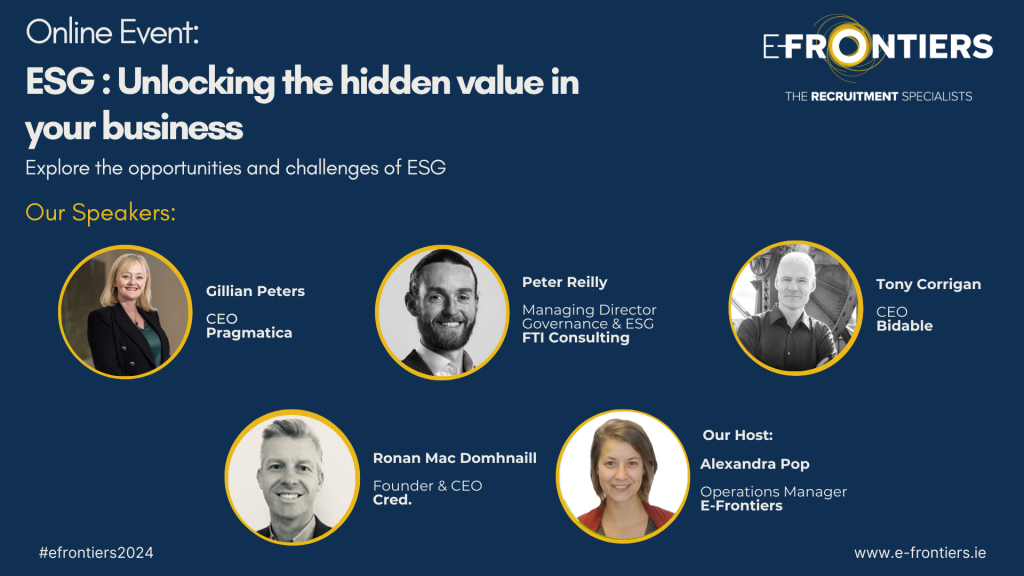
In this event, we brought together a panel of industry experts to share their perspectives on the trends, challenges, and opportunities that ESG presents. Alexandra Pop, Operations Manager @ E-Frontiers moderated and guided this conversation which addressed a wide range of topics.
Gillian Peters’ career has spanned various roles, primarily in marketing and business development within financial services. As Business Development Director at CPA Ireland, she earned her MBS in Business Practice and developed a deep interest in sustainability in business.
In February 2023, she transitioned to CEO of Pragmatica, where her mission is to create tailored roadmaps and innovative solutions that guide companies on their sustainability journeys.
Tony Corrigan With over a decade of experience in government bidding, Tony Corrigan has focused on helping SMEs succeed in public contracts. He founded TenderScout in 2014 to guide SMEs through the tendering process, equipping them with effective tools and strategies.
In 2023, Tony launched Bidable.ai, an AI-driven platform that enhances bids with precise insights, showing businesses their expected scores and ways to improve. This platform, built on Tony’s expertise, is a critical resource for SMEs aiming to win in the competitive tendering arena. His dedication to SME success remains the core of Bidable’s mission.
Peter Reilly Managing Director of Governance and ESG at FTI Consulting , advises major global companies on corporate governance, focusing on reporting, stakeholder engagement, remuneration, and ESG strategy development to meet institutional and regulatory standards. With deep expertise, Peter has led activist defense programs across the US and Europe, enhanced governance frameworks for boards, and conducted proxy support strategies.
Previously, he served as Lead Analyst for Northern Europe at Glass Lewis, overseeing ESG research and recommendations. He holds a BA in Economics, Politics, and Law from Dublin City University and an LLM from Trinity College Dublin.
Ronan Mac Domhnaill is the founder of Cred, a Sydney-based Education and Technology company.
Cred’s focus is on the “Social” side of ESG.
Cred helps organisations:
– Engage, retain, and attract top talent.
– Create the right culture – balancing profit, people and purpose.
– Bridge the generational leadership gap
– Identify future leaders
– Use ESG as a competitive advantage
So that they can increase their bottom line sustainably.
Our experts addressed topics such as:
Understanding ESG: Beyond Recycling
-Definition and scope of ESG (Environmental, Social, Governance) and how it differs from traditional sustainability practices.
-Discussion on why businesses are increasingly considering ESG, especially in B2B vs. B2C contexts.
External and Internal Factors Influencing ESG Strategy
-External factors: capital accessibility, supply chain, customer demands, and reporting obligations.
-Internal factors: workforce capabilities, talent competition, and aligning governance structures to support sustainability goals.
Navigating ESG Reporting and Social Responsibilities
-Overview of CSRD thresholds and VSME voluntary reporting for SMEs.
-Considerations for businesses when evaluating the social aspects, such as supply chain transparency, staff policies, and community engagement.
Our discussion helps to define ESG’s scope beyond traditional sustainability and explores the internal and external factors driving ESG strategies. Our expert panel sheds light on key issues shaping this evolving landscape and offers practical takeaways on ESG reporting and the importance of aligning social responsibilities with business goals.
If you missed it, reach out to our team today to learn how ESG can benefit your organisation.
Employee retention is crucial to allow business to grow and flourish but becomes more difficult when suitably skilled candidates are in short supply. This results in high demand for professionals and fierce competition among companies, leading to increased candidate turnover.
To highlight current trends, PWC recently published a survey outlining that 4 in 10 Irish workers are likely to switch jobs in the next year and detail some issues driving this trend. Read more here.
At E-Frontiers Recruitment, we provide a quality-driven recruitment service and take pride in seeing candidates we source have a long period of rewarding employment with our clients. We recognise the importance of retaining employees and are often asked by clients what are other companies doing to retain staff.
In this article, we want to share some actionable key employee retention strategies that are often easy to implement, to help your employees feel valued and prevent them from seeking opportunities elsewhere. Although some of these strategies may require financial investment, in most cases, significant budget increases are typically unnecessary.

10 Key Strategies for Employee Retention
Positive Work Environment
Create a collaborative and respectful environment where employees can share their opinions and participate in internal projects if they wish. Encourage participation in wellness projects, volunteering, and company events.
Promoting a culture of inclusion and diversity, where everyone’s ideas are respected and valued, will enhance well-being and help retain talent.
Employee Well-Being
Offer well-being programs that include psychological support, physical health programs, and general wellness activities.
A wellness committee composed of employees can be an excellent way to listen to the team, analyse their needs, and propose initiatives in this area.
Growth and Development Opportunities
Foster a culture where professional and personal growth is a priority. Offer continuous training and learning opportunities tailored to employees’ interests.
Establish clear and transparent career paths with internal promotions based on achievable milestones. Communicating these plans to all employees will significantly strengthen the team.
Encourage employees to participate in training other teams. Supporting those who wish to learn new technology or methodology and later share that knowledge through workshops is an initiative that makes them feel valued.
Recognition and Rewards
Recognising and rewarding good performance and significant contributions is crucial. Implementing both formal and informal recognition programs can be an excellent starting point to reinforce employee well-being and boost talent retention.
From performance bonuses to informal team awards, these initiatives effectively foster a sense of belonging and highlight the importance of each team member.
Competitive Compensation
Offering competitive salaries and benefits is essential. It’s crucial to avoid offering wages below market standards and ensure pay equity within the team. Proposing lower salaries to new employees can lead to feelings of undervaluation and motivate them to seek new opportunities.
Including bonuses, stock options, or equity participation can increase employee involvement in the business.
Workplace Flexibility and Remote Work
Implementing remote work options, hybrid models, and flexible schedules is essential. Numerous studies indicate that telecommuting benefits employee well-being, improves work-life balance, and increases productivity.
Although not all professions or projects allow for 100% remote work, offering a hybrid model and flexibility can be key to attracting, selecting, and retaining talent.
Challenging and Interesting Projects
Assign stimulating projects that allow employees to utilise and expand their skills.
Encouraging innovation and creativity at work while valuing and listening to employee ideas will help with employee retention.
Adequate Technology and Tools
Provide the necessary technologies and tools for employees to perform their work efficiently.
Staying up to date with the latest industry trends and advancements in the sector is fundamental for employee retention.
Good Communication and Feedback
Promote open and transparent communication at all levels. Leaders should consistently communicate their strategies and ensure smooth communication between employees, team leaders, operations departments, and executives.
Provide regular, constructive feedback through quarterly company meetings and one-on-one sessions with team members.
Attractive Company Culture
Align the company’s mission and values with those of the employees, starting with the recruitment process. Promote an inclusive and respectful culture with Diversity, Inclusion, and Equality policies.
Organise activities and events to strengthen team spirit. Team-building exercises are fundamental to fostering stronger relationships among employees and improving the sense of belonging, thereby enhancing talent retention.
Implementing these strategies can help companies keep their IT employees satisfied and engaged, reducing turnover and ensuring a solid and stable team. But do remember, the above strategies are neither exhaustive nor prescriptive so when considering what strategies will work best for your business, be sure to engage with your employees from the start of the process.
If you would like more advice or to share ideas, feel free to contact us for a call or meeting to discuss in more detail.

Nuestro Evento Online
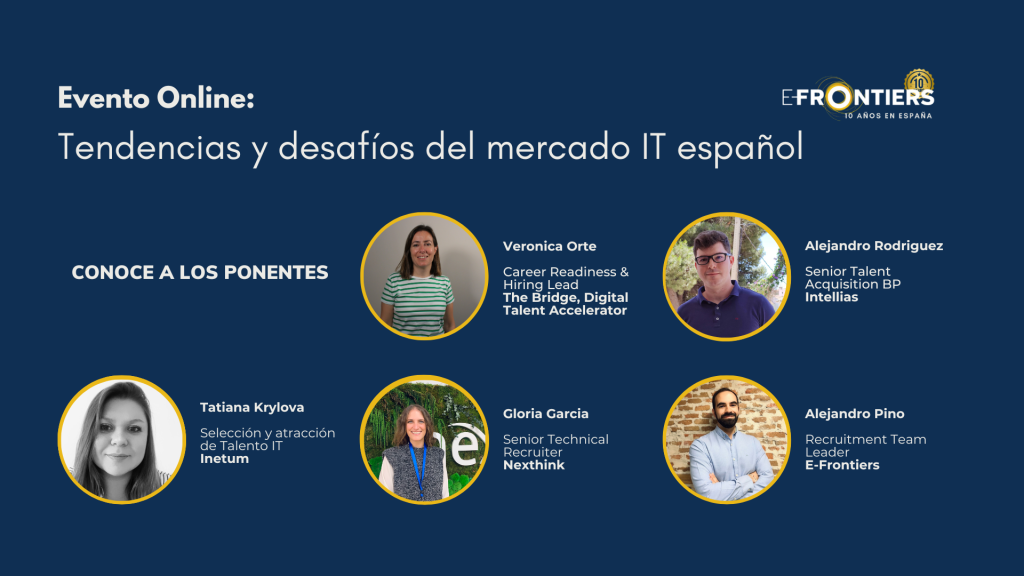
El pasado 3 de octubre tuvimos el placer de organizar una mesa redonda donde hablamos sobre las tendencias del mercado tecnológico en España para este 2024. En este evento reunimos a cinco expertos del sector del Talento IT, quienes compartieron valiosas perspectivas sobre cómo está evolucionando el mercado tech desde la perspectiva del talento. Los miembros de nuestro equipo de E-Frontiers España, Cristina Rafael (Marketing) y Alfonso Moreiras (Senior Technical Recruiter), moderaron y guiaron esta conversación, en la que se abordó una amplia gama de temas.
Los Panelistas
Verónica Orte Sánchez – Career Readiness & Hiring Lead @ The Bridge | Digital Talent Accelerator
Cuenta con más de 10 años de experiencia en el sector de RRHH. Especialista en talento digital y actualmente es responsable del departamento de carreras profesionales y relaciones con empleadores en la escuela The Bridge.
Tatiana Krylova Lekhanova – Selección y atracción de Talento IT – Inetum
Con más de 7 años de experiencia en Selección de Talento IT, se ha enfocado y especializado en el ámbito de la ciberseguridad.
Alejandro Rodríguez – Senior Talent Acquisition BP – Intellias
Está especializado en el área de selección dentro del sector tecnológico. Cuenta con diez años de experiencia en el mercado del talento Tech europeo y ha trabajado con empresas internacionales en las áreas de consultoría, SAAS y Fintech.
Gloria García Leis – Senior Technical Recruiter -Nexthink
Cuenta con 8 años de experiencia en el área de HR. Estudió Derecho, pero su pasión por las personas la orientó hacia Recursos Humanos. Está especializada en el sector IT tanto a nivel nacional como internacional, y ha trabajado en diferentes países, así como en consultoría y en empresa final.
Alejandro Pino Alamillo – Recruitment Team Lead – E-Frontiers
Con más de 10 años de experiencia como IT Recruiter, Alejandro se ha especializado en el mercado del Big Data. Además de ser responsable del equipo de E-Frontiers en España, es profesor de People Analytics en diferentes programas de bootcamps y másters.
Nuestros expertos abordaron temas como:
- Panorama del mercado en este 2024 y comparativa con 2023
- Perfiles más demandados
- Soft Skills e idiomas más valorados por las empresas
- Desde la perspectiva de la formación y bootcamps, ¿Qué es lo que más se está demandando?
- Consejos para perfiles junior en búsqueda de empleo
- Recomendaciones para perfiles senior
- Previsión para 2025 y tecnologías emergentes
Puedes ver la grabación del evento aquí:
El mercado está cambiando y esperamos que en 2025 continúe por el camino de este año. El auge de tecnologías en el ámbito de la ciberseguridad, los datos y la IA marcan el camino hacia una nueva era, combinándose, como siempre, con tecnologías de la última década, como la programación en Java, Python, etc.
Las habilidades blandas, como la capacidad de adaptación, flexibilidad y saber trabajar y comunicarse con equipos en remoto, son clave para los candidatos. En un mundo donde todo se mueve muy rápido, seguir actualizando los conocimientos es necesario para aportar valor y seguir progresando.
¡Sigamos aprendiendo y creciendo juntos!
Contáctanos para saber más sobre nosotros y cómo trabajamos con clientes y candidatos.
¡Te esperamos en la edición del año que viene!
En los últimos años hemos visto un crecimiento enorme en la importancia que le dan las empresas a la ciberseguridad, ya sea por el aumento de los ciberataques (según el Instituto Nacional de Ciberseguridad, solo en 2023 fueron registrados más de 110.000 incidentes en España) como por el aumento y evolución de sus posibilidades en el mercado laboral.
Desde E-Frontiers, os queremos ofrecer las diferentes opciones a tener en cuenta si quieres desarrollar tu carrera profesional en el campo de la ciberseguridad.

Me quiero dedicar a la ciberseguridad, ¿por dónde empiezo?
Al igual que cualquier campo dentro del sector IT, el camino clásico consiste en acceder a un grado universitario en ingeniería informática, de sistemas o Computer Science, realizando un master específico en la rama de la ciberseguridad.
Durante la última década hemos visto un cambio en este paradigma y actualmente existen otras vías, como los bootcamps específicos o las formaciones de nivel medio que te permitan acceder al mercado.
¿A qué me puedo dedicar?
Al igual que las vías de acceso pueden ser variadas, las posibilidades de desarrollo profesional son también muy diversas. Vamos a repasar los principales roles a los que puedes aspirar en el campo de la ciberseguridad en el sector IT.
Analista de ciberseguridad
Es el profesional encargado de monitorizar la red y los sistemas en búsqueda de amenazas y vulnerabilidades
Certificaciones recomendadas: CISSP, CEH, CompTIA
Ingeniero de ciberseguridad
Diseña e implementa las infraestructuras de seguridad, configurando firewalls, IDS o IPS.
Certificaciones recomendadas: CISSP, CEH, GCIA, CISM
Incident Manager
Es la persona encargada de responder a incidentes de seguridad una vez se han dado, reduciendo el impacto en los sistemas y organizando planes de recuperación.
Certificaciones recomendadas: ECIH, GCIH, CompTIA CySA
Pentester
Es el profesional ocupado en las pruebas de penetración o pentesting, explorando vulnerabilidades en sistemas, redes y aplicaciones simulando ataques reales para evaluar los sistemas de seguridad
Certificaciones recomendadas: CEH, OSCP, CPTP y CPEN
DevSecOps
Es una aplicación de la ciberseguridad en las prácticas clásicas de DevOps, asegurando la integración de las pipelines y los contenedores y automatizando pruebas de seguridad.
Certificaciones recomendadas: CDP, CKS, CCSP
Cloud Security Specialist
Es la persona encargada de salvaguardar la seguridad de entornos en la nube, implementando controles de acceso y monitoreo en los mismos.
Certificaciones recomendadas: AWS Certified Security, GPC Security Engineer, Azure Security Engineer Associate
Administrador de Sistemas de Seguridad
Administra y mantiene los sistemas de seguridad como firewalls, antivirus, etc. garantizando su actualización constante.
Certificaciones recomendadas: CompTIA, Cisco Certified CyberOps Associate
Arquitecto de seguridad
Diseña y planifica la arquitectura de seguridad de la organización, colaborando y coordinando el resto de integrantes del equipo de ciberseguridad.
Certificaciones recomendadas: CISSP, CISM, CCSP, GSLC
CISO
El nivel más alto a nivel ciberseguridad en una empresa, define toda la estrategia en materia de seguridad y lidera y supervisa a todo el equipo, evaluando objetivos y presupuestos y asegurando el cumplimiento de normativas y regulaciones.
Certificaciones recomendadas: CISM, CISSP, CRISC
Si deseas más consejos o intercambiar impresiones, no dudes en contactarnos para concertar una reunión.
Autor del artículo: Alfonso Moreiras
¿Hablamos? Organiza una llamada con nuestro Líder de Equipo, Alejandro Pino, aquí: Mi calendario