

• Submit Resume
  • Submit Job
  • +353 (1)6854000
  • info@e-frontiers.ie
  • facebook-icon linkdin-icon twitter-icon twitter-icon
Back

Industry Insights

Mastering Job Hunting: Proven Tips for a Successful Job Search

job search

When it’s time to look for a new position, following these essential tips will help ensure your success:


1. Define Your Goals

Evaluate your current role and responsibilities to determine what you want in your next position.  

Consider factors such as the type of role, responsibilities, salary, and benefits 

Identifying both your wants and your deal-breakers will help you focus your job search. 

Reflect on your career aspirations, the skills you want to develop, and the work-life balance you aim to achieve. This self-assessment will not only clarify your goals but also increase your confidence and direction during your job hunt. 
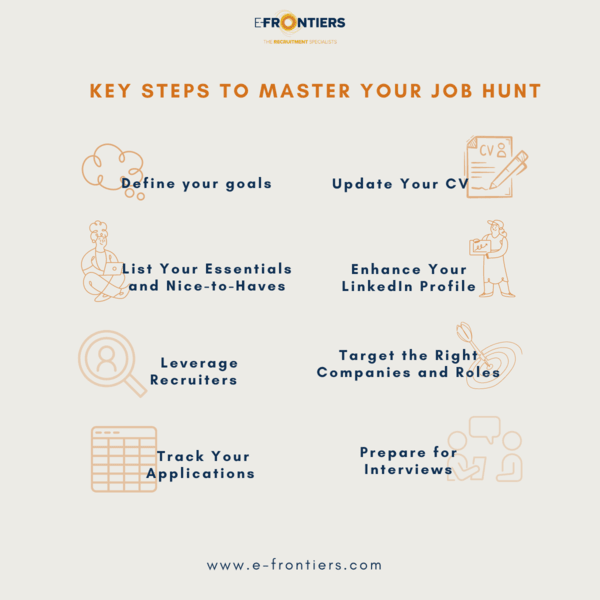
2. List Your Essentials and Nice-to-Haves

Create a list of essential requirements your next position and company must offer, as well as a list of nice-to-have but non-mandatory features. This clarity will guide you through the application, interview, and offer stages.

Essentials might include factors like job location, salary range, core responsibilities, company culture, and growth opportunities. Nice-to-haves could be perks like remote work options, flexible hours, additional benefits, or specific projects.

Having a clear distinction between these will help you prioritise and make informed decisions when evaluating job offers. 

3. Update Your CV

Revise your CV to reflect new skills, responsibilities, and tools you’ve acquired since your last update.

If you’re aiming for a new area without work experience, highlight relevant personal projects and provide concrete examples.

If your line of work requires some type of portfolio or similar, now it is time to update this too with your recent projects. 

4. Enhance Your LinkedIn Profile

A well-crafted LinkedIn profile is a powerful tool in your job hunt. Ensure it includes a professional photo, detailed work experiences, education, and courses. 

Don’t forget to select the “Open to Work” option to signal to recruiters that you’re open to new opportunities.  

Adding your personal touch is important too, so adding, sports you play, voluntary work you do, events you assist, counts! 

For more tips on optimiszing your LinkedIn profile, check out our detailed guide here.

5. Leverage Recruiters

Reach out to your favourite recruiter or ask your friends or former colleagues for recommendations if you don’t know any.

A good recruiter can provide insights into the job market, assist with your CV, and help you prepare for interviews. Applying through a recruiter can increase your success rate as they understand the client, hiring process, and necessary competencies. Read our Insights post here on  ‘A simplified recruitment process, making it easy for you’

Looking for a role can be stressful but having a professional leading this process for you, makes things easier.  

6. Target the Right Companies and Roles

Reflect on why you want to leave your current job and what you’re seeking in a new role.

Use your earlier list to identify target companies and research their locations, missions, team structures, benefits, culture, and values. 

This research will aid your application process and prepare you for interviews. You might also discover new, suitable companies that weren’t on your initial list. 

7. Track Your Applications

Maintain a system to track your applications, like a list using a notepad, word or spreadsheets.

We suggest avoiding applying to too many positions at once in order to stay focused on each recruitment process.

Prioritisze companies most relevant to you if you’re not in a rush. 

8. Prepare for Interviews

When you get an interview, thorough preparation is key.

  • Research the company, including its mission, values, products, and recent news.  
  • Review the job description and match your skills and experiences to the key responsibilities and requirements.  
  • Practice common interview questions and prepare your own questions for the interviewer.  
  • Dress appropriately for the company culture, and ensure you know the interview logistics, such as the time, place, or virtual setup. 
  • Finally, bring copies of your resume, a notepad, and a positive, confident attitude.  

For comprehensive interview preparation tips, visit our guide here.

And if your big interview is via  virtual/video, then visit our Insights post here on how to show your personality in a video interview 


Final Thoughts

If you’re considering a career transition and seek expert guidance, reach out to us!

We’re here to assist you every step of the way and be your career partner as you navigate this exciting change. 

key-steps-to-master-your-job-hunt-Candidate-blog
author avatar
Cristina Rafael

More Insights All Posts

View our industry experts opinion on all things recruitment, salaries, working from home and everything in between.